Subjects
Grades
 100%
100%
 100%
100% 100%
100%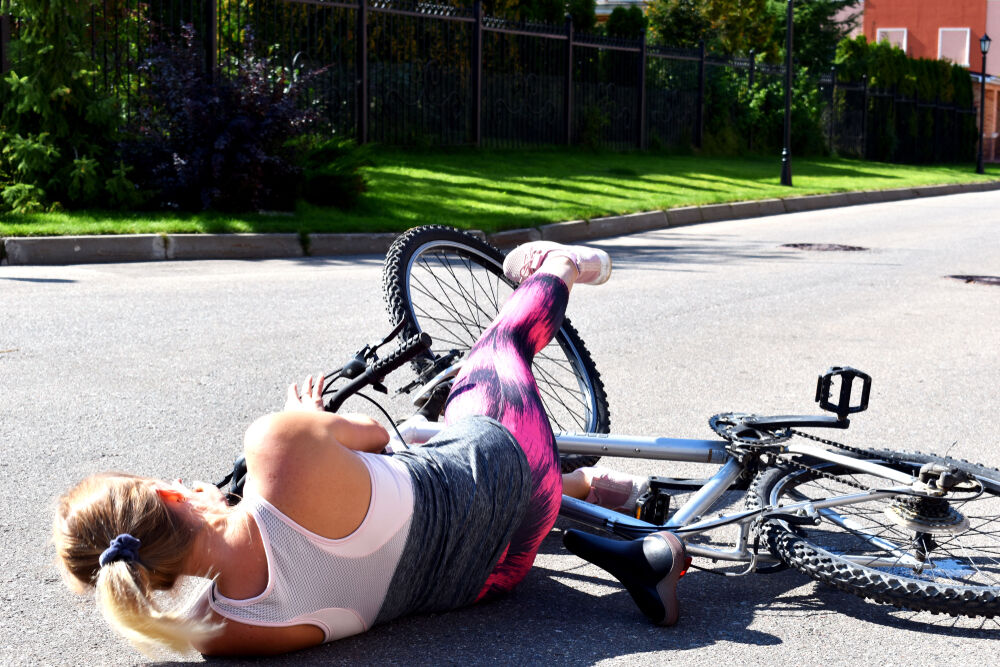 100%
100%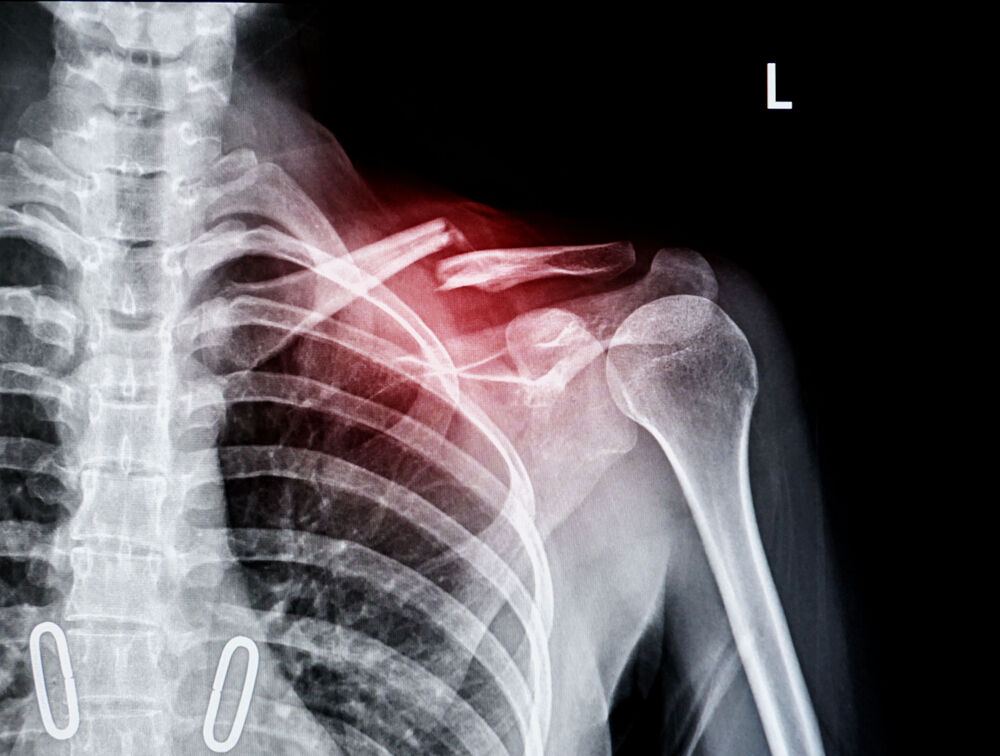
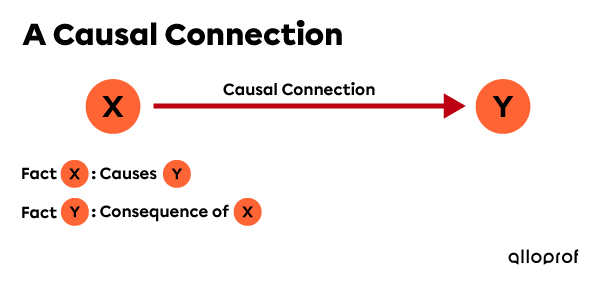
A causal connection links two facts. These facts are a cause and a consequence (effect).
Fact 1: Charles goes out in the sun without sunscreen.
Fact 2: Charles gets a sunburn.
What unites the two facts is the causal connection. Charles’ exposure to the sun without sunscreen leads to a sunburn.
Exposure to the sun without sunscreen is the cause of sunburn.
Sunburn is the consequence of exposure without sunscreen.
As part of this intellectual operation, the tasks to be carried out contain 3 items to be connected. In this case, there are 2 causal connections to be established.
You may have heard of this intellectual operation as The Three-Dot Question. It is sometimes unofficially called this because of the 3 statements (3 dots) to be connected.
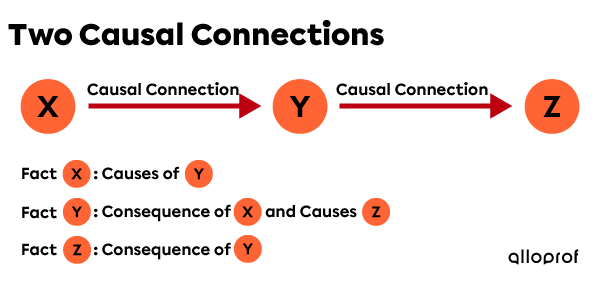
A fact can be both a cause AND a consequence.
For example, a fact Y can be the consequence of a fact X and the cause of a fact Z.
Concretely, Maikan’s fatigue (Y) may be the consequence of his lack of sleep (X). Maikan’s fatigue (Y) may also be the cause of his headache (Z).
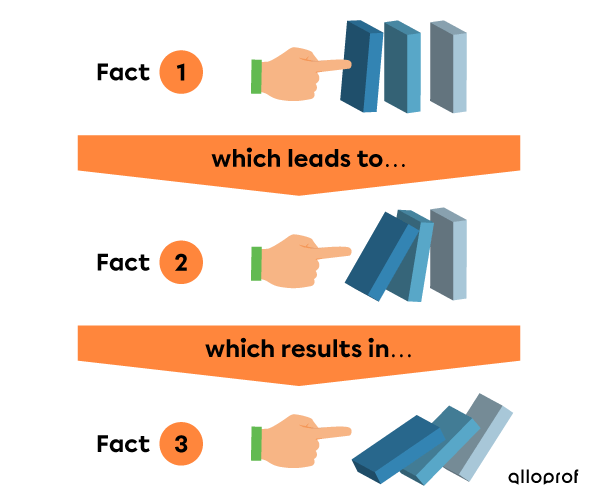
Causal connections can be illustrated using dominoes. The fall of the 3 dominoes represents the 3 facts.

| Fact 1 | I push the first domino, | Cause of fact 2 |
|---|---|---|
| Causal link | which leads to | |
| Fact 2 | the fall of the second domino | Consequence of fact 1 AND cause of fact 3 |
| Causal link | has the effect | |
| Fact 3 | of knocking down the third domino. | Consequence of fact 2 |
Causal connections can be presented in two sentences. For this example, we could write: “I push the first domino, which causes the second domino to fall. The fall of the second domino causes the third domino to fall.”
In this intellectual operation, you will be given three statements, which you will have to match to three documents in order to develop the statements with the help of the documents, and establish the causal connections between each element.
The 3 statements are always placed in order in the question. The only tasks are to develop and connect them.
Using documents 1, 2 and 3, explain how a careless driver’s behaviour can result in a hospital visit.
Answer the question by specifying the items below and connecting them.
A driver’s careless behaviour on the side of the road can lead to a fall for a cyclist. A cyclist’s fall can cause a fracture.
In the tasks that ask you to establish causal connections, you will have to develop each element and connect the statements. To carry out this intellectual operation, you must associate each statement to a document. It’s up to you to find the document that matches the right statement. The documents will help you develop the statements by guiding you to recall prior knowledge.
This intellectual operation also asks you to develop the statements. You must use your knowledge to develop each of the statements before connecting them.
Here’s a trick that can help you organize information when faced with a similar task.
Write the answer to each statement next to it.
An economic activity practised by Europeans in America → Answer
The place where Europeans established temporary settlements → Answer
The adaptation of an Indigenous people → Answer
Click on the example if you want more details.
To make sure you make the two causal connections, write your answer in two sentences so you are less likely to forget one of the two links.
It is highly recommended that you read the concept sheet on intellectual operations to fully understand how to complete the tasks for the different intellectual operations.
The two examples below are similar to what you might see on an exam. Try to complete the task before looking at the detailed solution. This will help you to see how well you can do the intellectual operations.
The two examples below are related to concepts that you might not have seen before. If so, don’t worry, you’ll learn them when they are introduced in class.
The first cycle (Secondary 2) example is on the American Revolution module.
The second cycle (Secondary 3) example is on the national demands and struggles module.
Statement: From the documentary record, explain the impact of the Seven Years’ War on the inhabitants of the Thirteen Colonies and how they reacted in 1773.
Answer the question by specifying the items below and linking them.
The Seven Years’ War
Britain’s actions to bail out its coffers
The reaction of the Thirteen Colonies’ inhabitants
|
Document 1 |
|---|
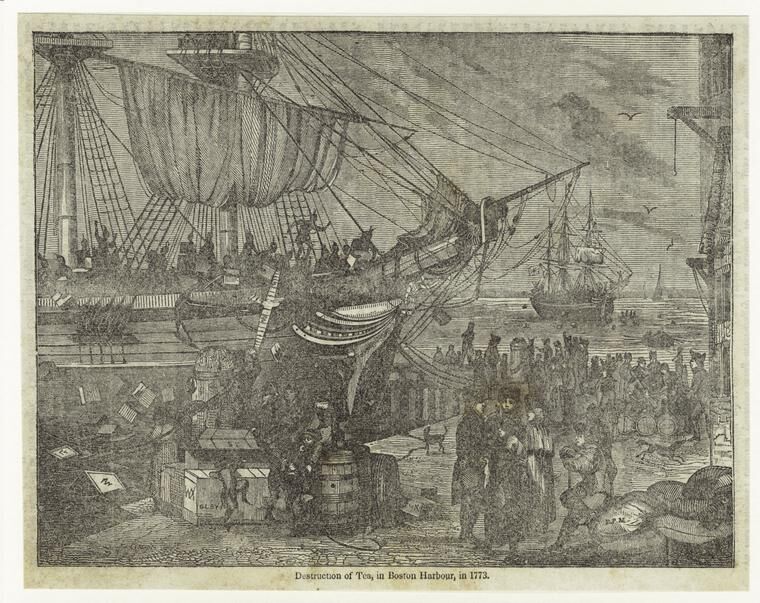 “Destruction of Tea, in Boston Harbour, in 1773.” |
Source: The Division of Arts, Prints and Photographs of Miriam and Ira D. Wallach: Picture Collection, New York Public Library, 1839. |
|
Document 2 |
|---|
|
“Furthermore, the British Crown had accumulated debt during the Seven Years’ War. King George III felt that the colonies should help repay the debt.” |
Source: Campeau, F. et al. (2018). Reflections.qc.ca - Origins to 1840. Chenelière Éducation. |
|
Document 3 |
|
|---|---|
|
Sugar Act |
1764 |
|
Stamp Act |
1765 |
|
Tea Act |
1773 |
Statement: Using documents 1 to 3, explain how the Napoleonic Wars influenced the economy of Lower Canada. Answer the question by specifying the items below and connecting them.
Napoleon’s action against the British
A natural resource imported by the United Kingdom
The rise of a new trade in Lower Canada
|
Document 1 |
|---|
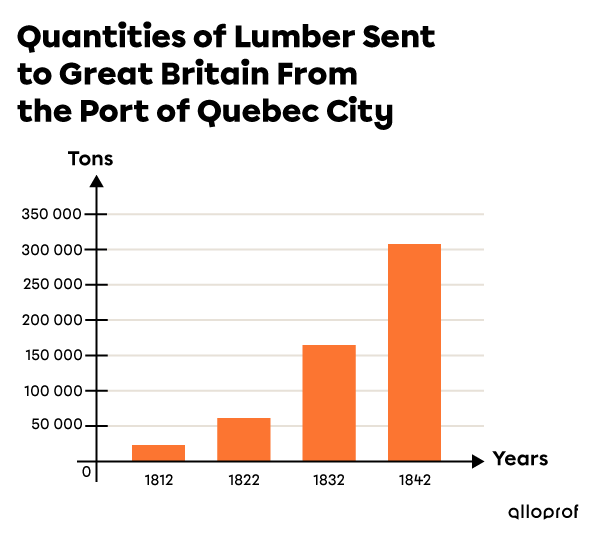 |
Source: Service national du RÉCIT, social universe domain, n.d. |
|
Document 2 |
|---|
|
“In 1806, Emperor Napoleon I of France imposed a continental blockade on the United Kingdom, preventing it from exporting its products to Europe and importing European goods. The objective of the blockade was twofold: |
Source: Campeau, F. et al. (2018). Reflections.qc.ca - Origins to 1840. Chenelière Éducation. |
|
Document 3 |
|---|
|
“At war with France, the United Kingdom needed timber to build its warships.[...] it decided to import timber from its colonies.” |
Source: Campeau, F. et al. (2018). Reflections.qc.ca - Origins to 1840. Chenelière Éducation. |
Alloprof. (s.d.). À la veille de la Révolution américaine. https://www.alloprof.qc.ca/fr/eleves/bv/histoire/la-revolution-americaine-mise-en-contexte-h1471#
Alloprof. (s.d.). La guerre anglo-américaine de 1812. https://www.alloprof.qc.ca/fr/eleves/bv/histoire/la-guerre-anglo-americaine-de-1812-h1547
Alloprof. (s.d.). La pêche européenne en Amérique. https://www.alloprof.qc.ca/fr/eleves/bv/histoire/histoire-la-peche-europeenne-en-amerique-h1369
Alloprof. (s.d.). Le commerce du bois. https://www.alloprof.qc.ca/fr/eleves/bv/histoire/le-commerce-du-bois-h1377
Duhamel du Monceau, H.-L. et La Marre, L. H. (1769-1782). Traité général des pesches et histoire des poissons qu’elles fournissent. parties [5] à [8] / , tant pour la subsistance des hommes, que pour plusieurs autres usages qui ont rapport aux arts et au commerce. [Numérisation]. BnF. https://gallica.bnf.fr/ark:/12148/btv1b8626558w/f217.item
Tuck, J. A. (2019, 20 juin). Beothuk. L’encyclopédie canadienne. https://www.thecanadianencyclopedia.ca/fr/article/beothuks
La Division des arts, estampes et photographies de Miriam et Ira D. Wallach : Collection d’images, Bibliothèque publique de New York. (1839). Destruction du thé, dans le port de Boston, en 1773. https://digitalcollections.nypl.org/items/510d47e0-f4df-a3d9-e040-e00a18064a99