Subjects
Grades
 100%
100%
 100%
100%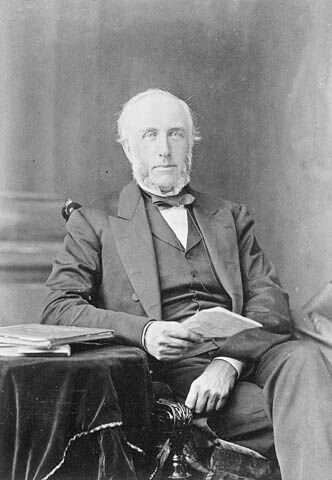 100%
100%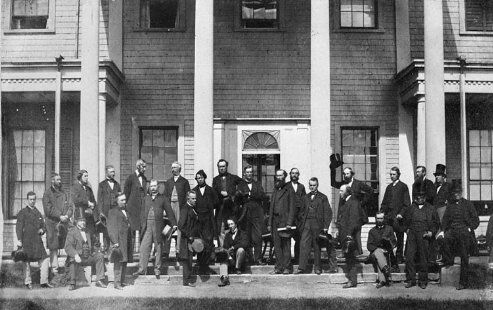
| Lower Canada | Upper Canada |
|---|---|
|
Conservative Liberal party (Blue Party)
|
Clear Grit Party (Liberal)
|
|
Red Party (liberal)
|
Conservative Liberal Party (Tories)
|
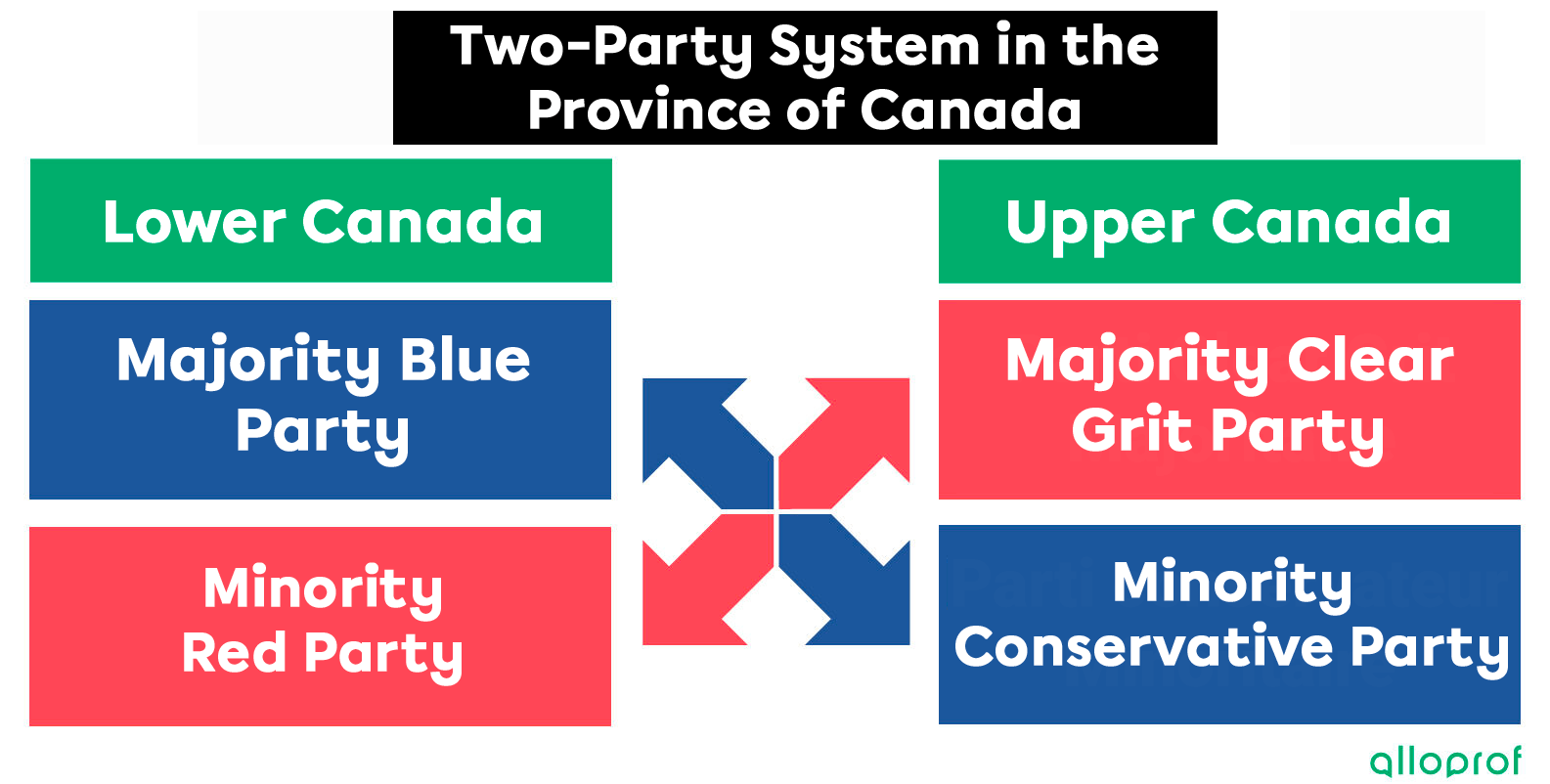
In the mid-19th century, the Province of Canada went through a period of political instability. Lower Canada and Upper Canada had different interests, and it was difficult for the single government created by the Act of Union to actually govern.
Moments in the video :
In 1851, Louis-Hippolyte La Fontaine and Robert Baldwin withdrew from politics, bringing an end to 11 years of reformist government. Although the elected members of this party had previously been united, they were becoming increasingly divided. A two-party system of government came into being.
The two-party system is a political system based on the existence of two distinct parties. Power alternates between the two parties, in this case, the Conservatives and the Liberals.
The more radical members, who wanted changes, were opposed by the moderates, who were satisfied with a responsible government. These divisions transformed the political landscape in the Province of Canada’s parliament and led to the formation of new parties from Upper Canada and Lower Canada.

| Lower Canada | Upper Canada |
|---|---|
|
Conservative Liberal party (Blue Party)
|
Clear Grit Party (Liberal)
|
|
Red Party (liberal)
|
Conservative Liberal Party (Tories)
|
From the early 1850s, ministerial instability began to set in because of the double majority problem.
Under the Act of Union, the Legislative Assembly of the government contained an equal number of elected members from both Upper Canada and Lower Canada (42 members for each region, for a total of 84). To have a majority, the parties needed a double majority (a majority of seats in Upper Canada and Lower Canada).
Since the elected parties almost always ended up with a minority in the Legislative Assembly, they were constantly blocked by the opposition. This in turn resulted in the dismantling of the government in place.
Before 1851, Francophones made up most of the population of United Canada, but the English-speaking population of Upper Canada kept growing, driven by several waves of immigration from Great Britain, among other things. In spite of this demographic growth, each region had the same number of seats in the Legislative Assembly.
The Clear Grits from Upper Canada then demanded a number of members in proportion to the population. George Brown, their leader, wanted to limit the power of Lower Canada and the Francophones in the Legislative Assembly. This type of representation was called proportional representation or “Representation by Population” (Rep by Pop).
Proportional representation is a way of determining the number of members elected from each region. With this process, the number of seats awarded to each colony (or province) was determined according to the number of inhabitants. A region with more people would have more representatives in the government.
Moments in the video :
George Brown was a fervent defender of representation by population (Rep by Pop).
With the rising population of Upper Canada, George Brown demanded that seats be awarded based on population, giving Upper Canada more power. This subject caused many disputes between the parties.
Over the course of 10 years, there were more than 10 successive minority governments in United Canada. After each election, the parties formed new alliances to hold power.
This situation resulted in ministerial instability, making it increasingly difficult to manage the affairs of the colony. There were constant debates about such things as moving parliament from Montreal to Toronto or Quebec City, or the number of members to be elected in Lower Canada and Upper Canada.
This situation eventually pushed the leaders of the different political parties to form the Great Coalition of 1864 to find a solution to the political crisis. This understanding, organized by political names such as John A. Macdonald, Étienne-Paschal Taché, George-Étienne Cartier and George Brown, brought together politicians who had different ideas but who wanted to build a new union between Upper Canada and Lower Canada, as well as the other British colonies.
The Charlottetown Conference was attended by representatives who wanted to solve the different problems affecting United Canada.