Subjects
Grades
As of 1627, the Company of One Hundred Associates was responsible for managing the colony. It implemented the same land organization that existed in France at that time: the seigneurial system. This system divided land into seigneuries (or sometimes spelled ‘seigneury’), organized both the land and society, and lasted throughout the French Regime.
The first seigneuries were located in the St. Lawrence Valley, close to Quebec City, Trois-Rivières and Ville-Marie, Montreal.
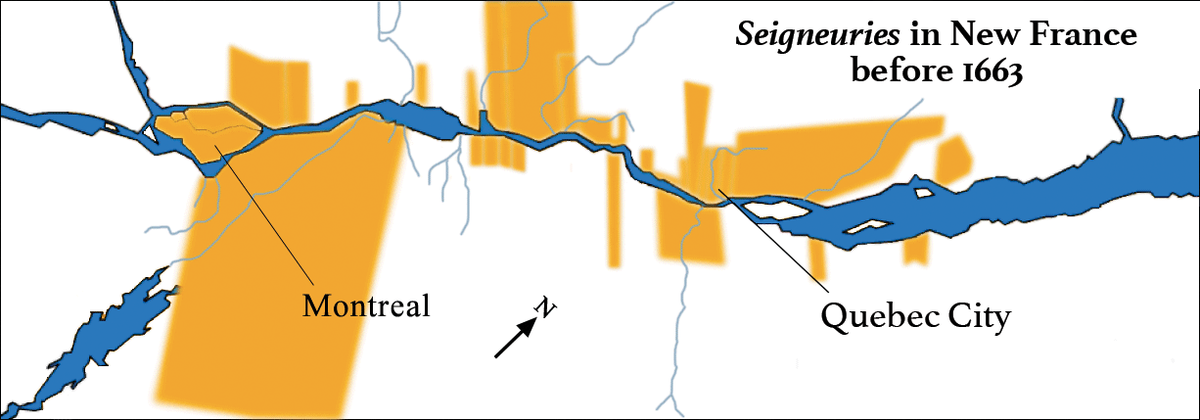
Seigneuries in New France before 1663
The seigneuries were perpendicular to the St Lawrence River or other waterways, which were the main means of communication at the time. The censives were long, narrow rectangles of land designed to ensure that the maximum number of settlers had land on the banks of a river or waterway.
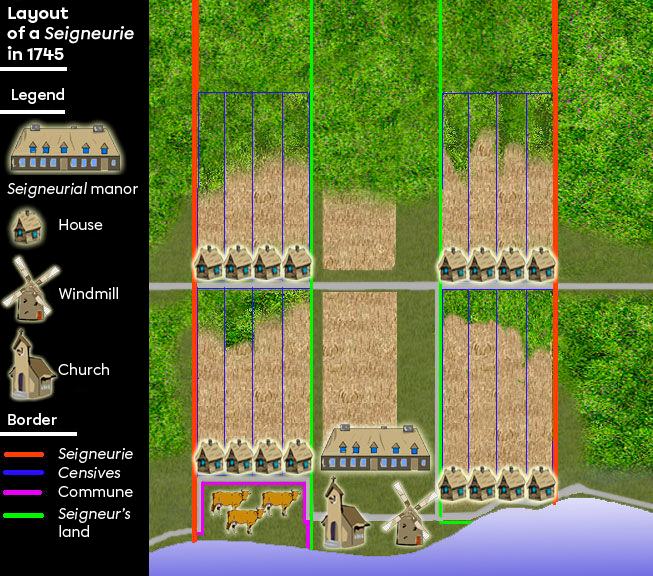
Layout of a Seigneurie in 1745
Although the social origin of the seigneurs varied, they were generally influential, rich people who were part of the elite in New France’s society. Many of them were from the bourgeoisie or were nobles, administrators or military officers. The religious communities also had several seigneuries.
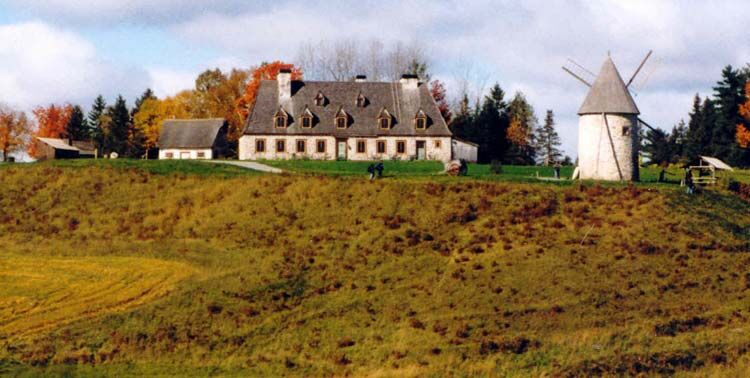
Photograph of the New France seigneurie mill and manor in Rivière-du-Loup
The tenants were responsible for clearing their land, which meant that they had to cut back the vegetation and the trees; first, to build their house and then to farm the land. Settlers spent most of their time doing farm work.
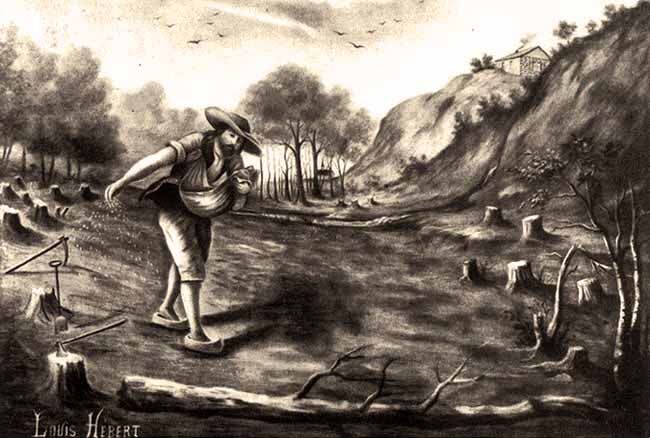
Louis Hébert preparing his land for farming
In addition to helping with farming, women had to do the housework. They educated the children, prepared meals and made clothes. Winter was a break for the settlers: they spent time on crafts and entertainment, such as card games, and with friends and family.
Social Organization
Large areas of land, known as seigneuries, were distributed to seigneurs, or lords, by the Company of One Hundred Associates. Each lord first divided his land into censives, or lots, that he then distributed to the censitaires, his tenants.
Under the seigneurial system, the lords served the King of France. Both lords and tenants had certain rights, but also responsibilities.
Pledge loyalty to the King of France
Distribute the censives, or lots, among tenants
Live in the seigneurie (often a manor)
Hold a court of law to manage conflicts between the tenants
Reserve the metals and the oak wood in the seigneurie for the King
Build and maintain a flour mill in the seigneurie
Build roads in the seigneurie
Pay 1/5 of the value of the seigneurie to the King if he sold it
Give the authorities a summary of the seigneurie (population, harvest, etc.)
Farm their land
Pay the tithe and rent to their lord every year (in money or in agricultural produce)
Use the seigneurie’s flour mill and give part of the milled grain to the lord
Work for the lord for three days per year
Maintain the roads that went through their plot of land