Subjects
Grades
 100%
100%
 100%
100%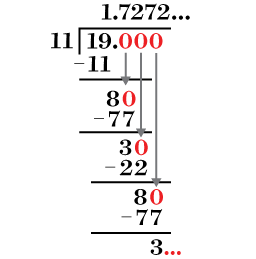
Sometimes, it can be useful to switch from a periodic number to a fraction or vice versa. The following concept sheet discusses the methods for successfully performing these switches.
Before presenting the methods, review the definition of period.
When a group of numbers written in decimal notation repeat indefinitely, it is called a period. When the numbers are written, identify the first period after the decimal point by drawing a horizontal bar above it.
Here are some examples of periods.
||\begin{align}0.666666666...&=0.\overline{6}\\
0.345252525...&=0.34\overline{52}\\
3.636363636...&=3.\overline{63}\\
0.714285714...&=0.\overline{714285}\end{align}||
When expressing a fraction in decimal notation, the division of the numerator by the denominator may never end. This creates a period.
Divide the numerator by the denominator.
Determine the period.
Write the number in decimal notation using the horizontal bar above the period.
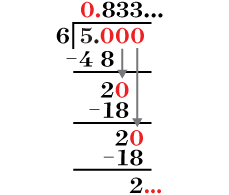
Express the fraction |\displaystyle\frac{5}{6}| in decimal notation.
Divide the numerator by the denominator.

Notice that the |3| repeats itself indefinitely.
Determine the period.
||0.8\underbrace{\color{blue}{3}}_{\color{blue}{\text{period}}}33...||
Write the number in decimal notation using the horizontal bar above the period.
Thus, we get |\displaystyle \frac{5}{6}=0.8\overline{3}|
Express the fraction |\displaystyle \frac{19}{11}| in decimal notation.
Divide the numerator by the denominator.
Notice that the |72| repeats indefinitely.
Determine the period.
||1,\underbrace{\color{blue}{72}}_{\color{blue}{\text{period}}}72...||
Write the number in decimal notation using the horizontal line above the period.
Thus, we get |\displaystyle \frac{19}{11}=1.\overline{72}|
The method of switching from a periodic number in decimal notation to its fractional notation is more complex and requires the use of algebra.
Define the periodic number as a variable. Multiply the number by the power of |10| that places the decimal immediately before the first period (or repeating part), if necessary.
Multiply the number by the power of |10| that places the decimal immediately before the first period (or repeating part).
Subtract the number from step 1 from the number from step 2 to obtain an integer or whole number.
Isolate the variable and simplify the fraction.
We will differentiate two particular cases in the examples. In the first case, the period will be directly after the decimal point. In a second case, the period will be separated from the decimal point by at least one digit. Step 1 will be slightly different in these two cases.
Express |0.\overline{36}| in fractional notation.
Define the periodic number as a variable. Multiply the number by the power of |10| that places the decimal immediately before the first period (or repeating part), if necessary. ||n=0.\overline{36}|| Since the period is already located to the right of the decimal point, we go directly to step 2.
Multiply the number by the power of |10| that places the decimal immediately after the first period (or repeating part). ||\begin{align}n\times 100&=0.\overline{36}\times 100\\ 100n&=36.\overline{36}\end{align}||
Subtract the number from step 1 from the number from step 2 to obtain an integer or whole number. ||\begin{align}100n-\color{red}{n}&=36.\overline{36}-\color{red}{0.\overline{36}} & &(\text{The decimal part cancels out.})\\ 99n&=36\end{align}||
Isolate the variable and simplify the fraction. ||\begin{align}99n=36\Rightarrow n&=\frac{36}{99}\\ n&=\frac{4}{11}\end{align}||
Thus, we get |\displaystyle 0.\overline{36}=\frac{4}{11}|.
Express |1.5\overline{24}| in fractional notation.
Define the periodic number as a variable. Multiply the number by the power of |10| that places the decimal immediately before the first period (or repeating part) if necessary.||n=1.5\overline{24}|| Note that the period is not located next to the decimal point.
Therefore, we must multiply by |10| to move it. ||\begin{align}n\times 10&=1.5\overline{24}\times 10\\ 10n&=15.\overline{24}\end{align}||
Multiply the number by the power of |10| that places the decimal immediately after the first period (or repeating part).||\begin{align}n\times 1000&=1.5\overline{24}\times 1000\\ 1000n&=1524.\overline{24}\end{align}||
Subtract the number from step 1 from the number from step 2 to obtain an integer or whole number.||\begin{align}1000n-\color{red}{10n}&=1524.\overline{24}-\color{red}{15.\overline{24}} & &(\text{The decimal part cancels out.})\\ 990n&=1509\end{align}||
Isolate the variable and simplify the fraction.||\begin{align}990n=1\ 509\Rightarrow n&=\dfrac{1\ 509}{990}\\ n&=\dfrac{503}{330}\end{align}||
Thus, we get |\displaystyle 1.5\overline{24}=\frac{503}{330}|.