Subjects
Grades
 100%
100%
 100%
100%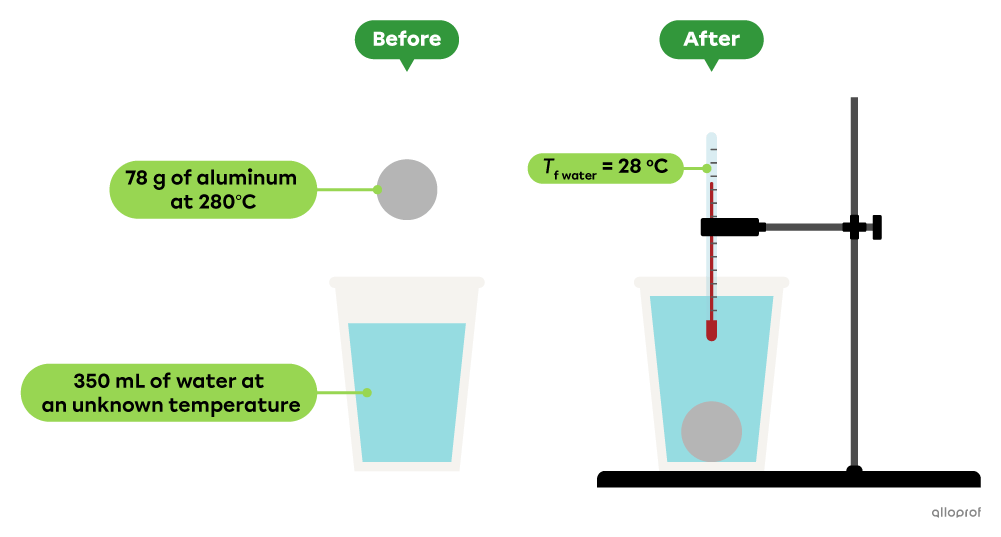
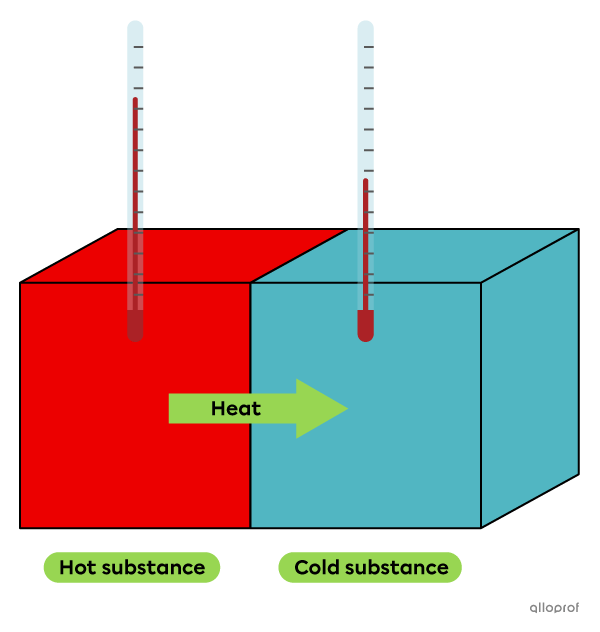
When two substances of different temperatures are in contact, some of the thermal energy of the hotter substance is transferred to the colder substance, until the two substances reach the same temperature. Both substances then undergo a temperature change. The hot substance experiences a decrease in temperature because it releases thermal energy. The cold substance experiences an increase in temperature because it absorbs thermal energy. This phenomenon is called heat.
Heat is the transfer of thermal energy between two systems at different temperatures.

Heat
The amount of heat absorbed or released by a substance depends on the mass of the substance, the specific heat capacity of the substance and the temperature change. Heat is calculated using the following formula.
|Q=mc\Delta T|
where
|Q\!:| heat in joules |(\text{J})|
|m\!:| mass in grams |(\text{g})|
|c\!:| specific heat capacity in joules per gram and degrees Celsius |(\text{J/g}{\cdot^\circ\!\text{C}})|
|\Delta T\!:| temperature change in degrees Celsius |(^\circ\text{C})|
The amount of heat |(Q)| is positive or negative depending on whether the substance absorbs or releases thermal energy.
When |Q| is positive, the substance absorbs thermal energy and its temperature increases.
When |Q| is negative, the substance releases thermal energy and its temperature decreases.
The specific heat capacity |(c)| is a characteristic property. It is the amount of thermal energy required to raise the temperature of one gram of a substance by one degree Celsius. The specific heat capacity is measured in joules per gram and degrees Celsius |(\text{J/g}{\cdot^\circ\!\text{C}}).| The following table gives the specific heat capacity of some substances.
|
Substance |
Air |
Aluminum |
Antifreeze |
Silver |
Copper |
Liquid water |
Ethanol |
Iron |
Mercury |
Lead |
Glass |
|---|---|---|---|---|---|---|---|---|---|---|---|
|
|\bf c| |
|1.01| |
|0.90| |
|2.20| |
|0.24| |
|0.39| |
|4.19| |
|2.44| |
|0.45| |
|0.14| |
|0.13| |
|0.84| |
Source: Couture et al., (2011)[1] |
|||||||||||
In short, the specific heat capacity of a substance describes its ability to change its temperature.
The lower the specific heat capacity of a substance, the easier it is for the substance to raise or lower its temperature. This is the case for silver, mercury and lead, among others.
The higher the specific heat capacity of a substance, the harder it is for that substance to raise or lower its temperature. Examples include antifreeze, liquid water and ethanol.
To find out the specific heat capacity of more substances, consult the following sheet.
The temperature change of a substance |(\Delta T)| is the difference between the final temperature |(T_{\text{f}})| and the initial temperature |(T_{\text{i}}).|
|\Delta T=T_{\text{f}}-T_{\text{i}}|
where
|\Delta T\!:| temperature change in degrees Celsius |(^\circ\text{C})|
|T_{\text{f}}\!:| final temperature in degrees Celsius |(^\circ\text{C})|
|T_{\text{i}}\!:| initial temperature in degrees Celsius |(^\circ\text{C})|
How much heat is absorbed by a |0.475\ \text{kg}| iron cube when its temperature changes from |10^\circ\text{C}| to |22^\circ\text{C}|?
The specific heat capacity of iron is |0.45\ \text{J/g}{\cdot^\circ\!\text{C}}.|
What mass of water releases |1100\ \text{J}| of thermal energy if its temperature decreases from |39.0^\circ\text{C}| to |20.5^\circ\text{C}|?
The specific heat capacity of water is |4.19\ \text{J/g}{\cdot^\circ\!\text{C}}.|
In a lab, |260\ \text{J}| of heat is transferred to a |25\ \text{g}| block of unknown metal. The temperature rises from |24^\circ\text{C}| to |104^\circ\text{C}.|
Determine the specific heat capacity of the metal in order to identify it.
|
Metal |
Aluminum |
Silver |
Copper |
Iron |
Mercury |
Lead |
|---|---|---|---|---|---|---|
|
|\bf c| |
|0.90| |
|0.24| |
|0.39| |
|0.45| |
|0.14| |
|0.13| |
Source: Couture et al., (2011)[1] |
||||||
One litre |(1\ \text{L})| of antifreeze at |5.4^\circ\text{C}| absorbs |10\ 500\ \text{J}| of thermal energy.
a) What is the temperature change of antifreeze?
b) What is the final temperature of antifreeze?
The density |(\rho)| of antifreeze is |1.135\ \text{g/mL}.|
The specific heat capacity of antifreeze is |2.20\ \text{J/g}{\cdot^\circ\!\text{C}}.|
In a lab, a |78\ \text{g}| aluminum ball with an initial temperature of |280^\circ\text{C}| is placed in |350\ \text{mL}| of water. After a few minutes, the water temperature reaches and stays at |28^\circ\text{C}.| Determine the initial temperature of the water.
The specific heat capacity of aluminum is |0.90\ \text{J/g}{\cdot^\circ\!\text{C}}| and of water is |4.19\ \text{J/g}{\cdot^\circ\!\text{C}}.|
The density of water is |1.00\ \text{g/mL}.|
The transfer of thermal energy between an aluminum ball and water
Couture, I., Lacombe-Harvey, M., & Levasseur-Thériault, G. (2011) Quantum - Chemistry. Chenelière Éducation.