Understanding and Teaching Digital Competency

Article

In all likelihood, digital technology is an integral part of your personal and professional life—whether you use it to communicate with friends, family, or your students’ parents; to keep up with the latest news; or to find information for your lessons. But beyond its everyday use, do you feel equipped to take a critical look at technological advances, make smart choices, and help your students develop their autonomy in using digital technology? The goal is to attain this level of digital savvy by developing your digital competency, as well as that of your students. Asking yourself why digital competency is important and how you can understand and teach it? This article has you covered. Alloprof’s dedicated digital competency collection, detailing each of the competency dimensions, is also a great tool!
Understanding Digital Competency

With the rise of artificial intelligence, virtual reality, and automation in recent years, digital technology has played an increasingly important role in the lives of all Quebecers. And the education sector is no exception. In 2018, the Ministère de l’Éducation adopted a Digital Action Plan for Education and Higher Education to prepare learners for tomorrow’s challenges. Its first orientation is to support the development of digital skills among young people and adults. 

Zooming in more closely, the Digital Competency Framework breaks down digital competency into 12 dimensions, each focusing on different skills and abilities: 

  • Exercising ethical citizenship in the digital age (inclure les liens vers les articles spécifiques)

  • Developing and mobilizing technological skills 

  • Harnessing the potential of digital resources for learning 

  • Developing and mobilizing information literacy 

  • Collaborating via digital technology 

  • Communicating via digital technology 

  • Producing content via digital technology 

  • Using digital tools to foster inclusion and address diverse needs 

  • Mobilizing digital technology for personal and professional empowerment 

  • Solving diverse problems via digital technology 

  • Developing critical thinking with regard to the use of digital technology 

  • Adopting an innovative and creative approach to the use of digital technology

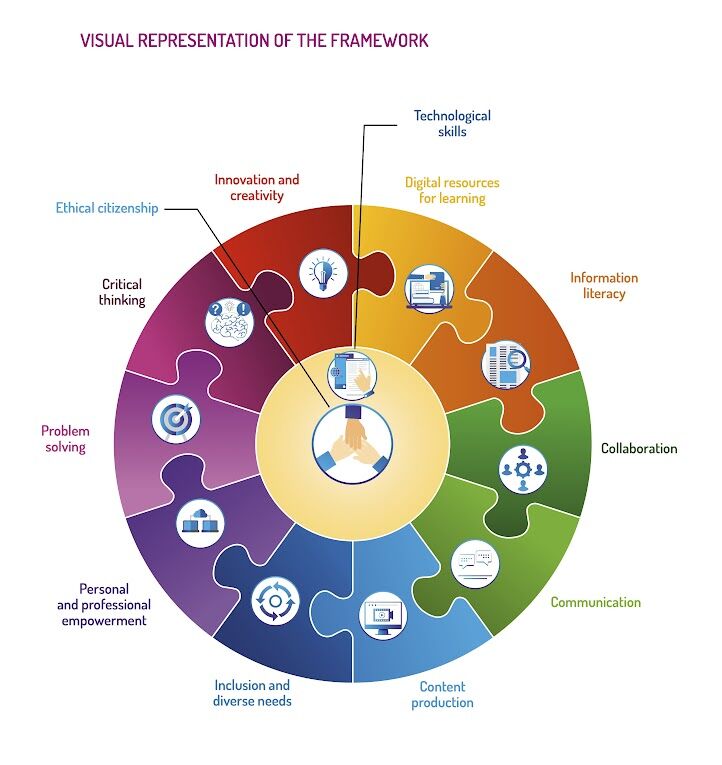
Here is a graphic representation of the 12 dimensions of the reference framework: 

Digital Competency Framework, Ministère de l’Éducation et de l’Enseignement supérieur (2019)

Image of the 12 dimensions.

It is also worth noting a few important elements: 

  • Dimension 1 (Exercising ethical citizenship in the digital age) and Dimension 2 (Developing and mobilizing technological skills), shown in the centre of the graphic, are considered central dimensions, around which the other 10 dimensions are articulated. 

  • The dimensions do not operate in isolation; one learning activity can address several dimensions simultaneously.

  • Dimensions are not discipline-specific and should be integrated into a multitude of contexts.

Why You Should Develop Your Digital Competency

One of the aims of the Digital Action Plan for Education and Higher Education is to encourage the development of digital skills in children and adults alike. In other words, as a teacher or education professional, developing your own digital skills is as important as developing the skills of your students. In fact, it’s one of the professional competencies required by teachers (competency 12: Mobilize digital technologies).

Definition

Digital competency is defined by the Ministère de l’Éducation as “a set of skills necessary to the confident, critical and creative use of digital technologies to achieve objectives with regard to learning, work, leisure, and inclusion or participation in society.” (Digital Competency Framework)

Ultimately, the hope is that by developing their digital competency, students, teachers, and all individuals will be able to: 

  • Acquire greater autonomy in their use of digital technology, so that they can make smart choices at school, at work, and in their everyday lives, for instance.

  • Adapt to technological innovations in the years to come, including advances in artificial intelligence, and be able to assess them critically.

  • Use digital resources for personal and professional development. Work, as well as public and community spaces will increasingly demand strong digital literacy. By preparing the next generation in your class for this reality, you’ll be giving them an incredible gift.

Be careful!

Digital competency touches all subjects, making it all the more relevant to teach and assess. You can find a way to integrate digital competency into many of your learning activities. Our digital competency collection is a great jumping off point—it contains activity ideas for each of the competency dimensions to get you started.

Resources for Teaching Digital Competency

The Ministère de l’Éducation has a number of resources to help teachers integrate and teach digital competency. Here are a few examples:

  • The Digital Competency Development Continuum breaks down each dimension into three levels of development: beginner, intermediate, and advanced. This can help you assess the level at which you or your students are currently situated and plan the next learning stage. 

  • Not sure where to start? The Ministère’s pedagogical guide lays out the nine steps for planning an activity that integrates digital skills.

  • The pedagogical guide also contains a blank template to help you plan an activity that integrates digital skills.

  • Finally, the pedagogical advisors at RÉCIT in Montreal designed 12 interactive and printable posters, one for each of the digital competency dimensions. They make great memory aids for the classroom.

Finally, our digital competency collection features an article for each of the competency dimensions, and is an invaluable tool for teachers looking for support in teaching digital literacy.

Collaborators

This concept sheet was written with the help of Séverine Parent and Jessica Métivier, professor and lecturer, respectively, in the educational studies department at Université du Québec à Rimouski – Campus de Lévis, and the students enrolled in “Mobilisation du numérique” (mobilizing digital technology) during the fall 2024 term.

References

Access our most relevant tools!

To make your life a little easier and receive some of our best Alloprof tools by email, subscribe to our teacher newsletter. You could even win a gift card for your favourite bookstore!