Ce contenu est protégé par le droit d'auteur. Toute reproduction à l'extérieur des forums Alloprof est interdite et pourra être considérée comme une violation du droit d'auteur.
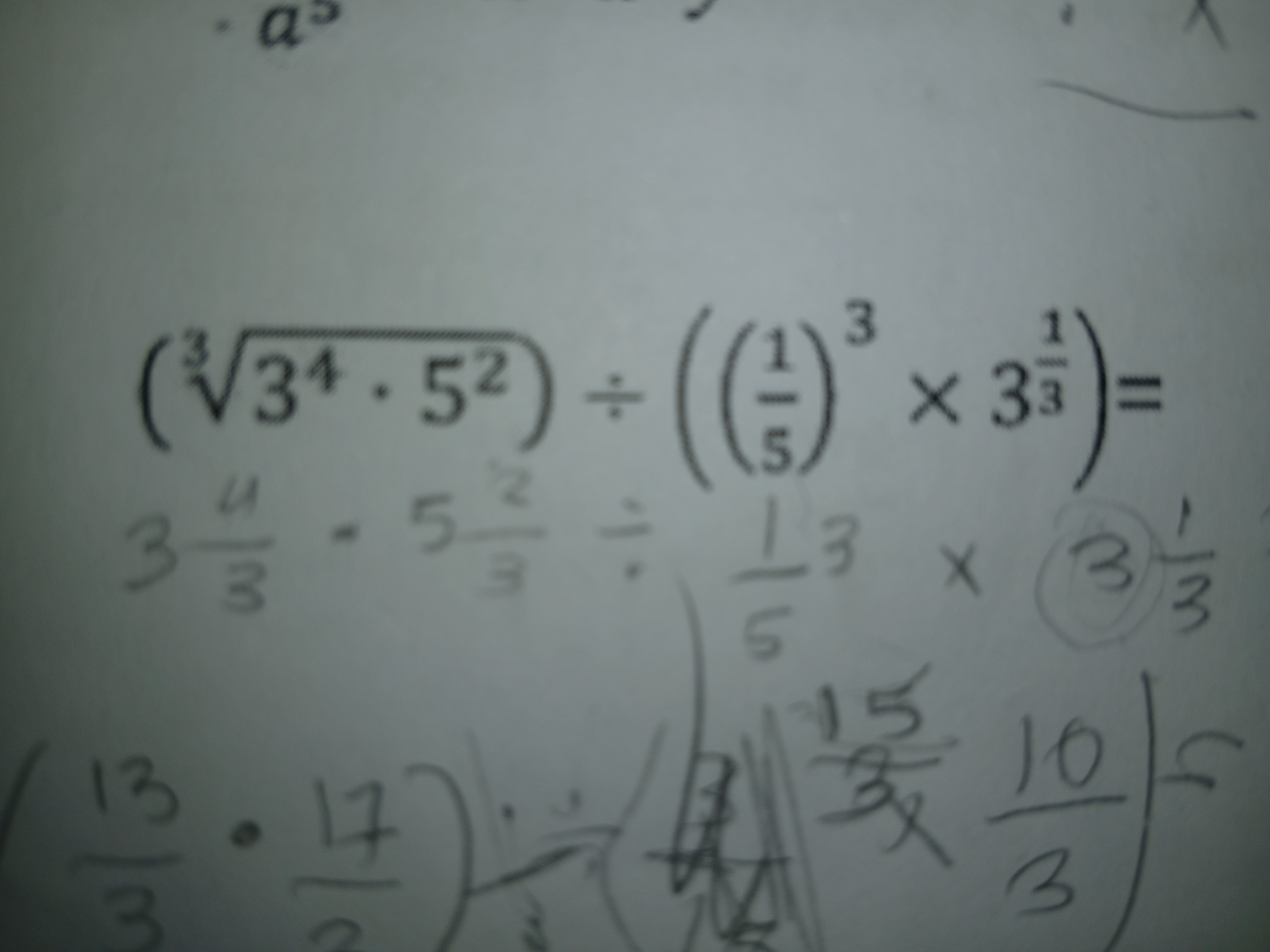
Quelqun peut me dire la réponse???? Je suis coincée dans cet exercise..
Ce contenu est protégé par le droit d'auteur. Toute reproduction à l'extérieur des forums Alloprof est interdite et pourra être considérée comme une violation du droit d'auteur.
Tu as raison qu'une racine cubique engendre un dénominateur 3. Cependant, l'exposant reste un exposant. La base et son exposant ne deviennent pas un nombre fractionnaire.
Encore une fois, dans \( 3^\frac{1}{3}\), 1/3 est un exposant, pas une fraction à multiplier avec 3.
Ce contenu est protégé par le droit d'auteur. Toute reproduction à l'extérieur des forums Alloprof est interdite et pourra être considérée comme une violation du droit d'auteur.
Ensuite, on peut distribuer un exposant lorsqu'il affecte une parenthèse qui contient une division.









Explanation from Alloprof
This Explanation was submitted by a member of the Alloprof team.
Bonsoir, CaribouPacifique7615!
Ce contenu est protégé par le droit d'auteur. Toute reproduction à l'extérieur des forums Alloprof est interdite et pourra être considérée comme une violation du droit d'auteur.
Tu as raison qu'une racine cubique engendre un dénominateur 3. Cependant, l'exposant reste un exposant. La base et son exposant ne deviennent pas un nombre fractionnaire.
$$\sqrt [n]{a^{m}}=a^{\frac{m}{n}}\neq a\frac{m}{n} $$
Cela vaut de même pour \( \sqrt [3]{5^{2}}\).
Encore une fois, dans \( 3^\frac{1}{3}\), 1/3 est un exposant, pas une fraction à multiplier avec 3.
Ce contenu est protégé par le droit d'auteur. Toute reproduction à l'extérieur des forums Alloprof est interdite et pourra être considérée comme une violation du droit d'auteur.
Ensuite, on peut distribuer un exposant lorsqu'il affecte une parenthèse qui contient une division.
$$ \left( \frac{a}{b}\right)^{m}=\frac{a^{m}}{b^{m}} \ \text{où} \ b\neq 0 $$
https://www.alloprof.qc.ca/fr/eleves/bv/mathematiques/les-lois-des-exposants-m1044
N'hésite pas à poser d'autres questions si tu en as suite à tes corrections!