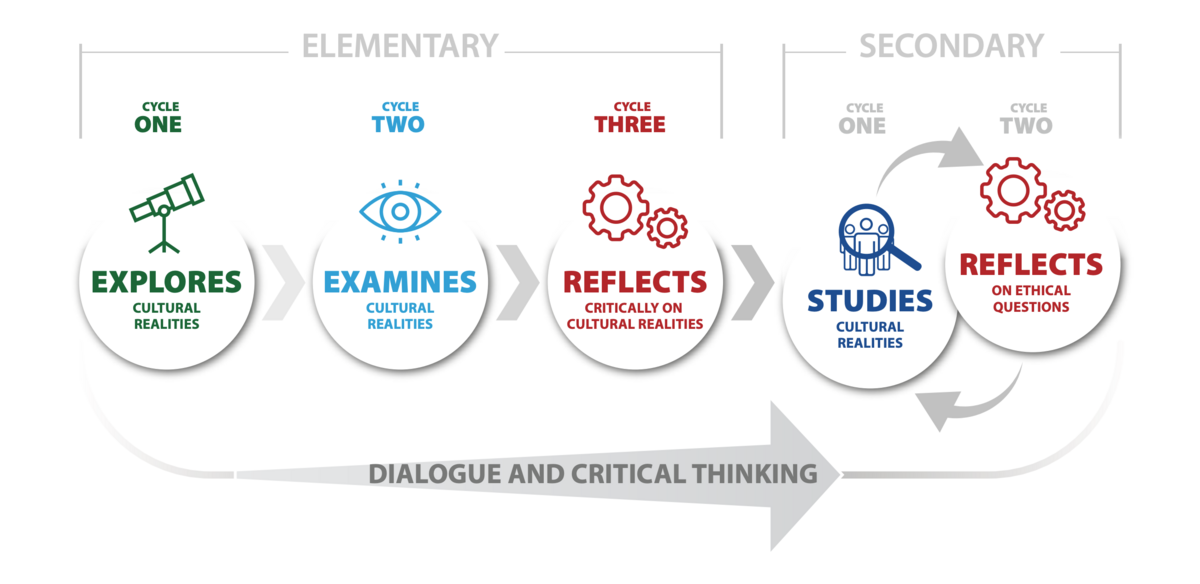
The CCQ program is taught through the lenses of sociology and ethics. In elementary school, these approaches are not formally distinguished, but you may find it useful as a teacher to understand the basics of the two disciplines.
The aim of the sociological approach is for students to observe their environment (which gets broader with each cycle of elementary school) and analyze cultural realities while reflecting on the relationships between individuals and groups. This is accomplished by introducing students to the scientific process of observing, evaluating the relevance of collected data, comparing observations, and so on. Among other things, this approach is intended to develop critical thinking skills.
Meanwhile, the ethical philosophy approach seeks to use dialogue and reflection to understand different perspectives. As a teacher, you should be concerned not with giving students the “right answers,” but rather with presenting a variety of viewpoints for them to consider and giving them the tools they need to evaluate multiple factors and possibilities.
The classroom should become a place where values, norms, rules, experiences, and feelings intermingle, and where disagreements can arise. This makes it an experiment in community life, with students under the supervision of an adult who encourages nuanced exchanges and mutual respect.
At the same time, not all opinions are created equal. It is your responsibility to intervene if someone’s comments go against the values of democratic society in Quebec, such as by violating the principles of the provincial Charter of human rights and freedoms.