20 Improv Themes to Improve Language Skills
Article
Improvisation is an activity that promotes spontaneity and creativity. When done together as a family, it offers several advantages:
- It requires (almost) no planning.
- It is particularly beneficial for overcoming the fear of looking silly and getting comfortable with making mistakes.
- It helps participants improve their communication skills.
- It promotes the development of certain skills that are essential to oral expression.
- It encourages the use of non-verbal language.
Giggles are guaranteed!
Grade
1-6
Table of contents
Organizing a Successful Improv Session
Supplies Needed
- A bowl
- Scissors
- A paper fastener
- Pencils
- A timer (cellphone, hourglass, etc.)
Instructions
- Print the tool and cut out the cards.
- Distribute the blank cards between all the participants, so that anyone who wants to can add a theme of their own.
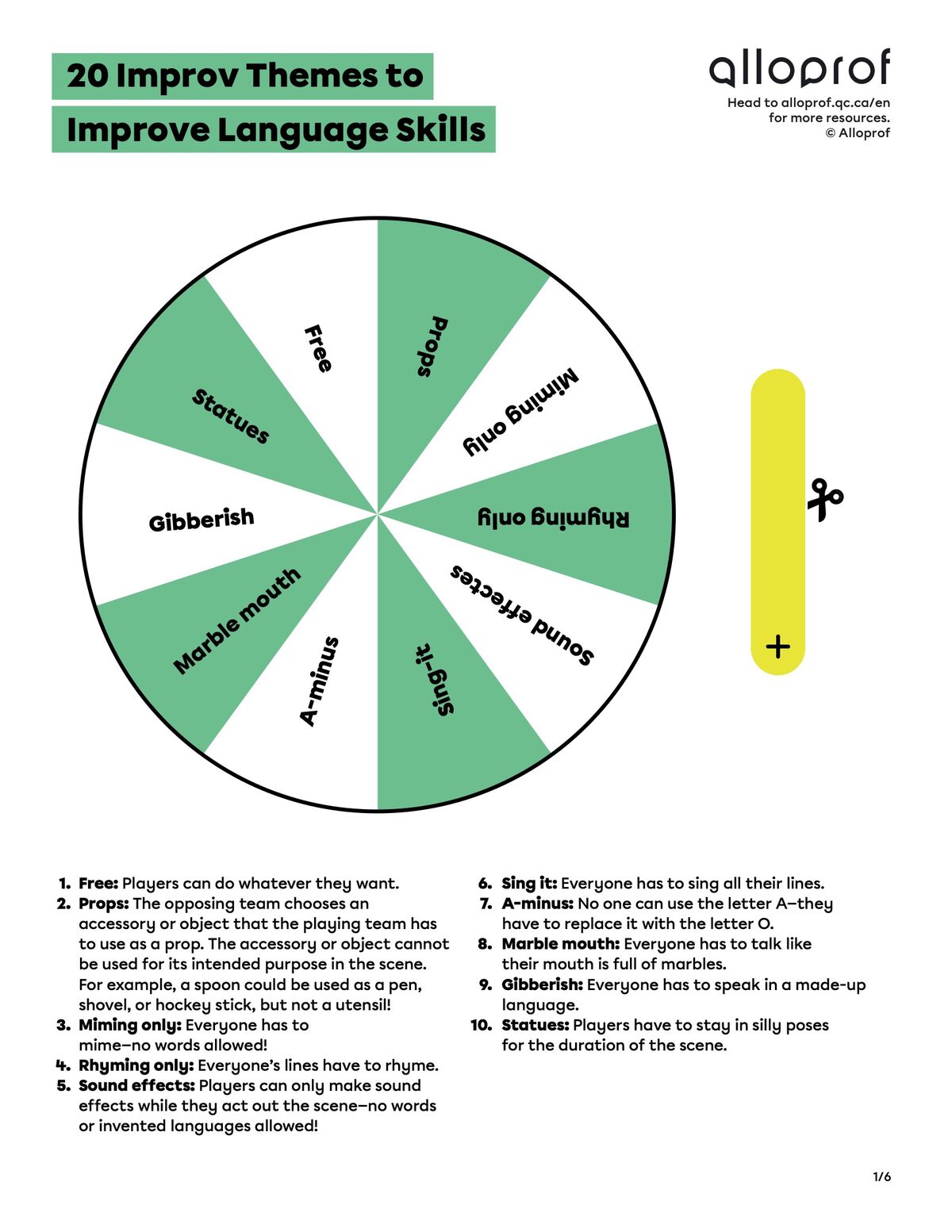
- Cut out the wheel and attach the arrow to it using a paper fastener. You can glue the wheel and arrow onto thicker paper before assembling to make them sturdier if you want to.
- Put all the cards in a bowl.
How to Play
- Form two teams and take two minutes (no more!) to come up with team names.
- Play rock paper scissors to determine which team will go first. The other team will be in charge of timekeeping and act as the audience (the teams switch roles every turn).
- One member of the playing team picks a theme and reads it aloud.
- One of their teammates spins the improv categories spinner and reads the category aloud. If necessary, refer to the detailed description below the instructions.
- The team has 30 seconds tops to huddle together and strategize before they start their scene.
- When the 30 seconds is up, the team has 2 minutes to improvise their scene.
- In this version of the game, there is no winning team. You decide when the game ends!