Winter Celebrations Around the World | Learning activity
For many people, December is the Christmas season, but there are many different cultural and religious holidays around the world that are also celebrated throughout the winter months, such as Hanukkah, Bodhi Day, St. Lucia’s Day, and Las Posadas. Learning about different celebrations and traditions is a great way to discover other cultures. This calendar features significant holidays from around the world.
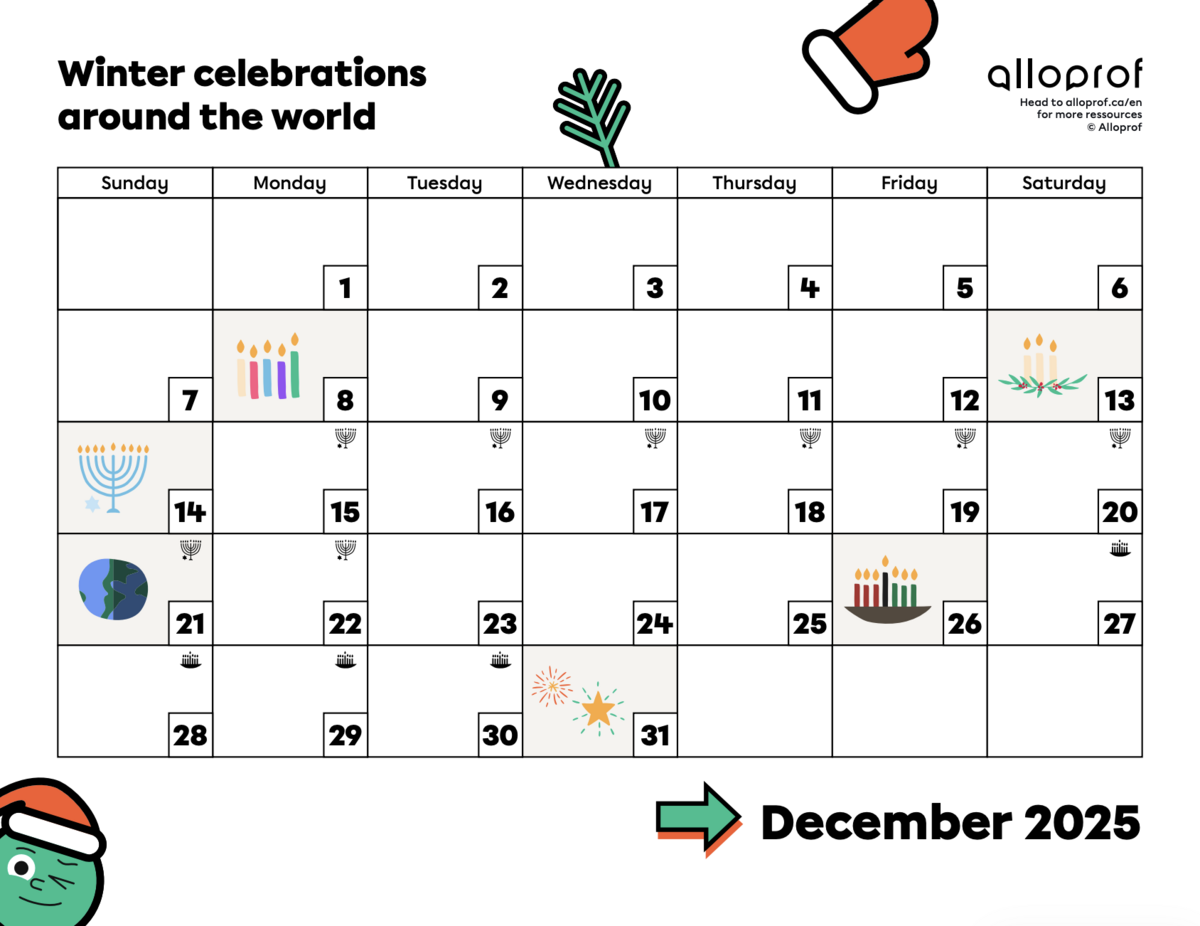
December
Hanukkah
December 14, 2024 - December 22, 2025*
This Jewish holiday, also known as the Festival of Lights, commemorates a miracle that is said to have taken place several thousand years ago in Jerusalem. According to tradition, a lamp that only had enough oil for one day miraculously burned for eight days. A menorah (a candleholder that holds eight candles) is used to symbolize this miracle. Each night during Hanukkah, a new candle is lit.
Feast of the Immaculate Conception
December 8
This Christian feast day celebrates the Immaculate Conception of the Virgin Mary. Festivities vary from region to region and country to country, but usually involve placing lit lanterns and candles on windowsills, along streets, and in public places in towns and cities. This holiday is particularly popular in Lyon, France, where it’s known as the fête des Lumières (Festival of Lights), and in Colombia and Venezuela, where it’s called Día de las velitas (Day of the Little Candles).
St. Lucia’s Day
December 13
In Scandinavian countries, it was tradition to light fires to chase away evil spirits on the longest nights of the year. This tradition lives on today as St. Lucia’s Day, a festival of lights that honours a Christian martyr. The festival begins with a procession of children in white robes singing traditional songs. To represent Lucia’s illuminated hair, the children wear crowns of candles or fairy lights and carry lit candles.
Winter solstice
December 21
Every year, around December 21, festivals and celebrations take place in different parts of the world to mark the official arrival of winter in the northern hemisphere. Here are a few examples:
- Shabe Yalda: Celebrated in Iran and Afghanistan, Shabe Yalda is one of the four major festivals of the Persian calendar. During this celebration, it’s very popular to eat red-fleshed fruits, such as pomegranates or watermelons. The colour red represents fire, symbolizing the sun that lights up the earth. It’s also customary to make wishes for the New Year and bid farewell to autumn.
- Dongzhi Festival: This major Chinese celebration falls between December 21 and 23*, according to the Chinese solar calendar. Originally, it was a festival marking the end of the harvest, when workers returned from the fields to share the fruits of their labour with their families. Today, families gather to commemorate the past year.
- Yule: For Wiccans and neo-pagans, Yule is a celebration of the sun’s return and the beginning of longer days. This Nordic festival was originally celebrated in Scandinavia. Today, a common tradition is to burn a Yule log to celebrate the return of the sun. This practice was adopted by Christians and integrated into the Christmas tradition.
Kwanzaa
December 26 to January 1
This secular festival of African culture celebrates the harvest, African heritage, and the seven principles of Kwanzaa, one for each day.
There are seven symbols of Kwanzaa, each representing a principle: a straw placemat (founding of the community), fruits and vegetables (abundance), corn (growth and prosperity), a cup (sharing), a seven-branched candlestick called a kinara and homemade gifts (creativity and intention). The seventh symbol, the unity of African peoples, is represented by the candles: three red, three green, and one black, corresponding to the colours of the Pan-African flag.
New Year’s Eve
December 31
New Year’s Eve is celebrated all over the world. Traditions vary from country to country and from culture to culture.
In Italy, Germany, Ireland, and the United States, it’s common to eat vegetables, such as leafy greens, for good luck and wealth in the new year.
Cakes and pastries in the shape of a circle, representing the past year, are served in the Netherlands, Mexico, Portugal, Spain, and Greece.
In some countries, it’s customary to eat pork as a symbol of prosperity for the coming year.
In certain Colombian villages, people make large dolls called años viejos (meaning old year) from old clothes and paper and burn them at midnight. They symbolize the failures of the past year.
A billion people around the world tune in every year to watch the ball drop at midnight in New York’s Times Square.
In the Netherlands, the New Year is greeted by the wailing of sirens from all the boats in port.
In Poland, it’s tradition to serve an odd number of dishes for dinner on New Year’s Eve. The crumbs from the meal are kept until spring, to be planted in the vegetable garden as a sign of renewal.
As part of the Scottish tradition of Hogmanay, after the new year has been rung in, people compete to be the first to cross the threshold of a friend or neighbour’s home.
January
Epiphany
January 6
This Christian feast day commemorates the arrival of the Three Wise Men who came to worship Jesus shortly after his birth. In France, Quebec, Acadia, Switzerland, Luxembourg, Belgium, and Lebanon, it’s customary to share a cake (king cake) with a bean or porcelain figurine hidden inside. The person who finds it in their slice becomes king or queen for the day. In Mexico, families eat a sweet brioche wreath, called Rosca de Reyes (wreath of the kings), with a little plastic Jesus figurine inside. In Spain, January 6 is a public holiday, as it’s one of the most important holidays of the year: the day when the Three Wise Men bring gifts to children.
Orthodox Christmas
January 7
Orthodox Christmas (celebrated by Orthodox Christians in Ukraine and Russia) is celebrated on January 7 rather than December 25, because the Orthodox Julian calendar is 13 days behind the Gregorian calendar used in most parts of the world. In addition, there is no Orthodox Santa Claus. For Orthodox Christians, Christmas is a strictly religious holiday. For this reason, they observe a 40-day fast prior to the holiday and refrain from exchanging gifts. Celebrations similar to those in Western countries take place on New Year’s Eve, when people exchange presents.
Orthodox New Year
January 14
This holiday is also known as the Old New Year. It’s observed by Orthodox Christians in Russia, Ukraine, and Georgia on January 1 of the Orthodox Julian calendar. Though Old New Year’s festivities are generally a bit more subdued than new New Year’s celebrations, families take this time to reflect on the year behind them and ring in the new year with big meals, carols, and toasts.
Yennayer
January 12 to January 14
Yennayer is the first day of the new year in the agrarian calendar used since ancient times by Berbers across North Africa (especially in Algeria and Morocco). It corresponds to January 1 in the Julian calendar, which is shifted 13 days compared to the Gregorian calendar. Depending on the region, the holiday is celebrated between January 12 and 14 in the Gregorian calendar. On Yennayer, families traditionally share a plentiful meal of pulses, couscous, and poultry to symbolize abundance for the coming year.
Laba Festival
January 26*
Laba is a traditional Chinese festival held on the eighth day of the twelfth month of the lunar calendar. On this day, it’s customary to eat Laba congee, a special rice porridge usually made with at least eight ingredients that represent people’s prayers for the harvest. Many temples offer free Laba congee to the public. This festival marks the start of the Chinese New Year celebrations, which fall in the middle of winter.
* These dates are not always the same every year in the Gregorian calendar.