Encouraging sibling collaboration during homework time
There are many benefits to encouraging your eldest to help their little brother or sister during homework time—not just for you as their parent, but also for both siblings. No matter your situation (a big family, a child with special needs, a particularly delicate work-life balance, etc.), when it comes to homework, sibling collaboration can be extremely valuable.
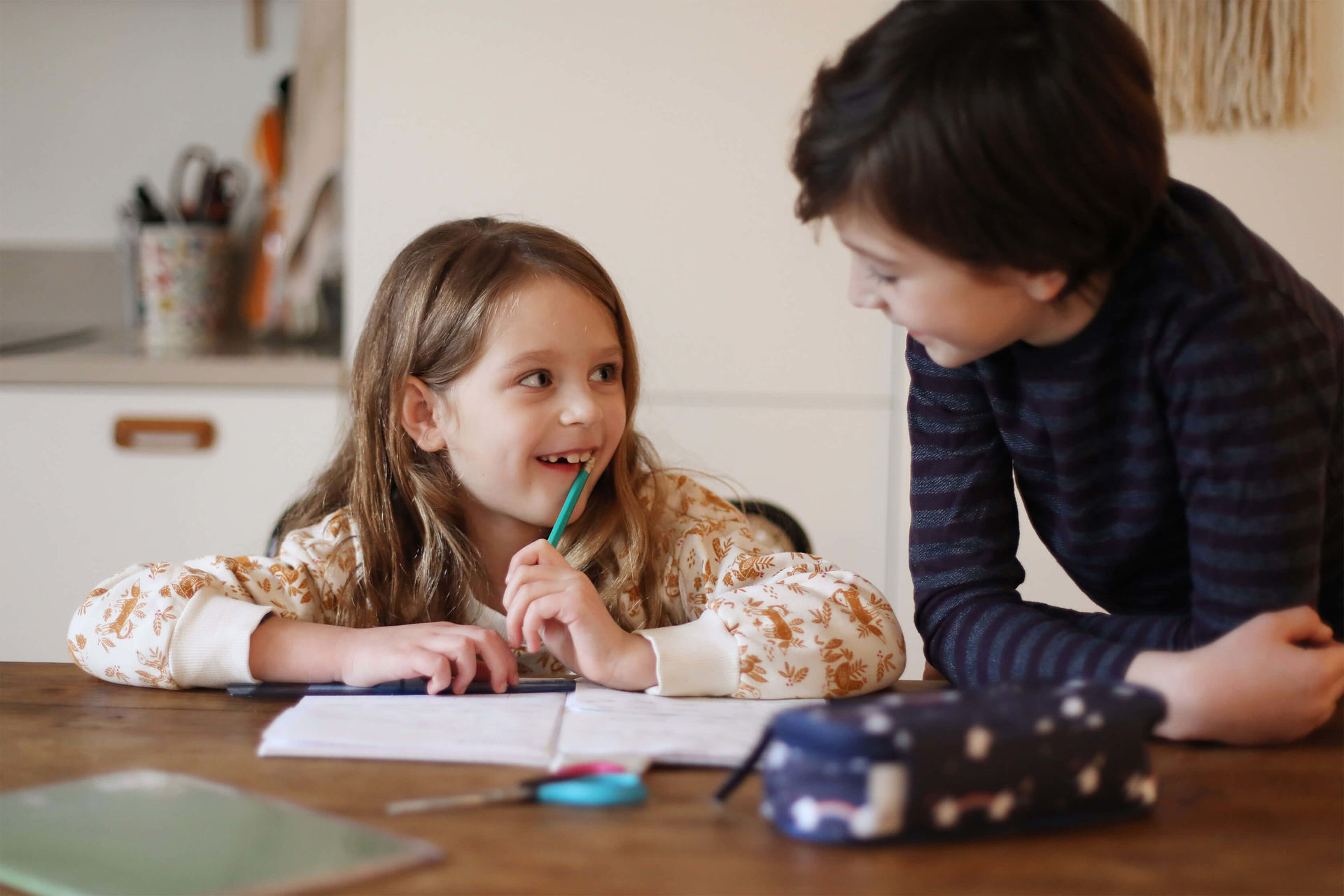

Homework buddies
Older siblings can support a younger brother or sister during homework time in a number of ways, whether that’s by simply keeping them company, reminding them of instructions, or explaining certain concepts. For example, your eldest could do the following:
- Quiz their younger sibling or help them practise reciting the alphabet, nursery rhymes, etc.
- Read them stories, listen to audio books together, or suggest books they might like
- Share tips on establishing a homework routine, using study strategies, organizing their work space, etc.
- Impart learning strategies that were useful when they were the same age
- Offer to help if their sibling doesn’t understand an assignment
In addition to supporting their brother or sister on a practical level, older siblings can help reinforce the importance of school and learning by doing the following:
- Encouraging their younger sibling to do their homework
- Positively reinforcing their younger sibling’s progress and achievements
- Acting as a role model
- Etc.
5 criteria for sibling collaboration during homework time
1. Mutual support as a core family value
Children often emulate the support and guidance they receive from their parents. Instead of telling your eldest that it’s their responsibility to help their younger siblings, aim to model the importance of mutual support in a variety of situations. If your kids are taught to value every small act of kindness or generosity, helping others will come more naturally to them.
2. A positive sibling relationship
Both children have to be interested in working together. If there are many kids in your household, consider pairing up siblings who get along best. The younger child should be receptive and open, while the older one should be patient and caring.
3. No sibling rivalries
To keep your kids from feeling that they’re in competition with one another, explain that everyone progresses at their own pace. Try using a staircase analogy: each person is on a different step, and the height of each step is different for everyone.
4. A homework routine
Make it routine for your kids sit down to do their homework at the same time, in a quiet environment with no distractions. This will make it easier for them to ask each other questions and work together.
5. Praise and recognition
Acknowledging when your younger child makes progress (e.g., when they master their multiplication tables, learn to read aloud more fluently, figure out the meaning of a difficult word) will help both siblings recognize the benefits of working together, build their sense of competence, and motivate them to keep going. You can also praise your eldest for sharing what they know and doing such a good job at explaining things to their little brother or sister to ensure they feel valued.
A win-win situation
When an older sibling helps their younger sibling at homework time, both children benefit.
The youngest child:
- Gets valuable help
- Receives that help in language suited to their age, culture, and level of understanding (because their older sibling has been in their shoes)
- Feels encouraged and supported in their academic learning
Meanwhile, the eldest child:
- Gains confidence in their abilities
- Strengthens their subject-specific competencies and their understanding of various concepts as a result of formulating explanations, making connections, and coming up with examples
- Develops greater autonomy
Lastly, when siblings help each other during homework time, it brings them closer together. Making learning fun is a terrific way to foster success and an appreciation for school!
References