How to Talk to Your Students About AI
With generative AI (genAI) now accessible to all, it’s become a real hot topic. But how do you talk about it with your students? This article offers practical tips for talking about AI in the classroom.
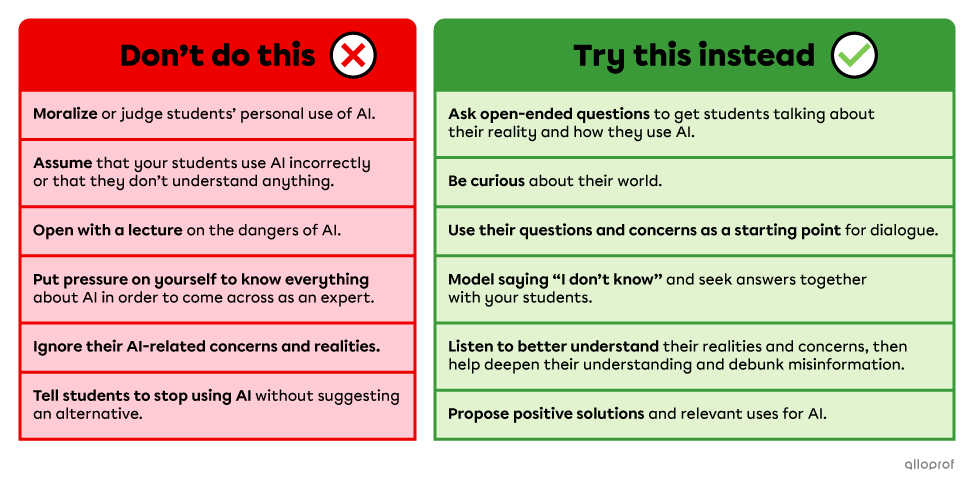
Today’s youth live in a technological reality that’s vastly different from the one we experienced growing up. As such, it’s important to listen to their perspectives and questions first, and to show an interest in understanding their point of view. Keep in mind that it’s perfectly normal not to know everything about AI. By working together with your students to find answers from reliable sources, you’re modelling crucial skills.
Here are a few tips to start the AI conversation.

To start the conversation and address the issues involved in using AI, ask your students if they’ve ever used AI tools and if so, how they use them. Write down their answers on the board as they give them. Next, ask them to name AI applications that make everyday life easier (you can complete this list with them by mentioning advances in medical diagnostics, ride-sharing apps, improvements in the accuracy of weather forecasts, etc.).
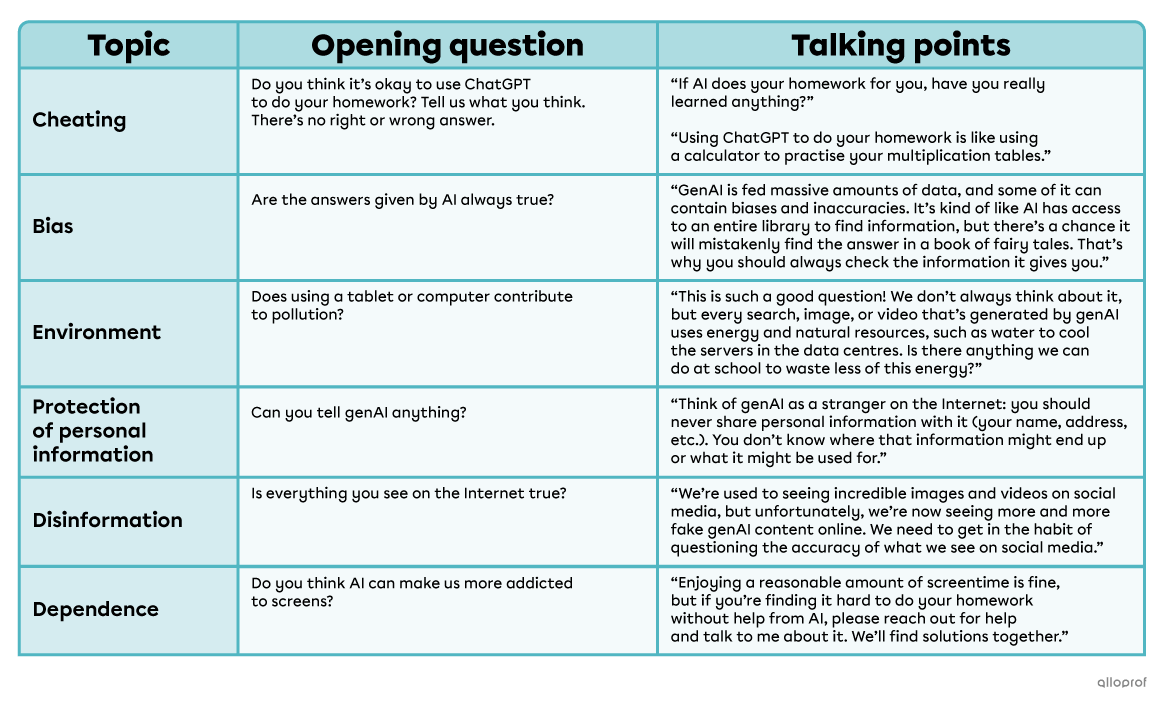
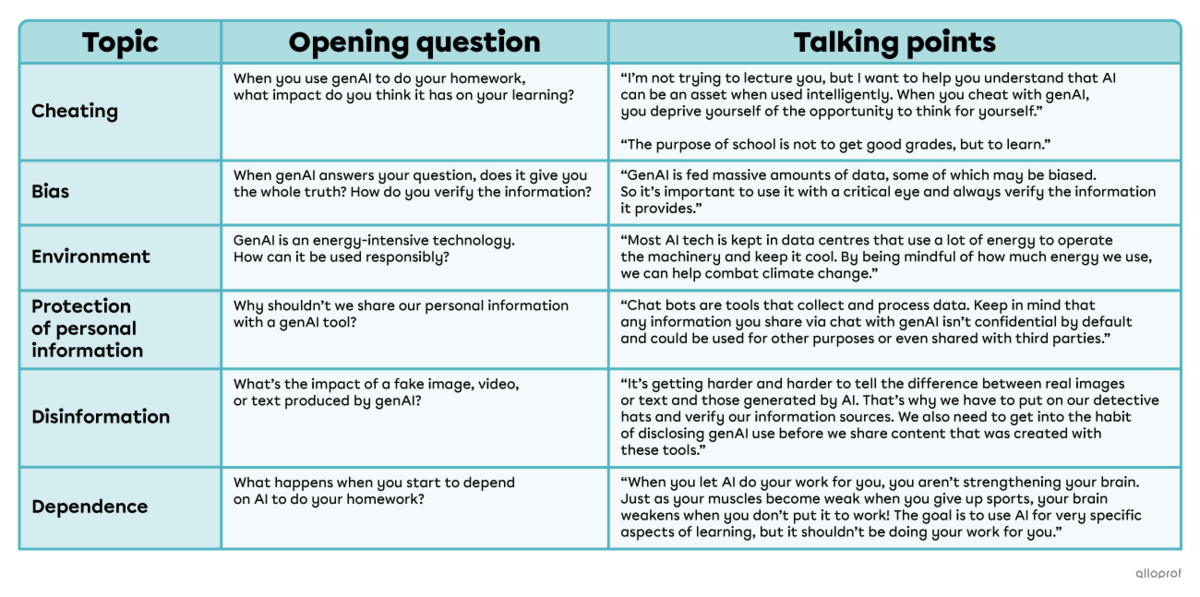
Once this collective portrait of AI is complete, help your students go deeper and add nuance to what they’re saying about the use of AI and its key issues, as well as its potential if used correctly. Use the tables below as inspiration for your class discussion.
Start from Their Reality: Elementary School

Start from Their Reality: High School

In 2024, an average ChatGPT query required around 10 times more electricity than a Google search. By 2025, Gemini had become more energy efficient, with a Gemini query (0.24 watt-hours) consuming about the same amount of energy as a Google search (0.2 to 0.3 watt-hours). In 2025, a Gemini query uses the same amount of energy as the following:
While this amount of energy (0.24 watt-hours) may seem like nothing, keep in mind that millions of people use AI every day, which continues to increase the global demand for electricity and other resources (for example, the rare earth minerals needed to manufacture the computer parts used in servers).
The best way to promote an ethical and educational use of genAI is to bring students into the discussion. By creating a genAI code of ethics or charter with your students, you can get them actively involved in the process. By taking ownership of the rules, they are more likely to follow them and demonstrate intellectual integrity.
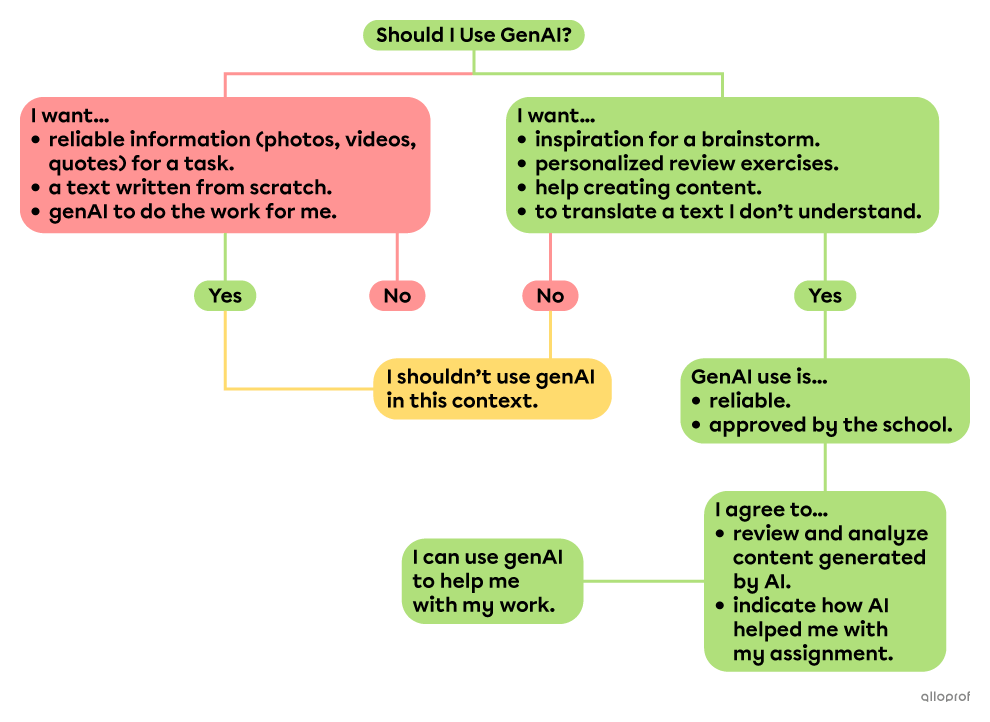
Use this flow chart as inspiration to teach your students about appropriate uses of genAI for learning.
Should I use GenAI to do my homework? (Inspired by the Government of New Brunswick’s AI integration guide for schools [in French only])

The EngageED Learning site suggests a model for developing an ethics code for AI use in schools. In short, they recommend starting with a clear distinction between acceptable and unacceptable uses of AI.
For teachers
✅Acceptable uses
🚫Unacceptable uses
For students
✅Acceptable uses
🚫Unacceptable uses