Teaching Students to Formulate Effective AI Prompts

Article

Before the advent of artificial intelligence (AI), you taught your students how to do a good Google search using the right keywords. Today, with the arrival of AI functionalities adapted for learning, a new skill is just as crucial: the art of writing a good prompt. This article suggests strategies for teaching your students how to formulate chatbot prompts in order to reap the educational benefits.

Formulating Effective Prompts: A Key Skill

Prompt engineering is the process of formulating clear, precise, and structured prompts to obtain relevant answers from an AI chatbot.

Think of AI as a robot that needs to be programmed. The clearer and more detailed the instructions it receives, the more likely it is that its actions will meet the user’s expectations. While in the past, AI models responded only to simple commands, today their complexity requires us to develop the skills to obtain relevant answers. Here are a few good reasons to model effective prompt writing for your students. 

This dimension of digital competency is addressed when learning how to formulate good prompts, as students have to mobilize the resources at their disposal to achieve the desired results.  

To get a good answer from an AI, you first need to know what you’re looking for. Students have to analyze their needs and structure their prompts. They also have to assess the relevance of the results.

  • Structuring your thinking

To formulate a clear and specific prompt, you need to organize your ideas. Prompt engineering helps students learn to define a role, a task, a context, and constraints for each prompt, which improves the clarity of their communication. This cross-curricular competency supports the development of the Communicating via Digital Technology dimension.

  • Transforming AI into a partner in academic success 

By teaching students how to interact well with AI, you will help them take full advantage of its benefits. AI will then become a tool to help them solve problems and deepen their knowledge, which directly addresses the dimension Harnessing the Potential of Digital Resources for Learning.

  • Stimulating creativity and innovation 

Learning to write prompts also means learning through trial and error. Students can experiment with different formulations to achieve unexpected and original results, as well as to create content, which is at the heart of the Adopting an Innovative and Creative Approach to the Use of Digital Technology dimension.


The Components of an Effective Prompt

To help your students move from a simple question to a high-quality prompt, it’s essential to provide them with a simple, effective method. The CAFE method, with its easy-to-remember acronym, is an excellent starting point. This checklist teaches students to structure their thoughts before using an AI chatbot, so they can get the most precise and relevant results.  

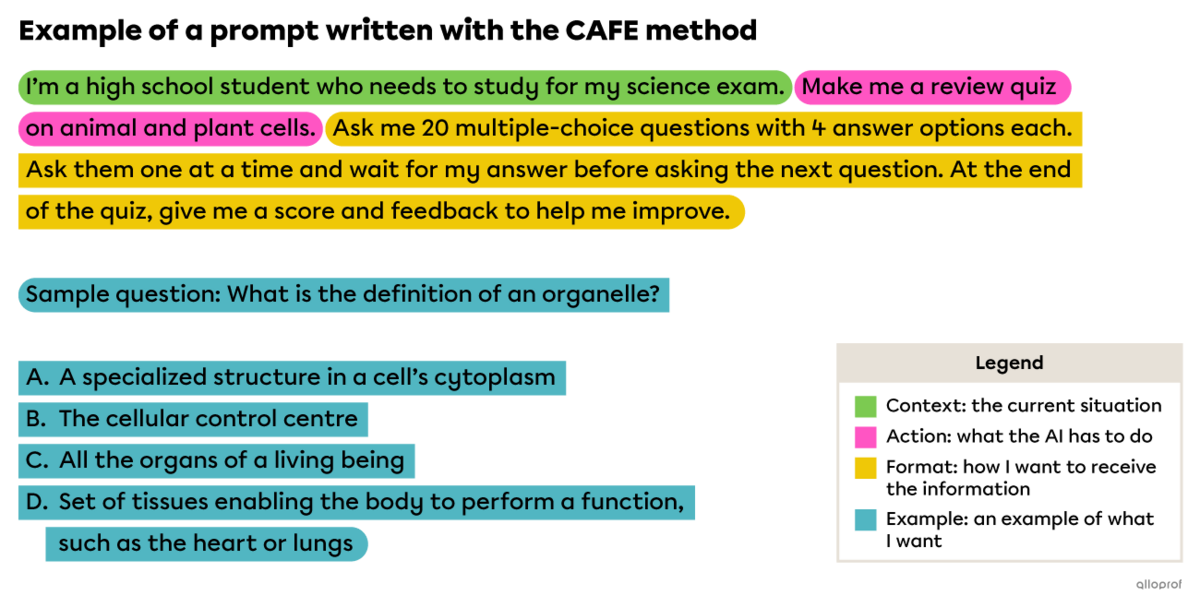
C for Context

  • What is it? The context gives the AI all the basic information it needs. This is where we define the situation, the role to be played, the target audience, or the sources to be used.

  • Example: In a prompt for a quiz, the context might be: “I’m a Sec. II student and I need to study for my science exam.”


A for Action

  • What is it? The action is the main task we’re asking the AI to perform. This is the action verb of the prompt.

  • Example: For the quiz, the action would be: “Make me a review quiz on animal and plant cells.”

F or Format

  • What is it? The format specifies how you want the AI to present the information. You can ask for a list, a table, a precise word count, or specific instructions for the answer.

  • Example: “Ask me 20 multiple-choice questions with 4 answer options each. Ask them one at a time and wait for my answer before asking the next question. At the end of the quiz, give me a score and feedback to help me improve.”

E for Example

  • What is it? An example is often the finishing touch that guarantees a quality response. The aim is to provide a model of what is expected. It’s a great way to model your expectations for the AI.

  • Example: “Sample question: What is the definition of an organelle? A. Specialized structure . . . B. Control centre . . .”

Example of the CAFE method in action:


Example of the CAFE method in action.

How to Teach the CAFE Method in the Classroom

Explicit instruction is the best way to help your students make the most of this method.

  • Show examples on the board 

Show well-formulated and less well-formulated prompts so that students can compare the results.

  • Ask students to spot the errors 

Create examples of poorly made prompts, and encourage students to hypothesize about the results. Then try out some suggestions together to see how the AI responds.

  • Write prompts as a group 

Ask students to share their needs (e.g., “I have trouble using commas . . .”) and build CAFE prompts together on your smartboard.

Be careful!

AI in the Classroom Needs to Be Approached Mindfully!

For artificial intelligence to be a partner in your students’ academic success, its use must be carefully thought out and guided. Here are a few tips for successfully integrating it into your classroom:

  • Check your institution’s policies 

Before you start using AI in the classroom, make sure you’re aware of your school or schoolboard’s policies and restrictions on AI use, if any.

  • Complement, not substitute 

Encourage the use of AI as a study or revision tool. AI should complement your teaching, not replace it.

  • Focus on reflection 

Use AI in activities that encourage students to explain, rephrase, check their understanding, and draw connections between concepts.

  • Combat plagiarism 

Teach students clearly that submitting AI-generated work is a form of plagiarism. This tool can be an assistant, but never a sole author.

  • Model good practices

Teach your students how to ask effective questions and, above all, how to critically evaluate the quality of the answers they receive.

  • Explore AI’s full potential

Encourage the use of AI for a variety of purposes, such as independent study, content creation (images, text), or personalized support.
References

Access our most relevant tools!

To make your life a little easier and receive some of our best Alloprof tools by email, subscribe to our teacher newsletter. You could even win a gift card for your favourite bookstore!