Ce contenu est protégé par le droit d'auteur. Toute reproduction à l'extérieur des forums Alloprof est interdite et pourra être considérée comme une violation du droit d'auteur.
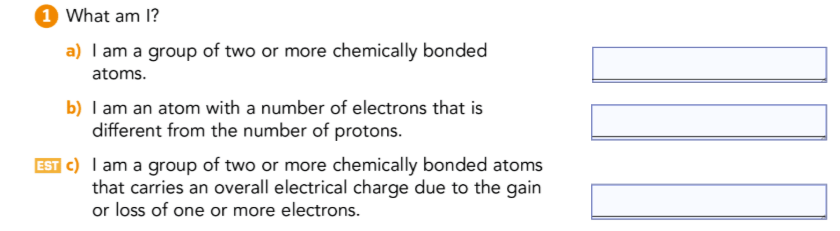
a) a group of chemically bonded atoms is called a molecule. Molecules are always electrically neutral (not positive nor negative) and can be formed with a covalent bond.
b) an atom with a number of electrons that is different from the number of protons is called an ion. There are two types of ions: cations (positive) and anions (negative). It is important to note that while the number of electrons can vary, the number of protons will always remain the same.
c) a group of chemically bonded atoms carrying an overall electrical charge due to the loss or gain of electrons is called a polyatomic ion, where the atoms are joined by a covalent bond, causing them to lose or gain electrons, hence giving the polyatomic ion an either positive or negative electrical charge.









Explanation verified by Alloprof
This Explanation was verified by a member of the Alloprof team.
Of course!
a) a group of chemically bonded atoms is called a molecule. Molecules are always electrically neutral (not positive nor negative) and can be formed with a covalent bond.
b) an atom with a number of electrons that is different from the number of protons is called an ion. There are two types of ions: cations (positive) and anions (negative). It is important to note that while the number of electrons can vary, the number of protons will always remain the same.
c) a group of chemically bonded atoms carrying an overall electrical charge due to the loss or gain of electrons is called a polyatomic ion, where the atoms are joined by a covalent bond, causing them to lose or gain electrons, hence giving the polyatomic ion an either positive or negative electrical charge.
Hope this helped!