Ce contenu est protégé par le droit d'auteur. Toute reproduction à l'extérieur des forums Alloprof est interdite et pourra être considérée comme une violation du droit d'auteur.
Ce contenu est protégé par le droit d'auteur. Toute reproduction à l'extérieur des forums Alloprof est interdite et pourra être considérée comme une violation du droit d'auteur.
On doit donc viser une concentration en chlore inférieure à: $$4\ \text{g} / 1\ 000\ \text{L}.$$









Explanation from Alloprof
This Explanation was submitted by a member of the Alloprof team.
Salut PapillonRose1268 😁
Merci pour ta question!
D'abord, revoyons l'équivalence suivante.
Ce contenu est protégé par le droit d'auteur. Toute reproduction à l'extérieur des forums Alloprof est interdite et pourra être considérée comme une violation du droit d'auteur.
On doit donc viser une concentration en chlore inférieure à: $$4\ \text{g} / 1\ 000\ \text{L}.$$
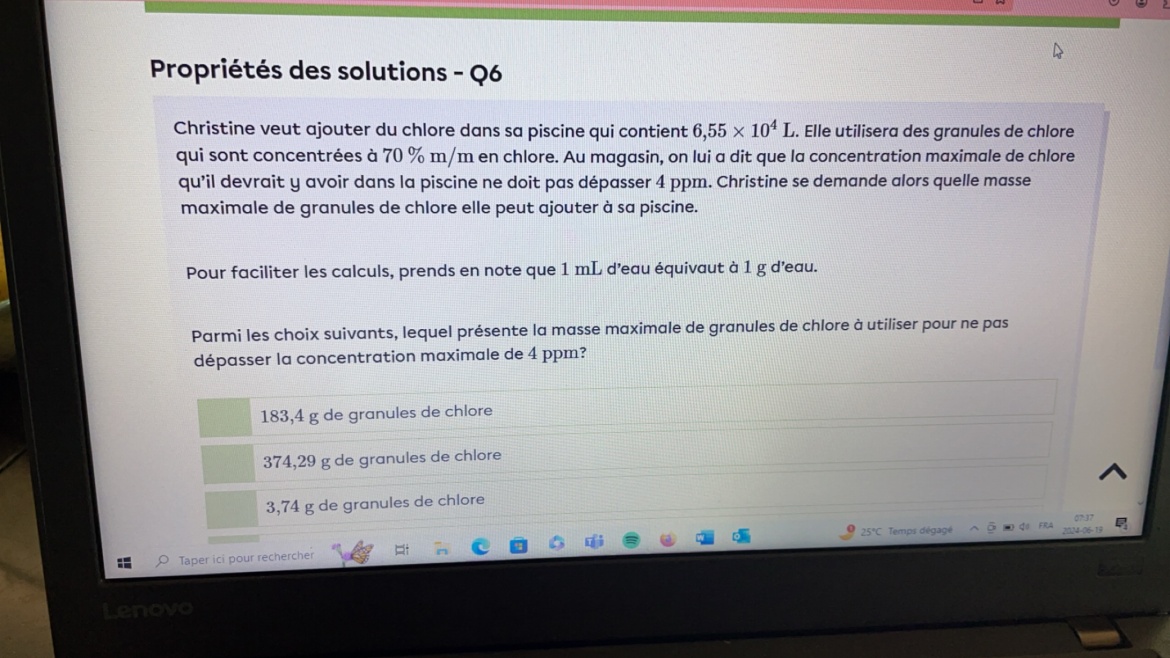
On a 6,55 x 10^4 L.
On doit alors ne pas dépasser:
$$\frac {4\ \text{g}} {1\ 000\ \text{L}} = \frac {\text {?}\ \text{g}} {6{,}55 \times 10^4\ \text{L}};$$
$$ \text {?} = \frac {4\ \text{g} * 6{,}55 \times 10^4\ \text{L}} {1\ 000\ \text{L}} = 262\ \text{g}.$$
Les granules de chlore étant concentrées à 70%, on peut atteindre une masse de:
$$\frac {70\ \text{g}} {100\ \text{g}} = \frac {262\ \text{g}} {\text {?}\ \text{g}};$$
$$\text {?}\ \text{g} = \frac {100\ \text{g}*262\ \text{g}} {70\ \text{g}} = 374{,}29\ \text{g}.$$
Cela veut donc dire que Christine doit mettre au maximum 374,29 g de granules dans la piscine pour ne pas dépasser la quantité de chlore recommandée.
N'hésite pas si tu as d'autres questions 😊
À bientôt 😎