Ce contenu est protégé par le droit d'auteur. Toute reproduction à l'extérieur des forums Alloprof est interdite et pourra être considérée comme une violation du droit d'auteur.
English is not my primary language but i'll do my best to assist you :)
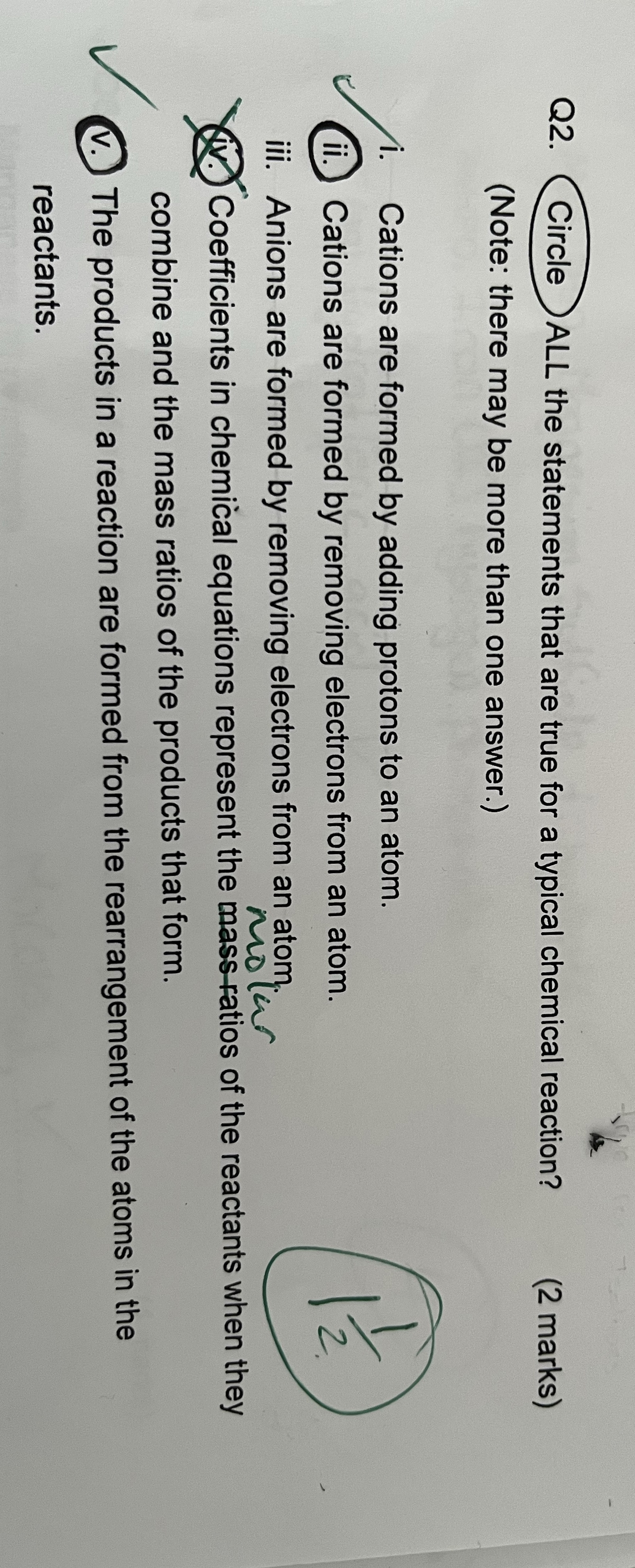
So the fourth statement is indeed incorrect, because the coefficient always applies for molar ratios.
It is because the mass isn't proportional in a reaction. For example, 100g of dihydrogen \(H_2\) has way more particles than 100g of difluor \(F_2\). You can determine that by using the formula :
$$ n = \frac{m}{M}$$
For the dihydrogen :
$$ n = \frac{100 g}{2,02 g/mol} = 49,5 mol$$
For the difluor :
$$ n = \frac{100 g}{38,00 g/mol} = 2.63 mol$$
But, when you say that you have 1mol of dihydrogen on one side and 1mol of difluor on another side, you have exactly \(6.022.10^{23}\) molecules for each side. And the coefficients will multiply this ratio and guarantee that all of our calculation stays proportionals.
I hope my explanation is helping you, feel free to write again if you have any other questions !
1
Suggestions en lien avec la question
Suggestion en lien avec la question
Voici ce qui a été trouvé automatiquement sur le site, en espérant que ça t’aide!










Explication d'Alloprof
Cette explication a été donnée par un membre de l'équipe d'Alloprof.
Hi EfficientEagle2708, thanks for your question !
English is not my primary language but i'll do my best to assist you :)
So the fourth statement is indeed incorrect, because the coefficient always applies for molar ratios.
It is because the mass isn't proportional in a reaction. For example, 100g of dihydrogen \(H_2\) has way more particles than 100g of difluor \(F_2\). You can determine that by using the formula :
$$ n = \frac{m}{M}$$
For the dihydrogen :
$$ n = \frac{100 g}{2,02 g/mol} = 49,5 mol$$
For the difluor :
$$ n = \frac{100 g}{38,00 g/mol} = 2.63 mol$$
But, when you say that you have 1mol of dihydrogen on one side and 1mol of difluor on another side, you have exactly \(6.022.10^{23}\) molecules for each side. And the coefficients will multiply this ratio and guarantee that all of our calculation stays proportionals.
I hope my explanation is helping you, feel free to write again if you have any other questions !
Suggestions en lien avec la question
Suggestion en lien avec la question
Voici ce qui a été trouvé automatiquement sur le site, en espérant que ça t’aide!