5 tips to help your child make everyday decisions

Article

Some children (and even some adults) have difficulty making choices and expressing what they want. The ability to make decisions is important for development, self-affirmation, and eventually, academic success. Your child is faced with choices every day, ranging from the trivial (such as what to wear or what ice cream flavour to get) to the very important (such as which path to follow after high school). This article provides tips to help your child develop confidence in their choices and incorporate winning strategies to make decision-making easier.

Promote self-esteem

Personality development is a lifelong process. This process is greatly influenced by our self-esteem, which helps us to become aware of our own value and to set healthy boundaries. Making decisions can be difficult for shy and introverted children. Because of their lack of self-confidence, they prefer to let others decide for them. They are more likely to say “I don’t know” than making a decision, since they fear that those around them might disagree.

You can help your child build their self-confidence so they can more easily express their preferences. They will become more comfortable making choices, even if they are different from yours. Here are some tips to help them:

  • Encourage your child to be themself and avoid comparisons with others
  • Share in your child’s joy when they feel proud 
  • Try to understand why your child is saying “no” or “I don’t know” when making a decision (provided they are not just acting out)
  • Listen carefully to what your child tells you
  • Remind them that their tastes and preferences are valid and do not have to be the same as other people’s
  • Etc.

Arrange and prioritize tasks

In order to effectively organize time and activities, the ability to make decisions is essential. Prioritizing tasks takes a good deal of judgment, initiative, and decision-making. All of these skills are key to academic perseverance. Children who have difficulty making decisions often do not know where to start. To avoid these moments of frustration, it might be practical to plan out their study, homework, and activity schedules the week before. Organizing tasks in advance, in a more neutral state of mind, can help deal with the immediate emotion they associate with each activity. When the time comes, your child will get to the task on their schedule instead of spending a long time determining which task to do first. Here are some tips for prioritizing tasks:

  • Plan the days when each step will be completed
  • Start with the longest or most difficult assignments
  • Start with the assignments that are due the soonest
  • Spend 10 minutes on each task and take a break between each one
  • Use our Motivational Timer to divide the work by subject
  • Create a work plan and arrange each step in a logical order
  • Etc.

Ask your child’s opinion

One way to strengthen your child’s decision-making skills is to give them frequent opportunities to make choices. For example, when choosing what to wear, you can say: “It’s nice out today. Would you rather wear your running shoes or sandals?”. This way, they are given only a few options from which to choose, limiting their hesitation while providing them with the necessary information.

This strategy can also be useful for scheduling tasks. For example, if you think your child needs a reward for their efforts, one idea to motivate them to do their homework is to tell them to write down each task or challenge of the day on small pieces of paper. They should also be allowed to write down one or two reward activities that they would like to earn. Put all the pieces of paper in a jar. Your child will pick a task (or a reward!) and then complete it (with a commitment to finish all the tasks in the jar, of course).

Determine what is negotiable

As you know, helping your child make decisions does not mean that they will always be the boss and decide to eat dessert instead of balanced meals, or to play instead of doing homework. Teaching your child to make decisions must take into account their ability to discern what is good from what is less so, and to prioritize what is urgent and what is not.

One way to help your child not only decide, but make informed choices, is to ask:

  • “What do you think is the best option?”
  • “Why do you think this is a good choice?”
  • “What will happen if you choose this?”
  • Etc. 

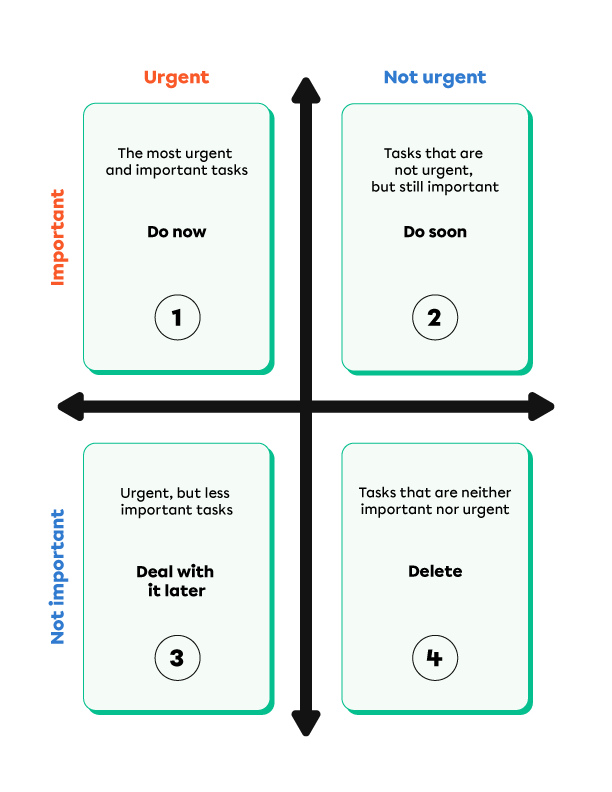
You can also show your child the Eisenhower Matrix to help them manage their priorities. The purpose of this method is to make choices more easily by visually organizing priorities.
 
As you will see, it is a very simple table:
aider-enfant-decisions-quotidien_EN

  • The horizontal axis represents the urgency of the tasks: urgent tasks on the left, non-urgent tasks on the right.
    • Quadrant #1 represents the most urgent and important tasks that absolutely must be completed.
    • Quadrant #2 contains tasks that are not urgent, but still important. Since they do not necessarily have an imminent deadline, it can be easy to put them off. To avoid this danger, these must be scheduled.
  • The vertical axis represents the importance of the tasks: the important tasks are on top, while the unimportant tasks are on the bottom.
    • Quadrant #3 corresponds to urgent, but less important tasks that can be postponed or given to someone else.
    • Quadrant #4 contains tasks or activities that are neither important nor urgent and therefore do not align with long-term goals. However, this is the quadrant where your child can put in their breaks. After all, they are well-deserved!

Consider pros and cons

No matter the situation, it is virtually impossible to gather all the information needed to make a decision. This can be intimidating for a child when faced with important decisions such as their program of choice in CEGEP or their path after high school (link in French only). Here are some ideas to help them decide:

  • Make a list of pros and cons.
  • Create a mind map to visualize all the options
  • Identify their strengths and weaknesses.
  • Resist the urge to over-analyze. By limiting reflection to the most important points, they can trust their intuition a bit more.
  • Understand the risk associated with not making a decision. When a decision seems difficult to make, it is tempting not to make one. However, not making a decision is already a choice in itself that will have consequences.
  • The most difficult decisions might be those for which there are two equally positive outcomes. In these cases, remind your child that this is an opportunity: no matter which option they choose, they cannot go wrong

Collaborators

Writing : The Alloprof Parents' team

References