Promoting Communication in Children with Developmental Language Disorder

Articles


Developmental language disorder (DLD) affects both language comprehension and expression. This can make it more difficult to communicate with and understand others. As a result, this disorder has repercussions not only on language skills, but also on social skills. Fortunately, there are simple tools and concrete ways to help your child alleviate or bypass these language challenges!
The Importance of Adapting Communication

The first key to helping a child with DLD understand what you’re saying is to adapt the way you communicate. Since the DLD brain is more susceptible to cognitive overload, it’s important to use clear and simple language to avoid confusion.

Tips and tools

Here are a few effective tips to help a child with DLD understand.

  • Give one instruction at a time.
  • Avoid using abstract words.
  • Use action verbs.
  • Use positive phrases.
  • Speak slowly.
  • Make eye contact.
  • Use non-verbal communication to make yourself understood.
  • Use short sentences and simple words.

These small adjustments make a big difference. They help children to better understand what is expected of them and learn to use their own words to express themselves.

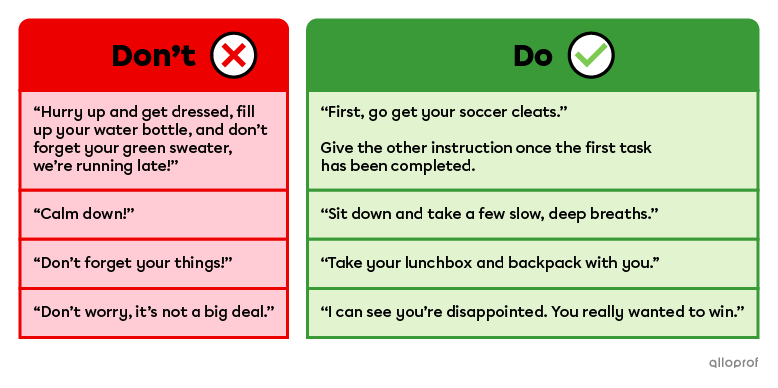
Here are a few examples of possible adaptations.

 Possible adaptations.
Tips and tools

It can also be helpful to use strategies to encourage or stimulate language expression in a child with DLD.

  • Let them answer at their own pace.
  • Give hints or sentence starters to help them find the right words.
  • Rephrase what they say to model more complex sentence structures.
  • Avoid making them repeat themself.
  • Ask open-ended questions.
  • Rephrase your child’s words to validate what they’re saying and model a richer vocabulary. 

Communication: The Key to Forging Relationships

DLD can make it more difficult to form personal relationships and social ties. In order to build relationships with others, children need to be able to hold conversations, understand others, and make themselves understood.

A child living with DLD may have struggle with the following:

  • Speaking when it’s their turn.
  • Approaching someone.
  • Recognizing and following social etiquette.
  • Decoding a person’s intentions.
  • Interpreting looks, silences, or tones of voice.

These cues are often implicit and vague. That’s why it’s important to explain them. Social skills are not innate, they are learned. They can be dissected, demonstrated, practised, and improved.

Tips and tools

You can help your child develop their social skills by teaching them what behaviour is expected in different contexts. You can show your child how to approach someone they don’t know, resolve a conflict, adapt to a new situation and so on.

Here are a few effective tips.

  1. Name the skill clearly: “Politeness.”
  2. Explain why it’s important: “Being polite shows that we respect the people around us.”
  3. Demonstrate how to do it: You can model the behaviour, roleplay, or use images.
  4. Give concrete examples: “When you run into your cousin on the street, you can say: ‘Hi! How are you?’”

Collaborators

This article was written in partnership with TDL Lanaudière, an organization that supports people with developmental language disorder (DLD), as well as their families, loved ones, and caregivers.

Consult the Regroupement TDL Québec to find organizations in your area. 

References