Developing vocabulary
Article
Update : April 2, 2026
Learning Together : An Initiative of the Institut des troubles d’apprentissage
Learning Together : An Initiative of the Institut des troubles d’apprentissage
A broad vocabulary is foundational when it comes to understanding a text and knowing how to correctly use words in a sentence. Learning a new word is a bit like mental gymnastics—it involves much more than straightforward memorization. You need to know its definition, some of its synonyms, recognize its class and gender, and so on. But don’t worry! The strategies in this learning sequence will provide you with the tools you need to help your child develop their vocabulary.
This sequence contains the following activities:
Learn more on the Institut des troubles d'apprentissage
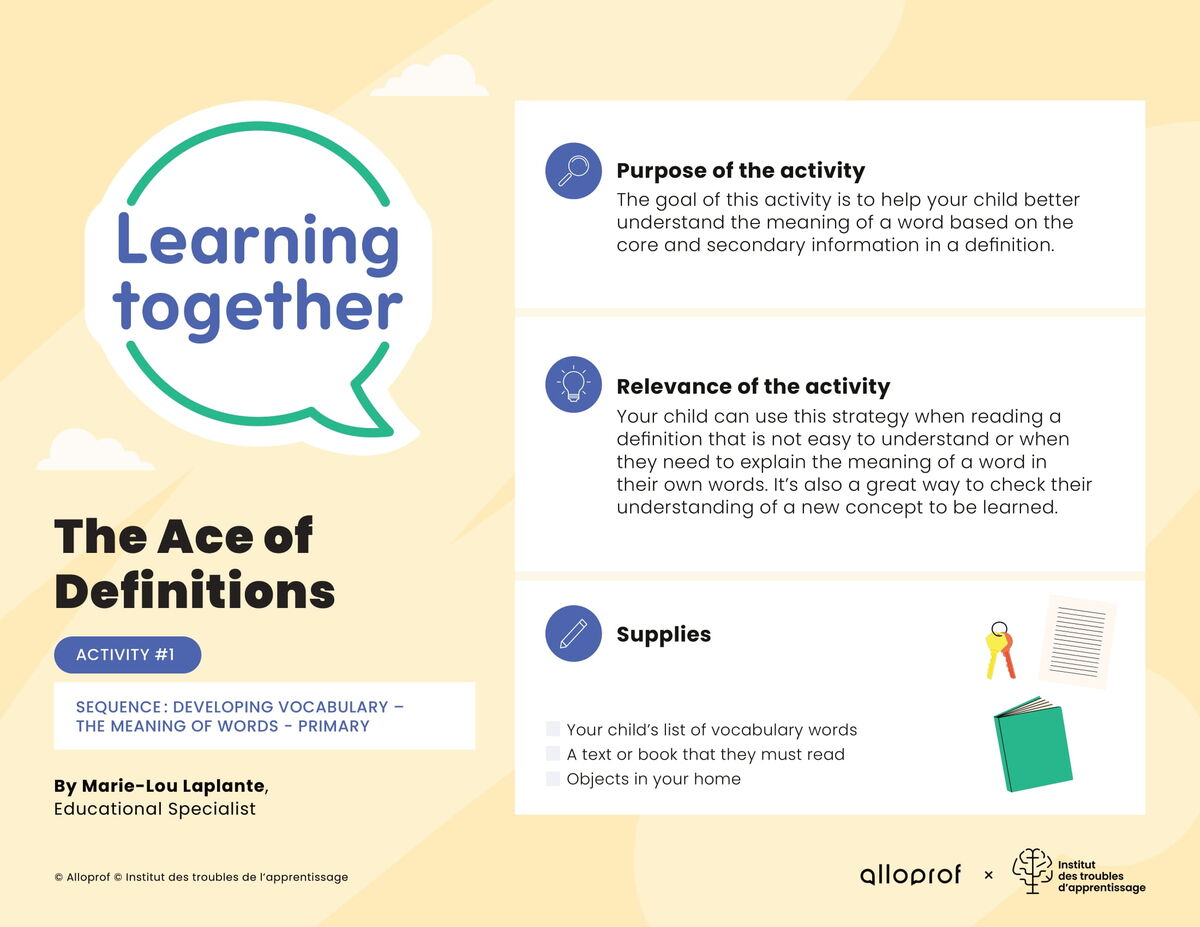
This activity is designed to help your child grasp the meaning of a word, not just from its definition, but also from context clues. By mastering this strategy, your child will be able to describe the meaning of a word in their own words. For tips you can use to help your child learn the definitions of words, check out this tool.
You will need:
Written by: Marie-Lou Laplante, resource teacher, Institut TA
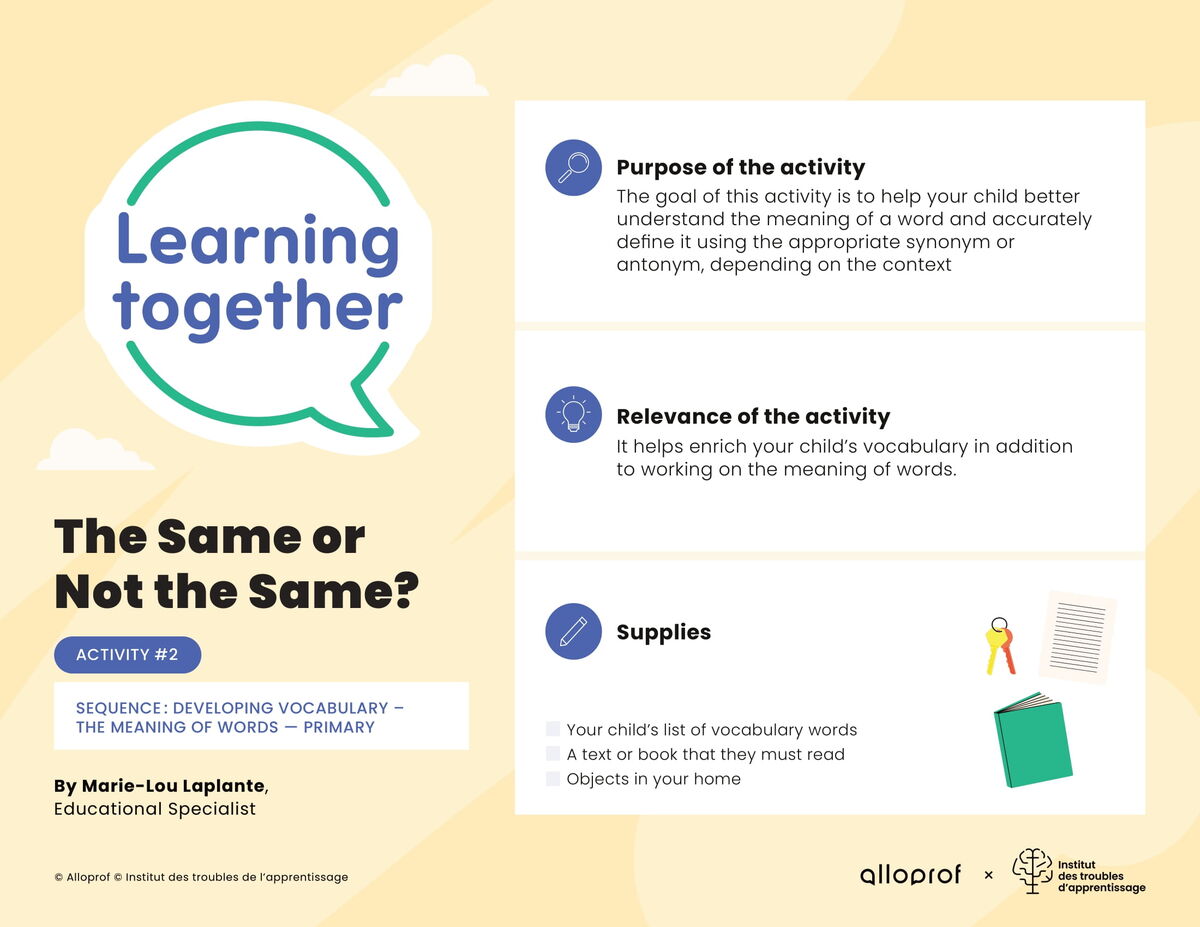
Helping your child understand the meaning of a word by using synonyms or antonyms is an effective strategy for broadening their vocabulary and improving their reading comprehension. By identifying words with similar or opposite meanings, children are encouraged to think about the nuances of meaning and develop their ability to choose the right word to express their ideas. This activity offers tips to help your child develop this skill.
You will need:
Written by: Marie-Lou Laplante, resource teacher, Institut TA
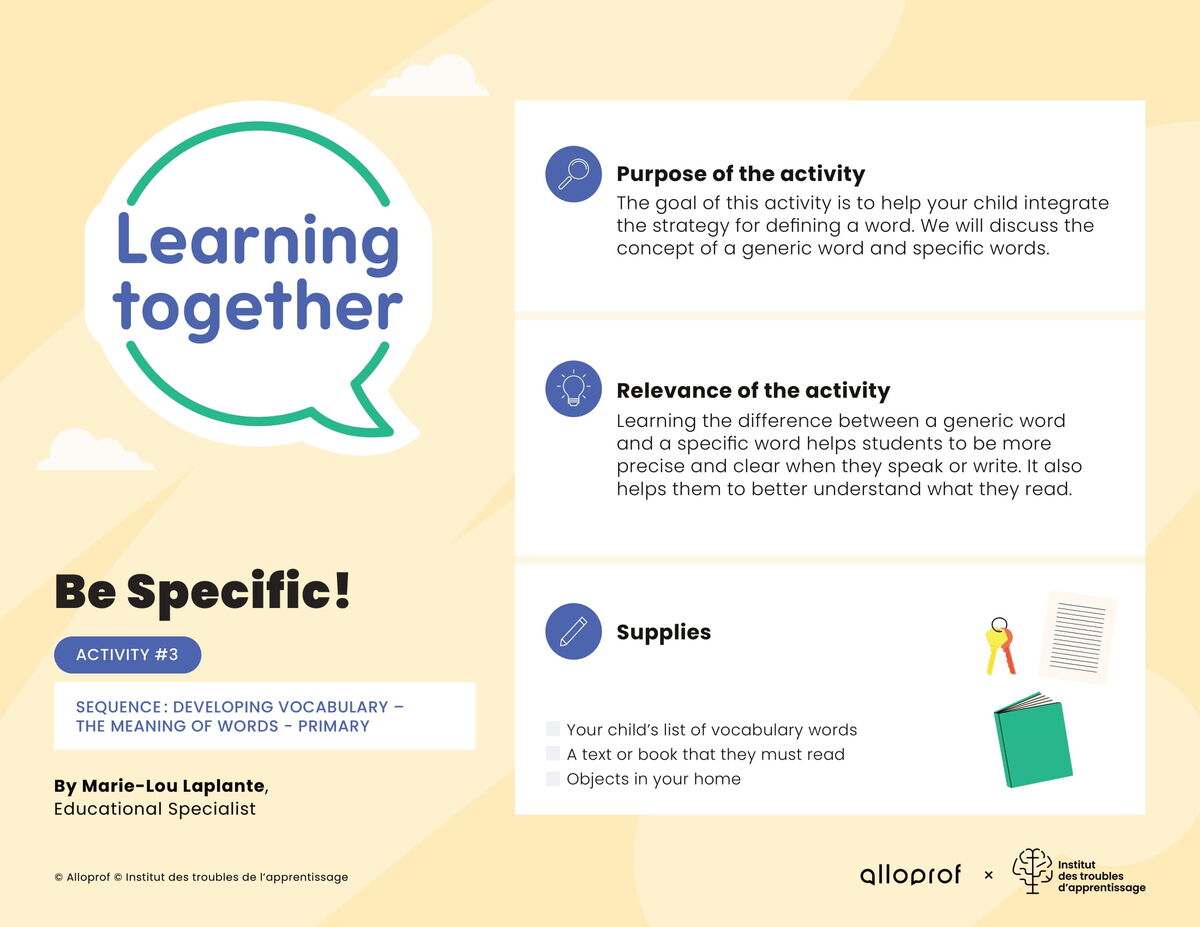
As your child learns to distinguish between generic and specific words, their vocabulary will become richer and more precise. Gradually, they’ll start to make connections between words and classify them in the appropriate categories. For example, it will become natural for them to classify the specific word sock under the generic category of clothing. This activity offers practical tips to help your child use more precise vocabulary.
You will need:
Written by: Marie-Lou Laplante, resource teacher, Institut TA
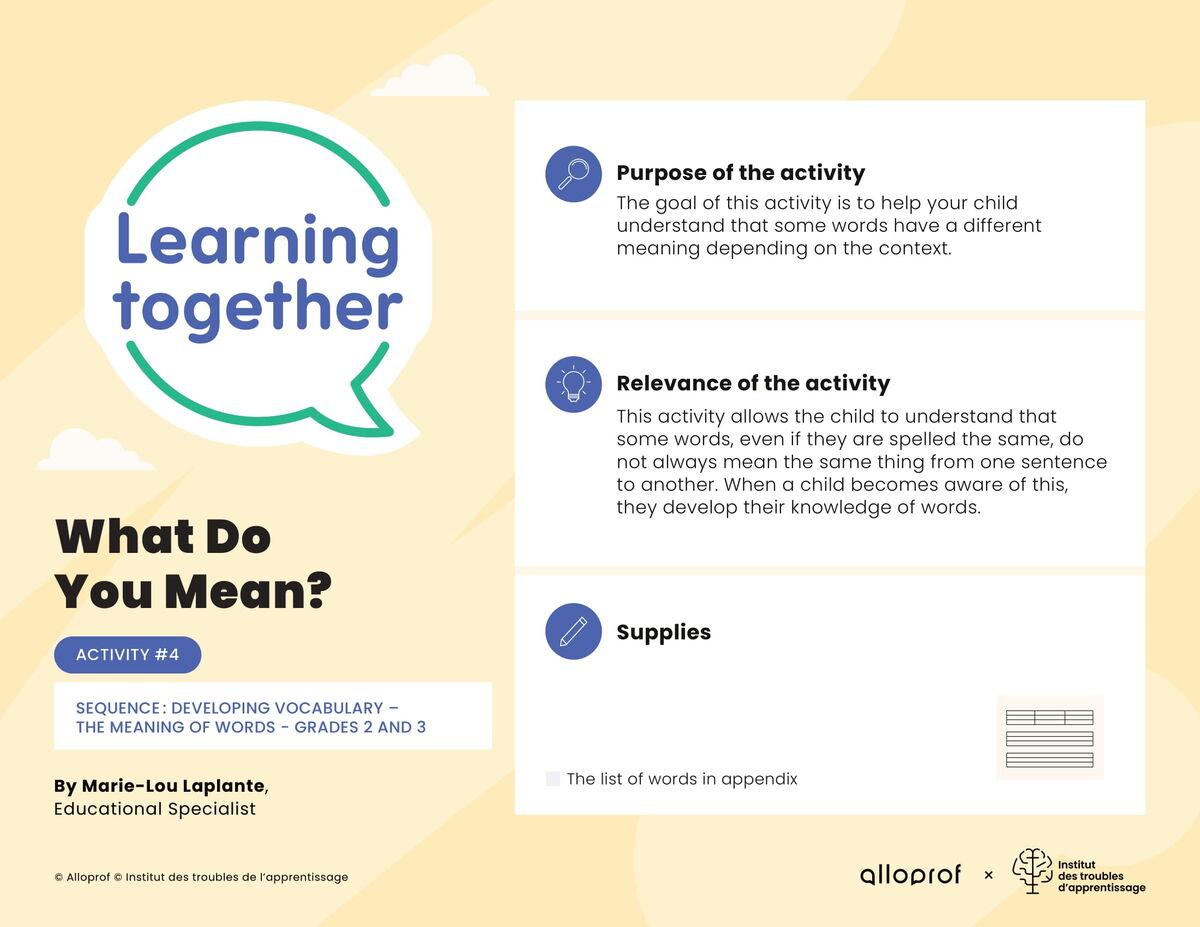
This activity will teach your child that some words can have different meanings depending on the context in which they are used, even if they’re spelled the same way. The word work is a good example: It can be used as a common noun such as when you do your work in school, but also as a conjugated verb, such as in the phrase “He works at the bank.” Feel free to encourage your child to look words up in the dictionary to expand their vocabulary. It’s a winning formula for choosing the right words!
You will need:
Written by: Marie-Lou Laplante, resource teacher, Institut TA
Activity # 5 : Attention to Details!
Recognizing that every word has a unique shape (spelling) is essential to learning to read and write. In this activity, your child will be encouraged to pay close attention to the spelling of words. The proposed strategies will help them build a good mental image of words, which in turn will improve their reading fluency.
You will need:
Written by: Marie-Lou Laplante, resource teacher, Institut TA
This activity is designed to help your child recognize clues in the way words are formed. These strategies will help your child make an educated guess about the meaning of unfamiliar words. For example, they’ll be able to recognize words with similar parts, such as words belonging to the same family.
You will need:
Written by: Marie-Lou Laplante, resource teacher, Institut TA
The purpose of this activity is to help your child learn that there are natural word associations in every language. This understanding is crucial for making choosing the right words, broadening our vocabulary, and properly organizing the words in a sentence.
You will need:
Written by: Marie-Lou Laplante, resource teacher, Institut TA
For a young child, it is natural to write using the same language register they would use when speaking. However, writing requires its own tone and register. The purpose of this activity is to make your child aware of these nuances so that they can adapt their writing style to the context, while using more precise and appropriate words.
You will need:
Written by: Marie-Lou Laplante, resource teacher, Institut TA