Subjects
Grades
 100%
100%
 100%
100%
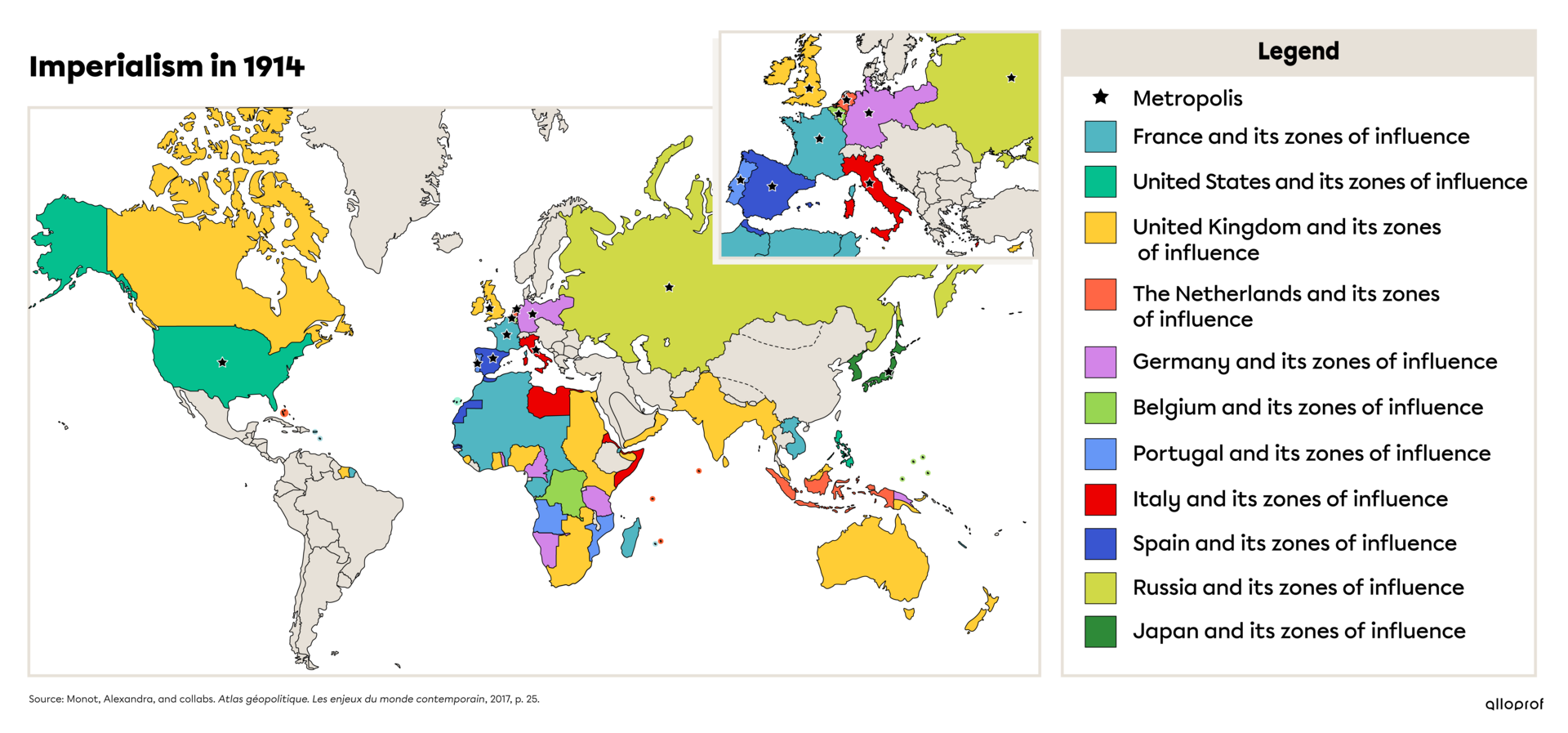
From the 19th century until the second half of the 20th century, European nations expanded their territory around the world by creating new colonies. The political and economic consequences of colonialism are still felt today.
Colonialism is a policy based on the occupation and economic, political or social exploitation of a territory by a foreign state.

Colonization is the act of taking possession of a foreign territory in order to exploit its resources.
During the 19th century, at the height of industrialization, the European powers launched a new colonization movement. This was largely due to their high need for raw materials.
For more information on industrialization, see the concept sheet on the industrialization of Great Britain.
This new wave of colonization affected Africa and Asia among other places. Some resources, such as cotton, did not exist in Europe. Others could be produced in the colonies at much lower costs, especially since labour was paid at a lower price. European countries, known as mother countries, colonized Africa to exploit its natural resources. These resources were turned into raw materials used by factories in Europe to manufacture various goods.
A mother country is a state that owns and administers its colonies, which involves exploiting territories outside its own country.
A colony is a territory governed and exploited by a foreign state.
By taking possession of new territories, European countries (mother countries) not only took advantage of new resources, but also gained access to new markets to sell the increasing number of products manufactured in their factories. This is because most mother countries forced their colonies to only trade with them. This meant that the colonies had restricted trade opportunities.
People living in a British colony could only buy the products they needed from British companies. This benefited the mother country because its companies sold more products.
By obtaining the raw materials they needed at a low cost and having markets to sell their products, European companies contributed to creating wealth in European countries. Exploiting the colonies was therefore beneficial for European countries.
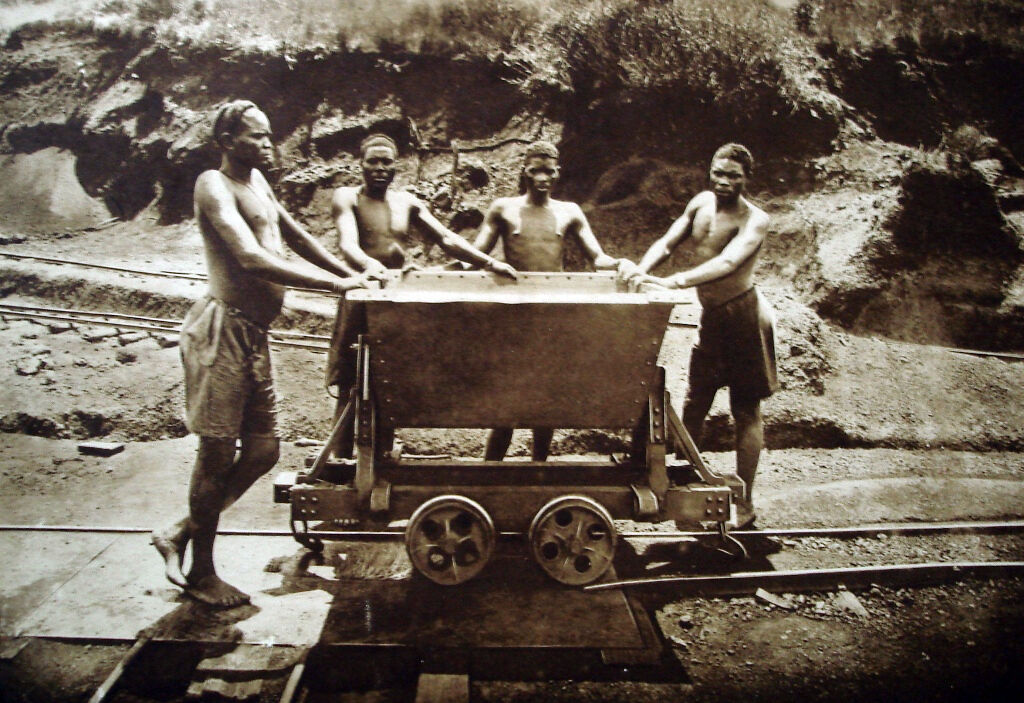
Rwandan Workers in a Copper Mine, Katanga (Belgian Congo)
Source: Ruandese workers at the Kisanga copper-mine, Katanga, Belgian Congo, Anonymous, Katanga, Copperbelt, 1928.
For mother countries, increasing the size of their territories around the world was a way to gain prestige and power. In addition to controlling the economy, they also controlled the politics of their colonies. Colonies could not make their own decisions and had to defer to their mother country.
The increased wealth generated by owning colonies also created powerful armies to:
ensure industrial production of the necessary material
pay salaries
transport equipment and people around the country and abroad
The mother country could use its armies to expand and maintain its colonial territory.
Taking possession of new territories allowed mother countries to access new resources to supply their factories and, in doing so, create significant wealth. Increased wealth allowed a country to develop and equip a more powerful army to help the expansion of its colonial territory. This expansion gave the mother country more prestige and access to more resources. Each of these factors benefited the mother country and contributed to the creation of more wealth.
However, during the 20th century and especially after World War II, colonialism was criticized and major waves of decolonization took place.
Sudan’s history dates back to the 2nd millennium BCE. Several civilizations have called the territory home over the years. In 1885, Sudan gained its independence from the Ottoman Empire, but thirteen years later, a military expedition formed by the United Kingdom and Egypt took the country. The purpose of this expedition was to prevent France from taking control of Sudan in order to build a dam on the Nile. Building a dam on the region’s main water source would have greatly reduced the water supply of Egypt, which was occupied by the United Kingdom at the time. The United Kingdom wanted to protect its interests in Egypt while also exploiting Sudan’s natural resources.
Egypt and the United Kingdom jointly administered Sudan. British authorities worked to improve means of transport (especially the railroad network) and communication in order to facilitate the exploitation of cotton, an important resource that was exported to Europe by ship.
Sudan gained its independence in 1956 at the same time as several other African countries.
Giguère Groulx, Jean-Félix and Marie-Hélène Laverdière. Immédiat. Richesse, 2017, p. 20-23.
Ladouceur, Maude and Alain Parent. Globe. Cahier d’apprentissage, 2014, p.146-147.
Monot, Alexandra, and collabs. Atlas géopolitique. Les enjeux du monde contemporain, 2017, 240 p.