A Survival Guide to Effective Note-Taking

Concept sheet | Study tips

Have you ever wondered why your teachers say it’s important to take notes? Do you want to take good notes, but don’t know how? Taking notes is an important skill that will help you better understand class material or a text you’re reading, as it allows you to describe concepts in your own words. But how do you take good notes? Read on for a ton of tips!

A Survival Guide to Effective Note-Taking

Why to Take Notes

You might think that listening carefully to your teacher is all you need to do to remember the class material, but in reality, we only retain: 

  • 10% of what we read
  • 20% of what we hear
  • 40% of what we see
  • 60% of what we hear and see at the same time (like in videos)
  • 80% of what we do (speaking, writing, etc.)
  • 90% of what we teach others

If you do a little math, that means that note-taking increases your information retention by 60%, since you’re writing while you’re listening to your teacher. Not bad, eh?
Another way to boost your information retention is to take notes in class, then explain what you learned in your own words to a classmate, someone who asked a question in the Alloprof Help Zone, or a family member. Here are some other benefits of taking notes:

  • It keeps you focused during the lesson.
  • It helps you organize information.
  • It’s an active learning strategy that requires you to engage with the material.
  • It helps you save time when reviewing key information.
  • Etc.

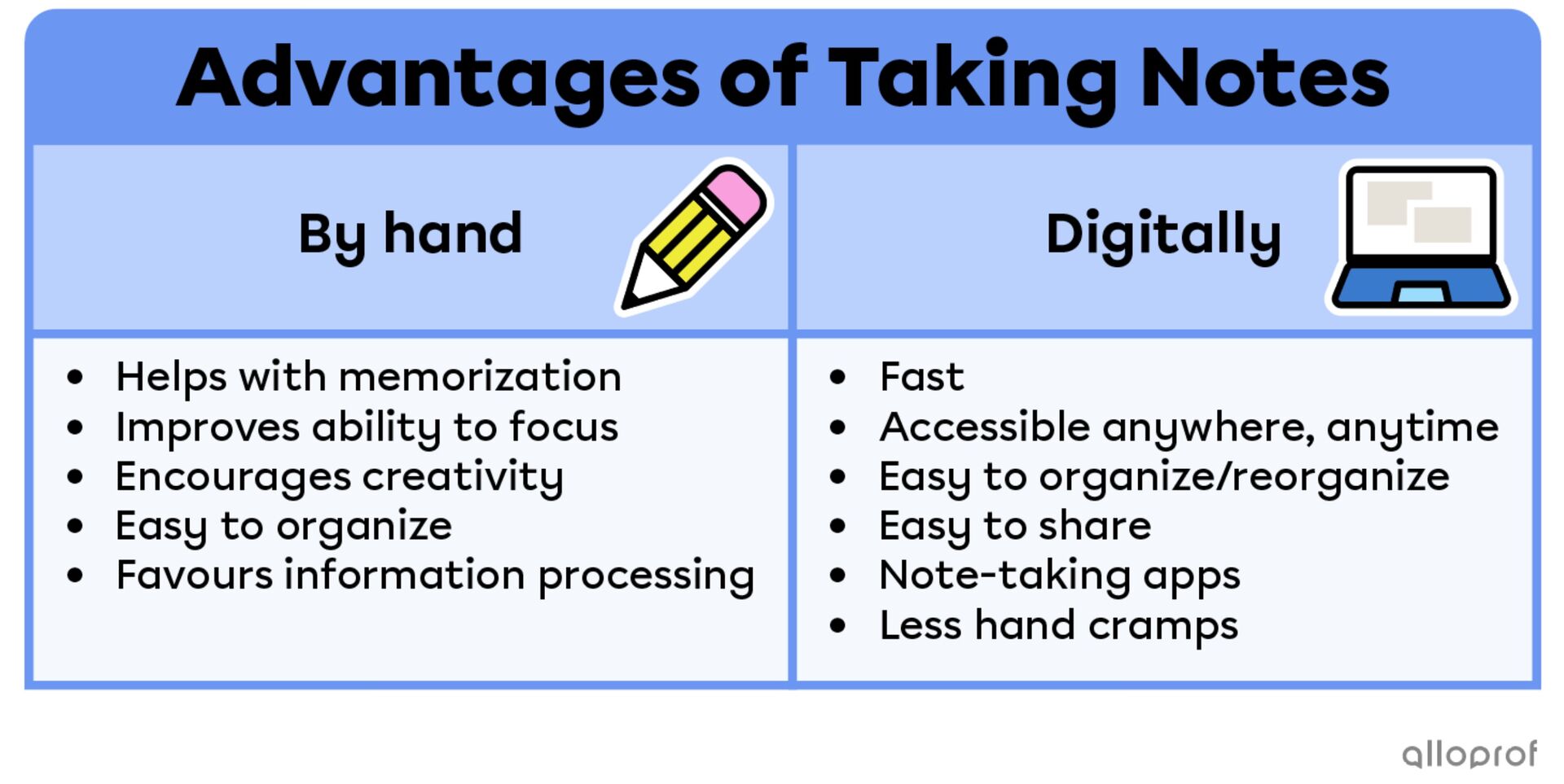
The benefits of taking notes by hand vs. digitally

the benefits of taking notes by hand vs digitally.

Preparing to Take Good Notes

It’s important to get ready to take notes before class by following these steps:

  • Pre-read textbook sections on upcoming material and reread your notes from the last class.
  • Get your supplies ready: loose leaf paper, notebooks (handy so you don’t lose anything), pencils, highlighters, sticky notes, rulers, etc.
  • Maintain healthy sleep habits, get enough exercise, and eat a balanced diet to boost your focus.
  • Be prepared to sit up straight, keep your pencil in hand, and keep your eyes on the teacher (watching their body language will also help you learn!).

What You Should (and Shouldn’t) Write Down

Taking notes is an art. Think of it like this: if you highlighted a whole page in your textbook, you wouldn’t know what’s important. Similarly, you shouldn’t write down everything your teacher says during a lesson. Plus, writing so much would make your hand hurt. Here are a few reasons why you shouldn’t write down everything you hear:

  • It breaks your concentration and makes it harder to follow what your teacher is saying because you can’t write as fast as they’re speaking.
  • It makes it harder to tell which information is important.
  • It makes it harder to retain key concepts.
  • It tires out your writing hand.

Here are a few rules of thumb for what to write in your notes: 

  • Things your teacher emphasizes with their tone of voice, gestures, or words—for example, they might say “This will be on the exam,” “Make sure to write this down,” or “This is an important example”
  • Things your teacher emphasizes or repeats, and anything they write in bold or highlight with another colour
  • Important dates, names, formulas, definitions, and facts
  • Examples
  • Concepts you’re having trouble with

Note-Taking Methods

Below, we describe a few of the most popular and effective methods for taking notes, but remember that you can always adapt them or come up with your own strategy that works for you. Tip: Click the links to download ready-to-use templates for each method!

  • The Cornell method. This simple structured method helps you improve your concentration and information retention. For this method, use our template or divide a large sheet of loose leaf paper into four sections:
    • Write the date and the subject or topic in the section at the top of the page.
    • Use the Summary section at the bottom to summarize the lesson after class.
    • In the smaller left-hand section, record questions (review questions or questions that might come up on the exam) and key concepts to study.
    • Use the larger right-hand section to take notes during class. 
  • K-W-L charts. K-W-L charts are used before, during, and after class (or while reading a text) to note down information that we know, want to know, and have learned about a topic.
  • Mind map. Creating a mind map is an ultra effective way to retain or organize information after class. With a mind map, you can structure, visualize, represent, and review the primary and secondary ideas (also known as branches) of different concepts in a creative way.
  • Sketchnoting. This method is ideal for people who are bursting with creativity: If you like drawing and hand-lettering, this method is for you. Sketchnoting is a way to take notes using visual elements such as drawings, calligraphy, and colours. Here are some visual elements you can use:
    • Embellished text: Set titles and key concepts apart with bold text, bubble letters, shading, or capital letters.
    • Basic shapes: Use simple geometric shapes such as rectangles, circles, and triangles. These shapes can be used as containers to group similar ideas. You can also draw bubbles, boxes, clouds, and banners.
    • Connectors: Use these to link ideas together. Dotted lines, arrows, and paths can be used to connect one concept to another.
    • Icons and pictograms: Make sure they’re easy to draw.
  • Venn diagrams. Venn diagrams are illustrations of two or more partially overlapping circles. They are used to visually represent the differences and similarities between two or more concepts.

Helpful Tips for Taking Notes

The first step is to make a general outline of the class, with the date, title, subheadings, etc., clearly marked. Remember to sharpen your concentration so that you can briefly transcribe what your teacher has said. You don’t have to write down every word!   Remember:

  • Leave space around your words, your lines, and different concepts to make your notes easier to read and skim.
  • Pick the right paper and writing utensil to make your notes easier to read. If you tend to write big, use wide-ruled notebook paper. If you tend to write small, use pencils, pens, and markers with finer points.
  • Use abbreviations, symbols, and colour-coding to speed up your note-taking. We recommend that you always use the same abbreviations and codes, so it’s easier to decipher your notes later!
  • Organize your notes into main ideas, key concepts, examples, keywords, etc. Use a different text or highlight colour for each section of your notes. For example, make headings red, subheadings green, examples blue, and dates purple.
  • Make a habit of reading over your notes after class. This makes it easier to remember important points you may have otherwise forgotten.
  • Compare your notes with those of your classmates. This can help you add details, fill in any missing information, and check your understanding of the material. Your classmates may have noted down different information or understood something you didn’t. But be sure to check with your teacher if you’re unsure about anything.

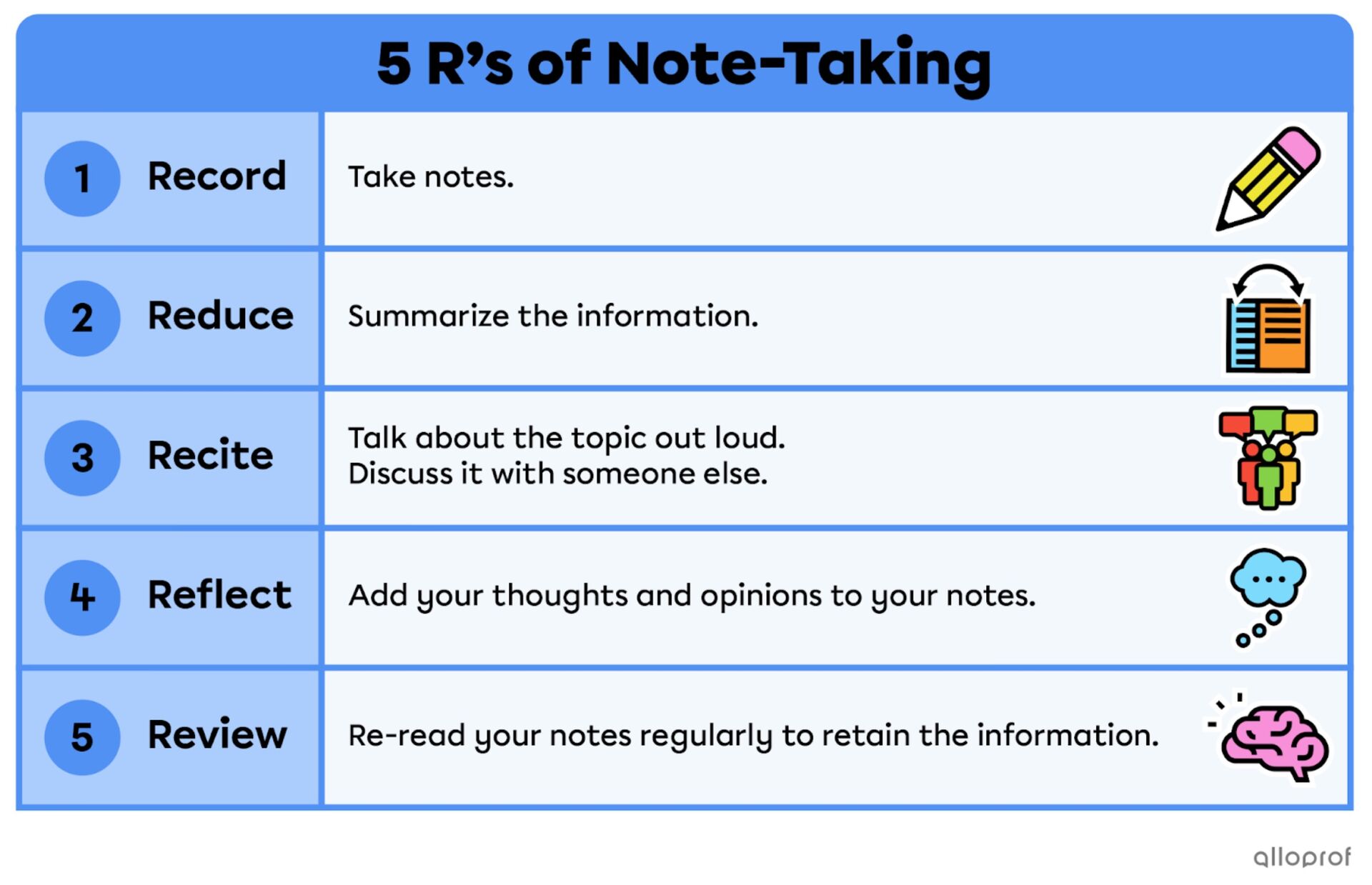
The 5Rs of note-taking

checklist

Symbols and Abbreviations to Speed Up Your Note-Taking

The following table has helpful abbreviations and symbols you can use to speed up your note-taking. Make sure you’re familiar with them so you can understand your notes when you read them over later. You can also use your own symbols (like asterisks) to mark information that you don’t fully understand or keep track of questions you want to ask your teacher.

Abréviation Définition
tdy today
i.e. that is
chap. chapter
comm. communication
behav. behaviour
w/o without
ex. example
b/c because
no. number
pt. point
prob. problem
b/4 before
rpt report
re: regarding, about
imp. important
vs. versus, as opposed to
etc. etcetera
Symbole  Définition
± more or less
= means, is
does not mean, is not
man
woman
interaction, interdependence
increased, increasing, goes up, rises
decreased, decreasing, goes down, falls
> bigger, higher, greater than
< smaller, lower, less than
? question, why
approximately
same as above
.·. therefore
- without
# number
yes, proven, correct

Adapted from: Dionne, B. Pour réussir. Guide méthodologique pour les études et la recherche, 5th edition, Beauchemin, 2008

References