The life-changing magic of using an agenda

Concept sheet | Study tips

Which of the following best describes your main strategy for staying organized?

A. I have a good memory, so I don’t need to write anything down. (Wait, when was that project due again?)

B. I make notes on scrap paper, Post-its, or the last page of a notebook. The important thing is to have key dates written down somewhere, right?

C. I use an agenda.

If you answered C, chances are you already know that our memory can only hold onto so much information, and that making scattered notes on bits of paper isn’t the most reliable way to stay organized. In this article, we’ll explain how to transform your agenda into the ultimate organizational tool!

The life-changing magic of using an agenda

What to write in your agenda

The first thing you should write down is your contact information! You don’t want to lose all of your important notes if you misplace your agenda. Writing down your contact information will ensure that whoever finds it has a way to get it back to you. Don’t forget that your agenda is even more useful if you keep it on hand at all times. Think of it as your personal assistant!

Here are the dates and other information we strongly recommend making note of in your agenda:

  • Assignments
  • Homework and lesson review
  • Tests and exams
  • Appointments
  • Trips
  • Tutoring sessions
  • Assigned readings
  • Sports practices
  • Extracurricular activities
  • Detentions and remedial classes
  • Hobbies
  • Your work schedule
  • Things to bring to class
  • Everything your teacher asks you to do
  • Etc.
Important!

As you can probably tell, an agenda is not a diary, sketchbook, or photo album. It’s a valuable tool that should be kept safe, well organized, and in good condition. If you like to doodle, it’s best to keep a separate notebook specifically for your artwork.

Planning enough time for all your activities

It’s a good idea to write your class schedule in your agenda on the first day of school. This will be your reference point for planning out each day. Here are some tips to help you organize your schedule:

  • Establish a homework routine and an after-school routine. Remember to take breaks into account in addition to your schoolwork.
  • Use colours and highlighters to make urgent tasks stand out and to distinguish between activities and subjects.
  • Use easy-to-remember abbreviations and symbols to maximize space.
  • Try to estimate how long each task will take to make your schedule as accurate as possible. This will also give you an idea of the total time you’ll need. If exams are coming up, you can use this tool to organize your study time.
  • If you know certain assignment deadlines or test/exam days in advance, mark the dates in your agenda (use sticky tabs if needed).
  • Mark the current page in your agenda with a paperclip so it’s easy to find.
  • Check off your daily tasks to make sure you don’t forget anything. (It’s also very satisfying!)
  • Be realistic about balancing your week. For example, since one week has 168 hours, you might set aside 60 hours per week for rest and 12 hours for homework and studying. Remember to take travel time, hobbies, meals, etc. into account.
Find out more!

In Quebec, students are not allowed to do more than 17 hours of paid work per week (10 hours max between Monday and Friday). Don’t be afraid to remind your employer if necessary!

Completing tasks in order of priority

Time management strategies can help you prioritize your tasks. Here are a few examples:

  • Divide long-term tasks into sub-tasks. You can alternate between them or take a short break after each one.
  • Plan to do a bit of work every day.
  • For maximum efficiency, aim to do intellectual tasks (homework, reading, etc.) when your concentration level is at its highest. When you’re feeling less focused, you can switch to something else.
Find out more!

Everyone is different when it comes to when and for how long they’re able to concentrate. Feel free to experiment with your study schedule to learn what works best for your brain and body!

  • Start with the task that you want to do least. Once you’ve gotten it out of the way, you’ll feel more motivated to tackle the rest of your to-do list.
  • If you have trouble deciding which task to start with (provided they’re all equally important), try writing each one on a piece of paper and then drawing them at random.
  • Take inspiration from the jar of life metaphor. To get through everything you need to do in a day, you should take care of urgent tasks (big rocks) first. Filling up your day with minor tasks (pebbles and gravel) leaves no room for the important stuff.

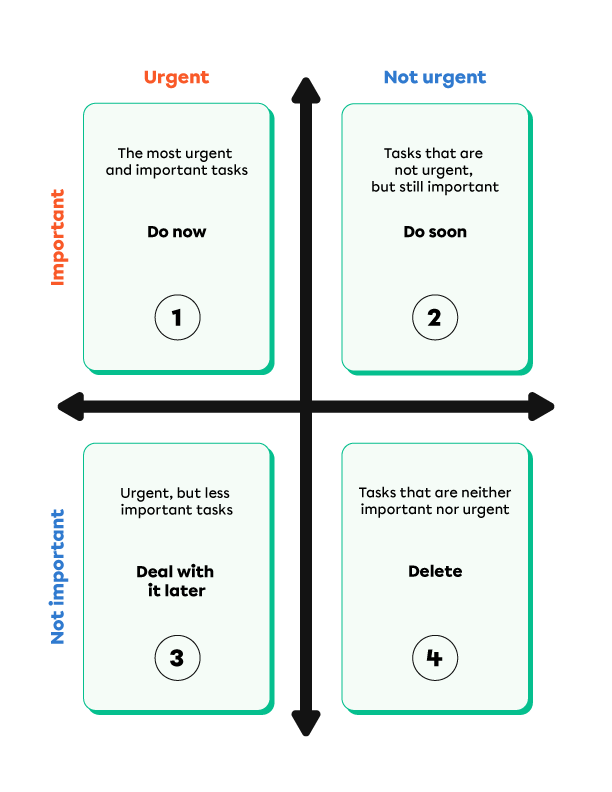
Using the Eisenhower Matrix

The purpose of this method is to make decision-making easier by visually organizing priorities.
As you can see, the matrix is a very simple table:
aider-enfant-decisions-quotidien


  • The horizontal axis represents the urgency of the tasks: urgent tasks are on the left, while non-urgent tasks are on the right.
    • Quadrant 1 corresponds to the most urgent and important tasks that absolutely have to get done.
    • Quadrant 2 corresponds to tasks that are non-urgent, but still important. Since these tasks don’t necessarily have an imminent deadline, it can be easy to put them off, which is why they need to be scheduled.
  • The vertical axis represents the importance of the tasks: important tasks are on top, while unimportant tasks are on the bottom.
    • Quadrant 3 corresponds to tasks that are urgent, but less important. These can be given to someone else or done when you’re feeling a little more tired.
    • Quadrant 4 corresponds to tasks or activities that are neither important nor urgent and therefore do not align with long-term goals. This is the quadrant where you can put breaks. After all, they’re well deserved!

References