Subjects
Grades
 100%
100%
 100%
100%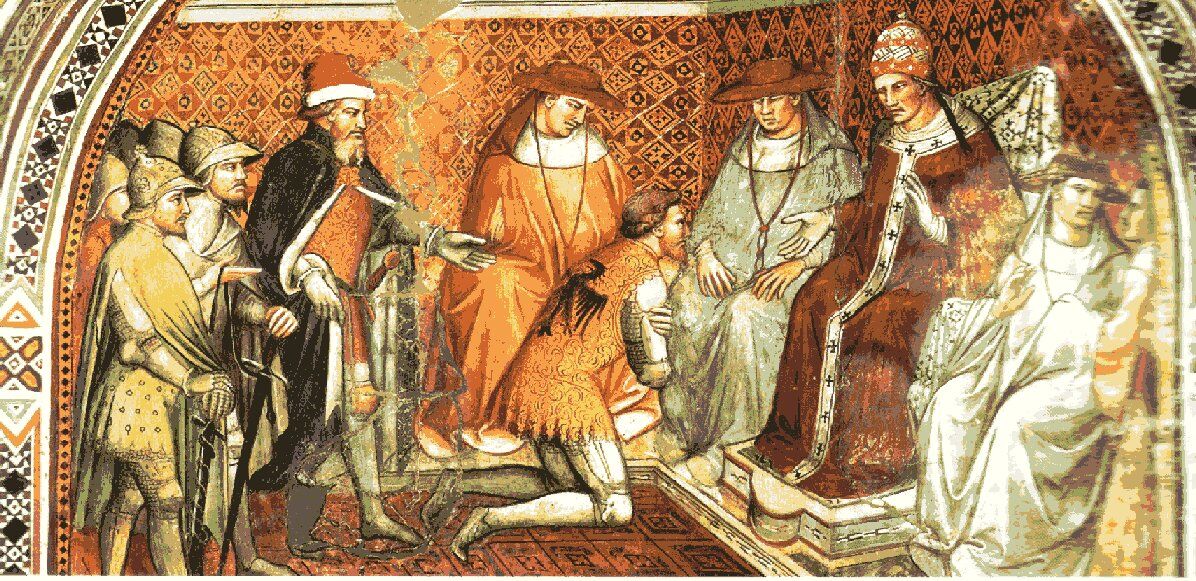
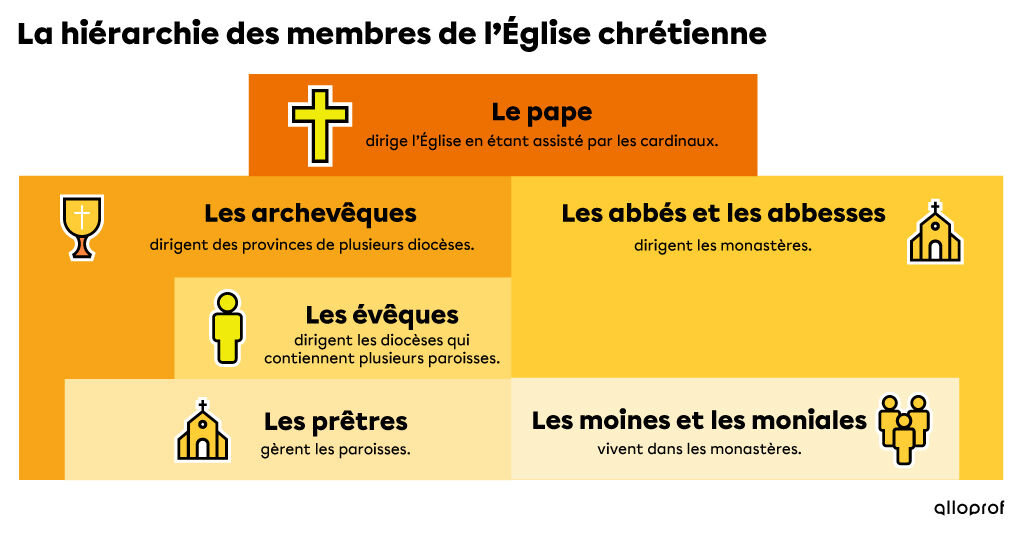
During the Middle Ages, the Christian Church organised itself and became a power not only in religious matters, but also in the economic and political spheres. Its influence grew steadily throughout the Middle Ages, as the Church owned a great deal of land and made fortunes from it, and allied itself with powerful kings. To continue this growth, its organisation and hierarchical structure were essential.
The Christian Church is a highly organised and hierarchical institution, meaning that there is a strict organisation in which each representative exercises authority over others.

The Holy Roman Emperor recognising Alexander III as Pope.
In the Middle Ages, the papal office was essential to the spread of Christianity. The Pope, assisted by special advisors called cardinals, made decisions that all the faithful had to respect, whether they were lords, priests or peasants. These decisions may concern the interpretation of the Bible or religious festivals. Over the centuries, the Pope became the supreme head of a complex institution made up of many groups to be governed. These included parish priests and monastic orders.
Many monastic orders were created during the Middle Ages. These orders were groups of monks or nuns who lived according to strict, communal Papal edict.
These different religious orders performed a wide variety of functions and activities that helped spread Christianity in the West. Some had intellectual tasks, such as writing and copying religious books or setting up the first universities. Others had tasks related to the well-being of the people, such as welcoming pilgrims and caring for the sick. Still others went into battle, particularly during the Crusades. Many monks and nuns devoted their lives to God in the Middle Ages.
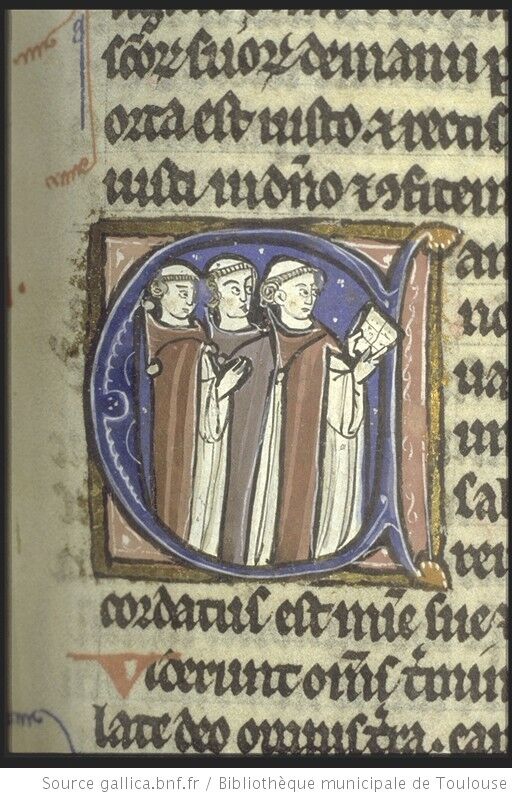
Illumination Showing Monks
| Contemplative Orders |
Their aim is union with God through prayer and isolation from the rest of the world. |
|
|---|---|---|
| Military Orders |
These monks fought to defend Christianity, including during the Crusades. |
|
| Mendicant Orders |
Mendicant orders are different from other orders in that they own no property and depend on the generosity of others. They are dedicated to the poor. |
|
| Apostolic Orders |
Their aim is union with God through mutual aid and service to others. |
|
Seigneurial dues were another important source of income for the Church, since it owned several seigneuries. It could therefore benefit from their revenues. These royalties took several forms. Firstly, there was the cens, which was an amount of money that a peasant had to pay to his lord or seigneurs. Cens is linked to the tenure (farmland) granted to the peasant by the lord or seigneurs. Forced labour is another form of payment and corresponds to days of compulsory work for peasants, during which they carry out tasks for their lord or seigneurs on his land. There were also other forms of royalty, such as taxes on the use of mills, ovens and wine presses.
These multiple forms of revenue enabled the Christian Church to become an economic power in Europe.
Author unknown (1250-1300). Monk [Illumination]. Bibliothèque nationale de France. https://gallica.bnf.fr/ark:/12148/btv1b10574643v#.
Spinelli, L. (14th or 15th century). Frederick Barbarossa submits to the authority of Pope Alexander III [Fresque]. Wikimedia Commons. https://commons.wikimedia.org/wiki/File:B_alexander_III2.jpg?uselang=fr.