Subjects
Grades
 100%
100%
 100%
100%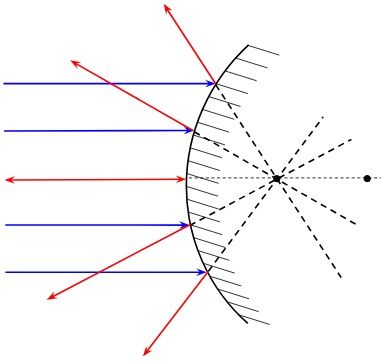 100%
100%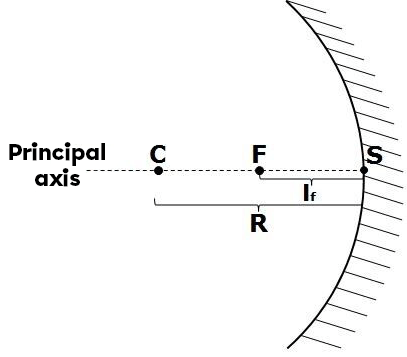 100%
100%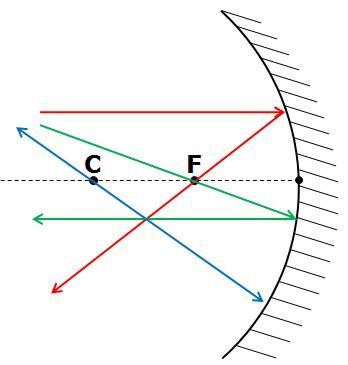 100%
100%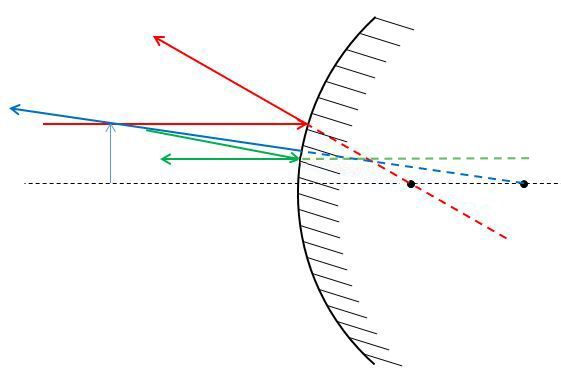 100%
100%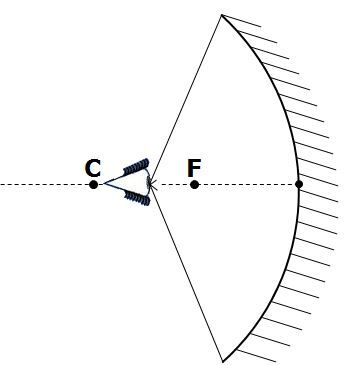 100%
100%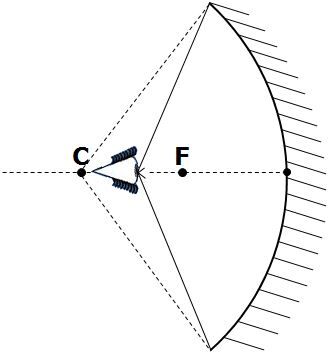 100%
100%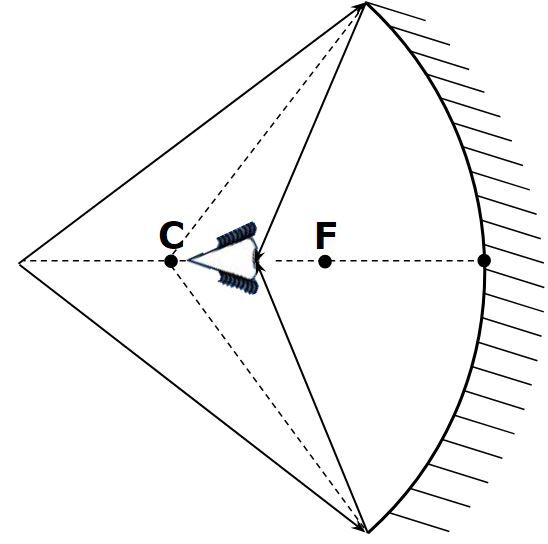 100%
100%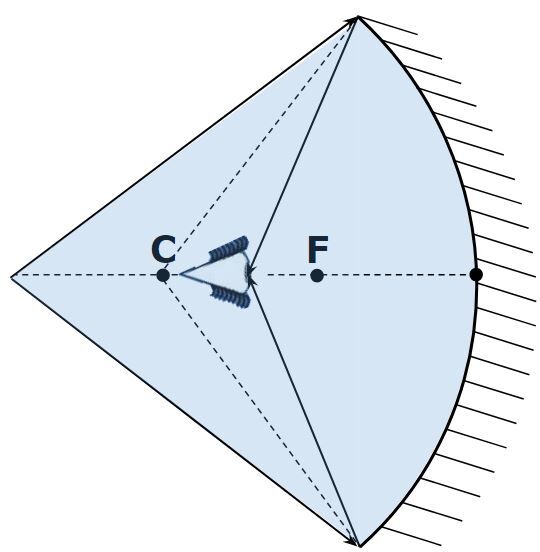 100%
100%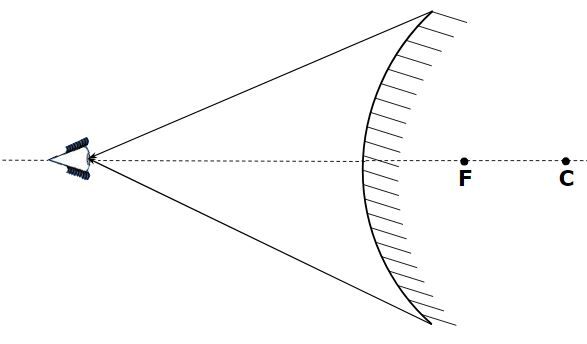 100%
100%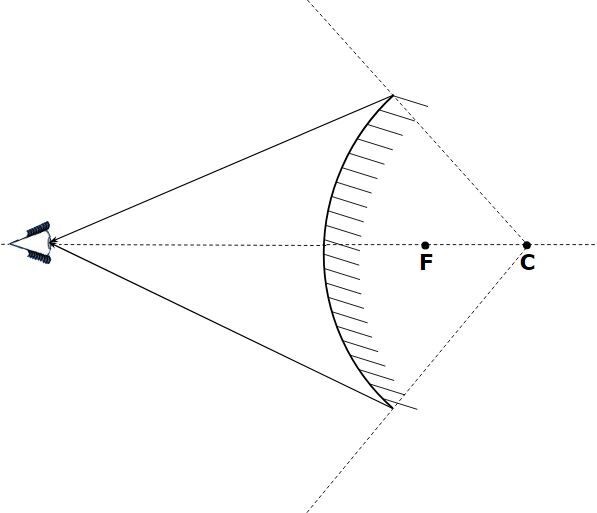 100%
100%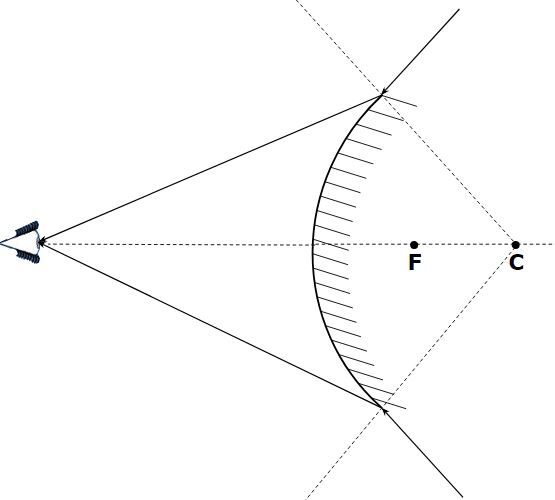 100%
100%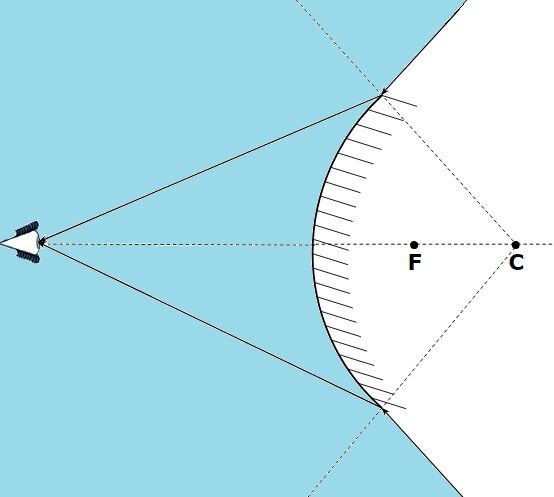 100%
100%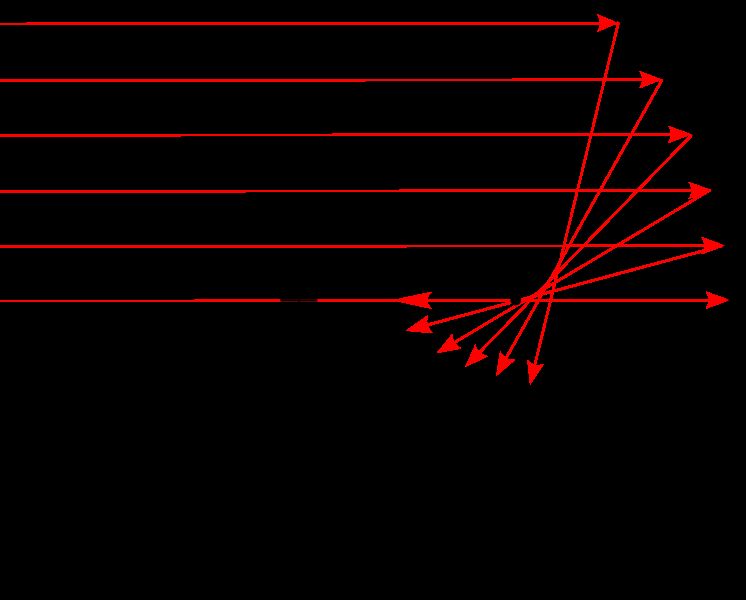 100%
100%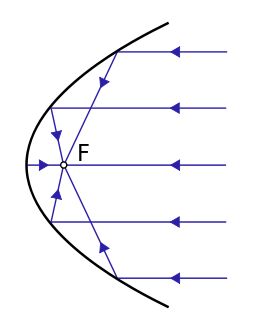
A curved mirror is one whose surface is not flat.
A spherical mirror is one whose surface is a section of a sphere.
A cylindrical mirror is one whose surface is a section of a cylinder.
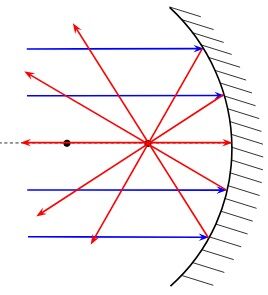
A concave, or converging mirror, is a mirror that deviates parallel light rays to reflect at a single point, the focal point.
You can recognize a concave mirror by its hollow surface, like that of a spoon.

A convex, or diverging mirror, is a mirror that disperses the reflected rays away from the mirror after they hit it.
You can recognize a convex mirror by its rounded surface, like the back of a spoon.
The vertex of the mirror (V) is the intersection point between the principal axis and the mirror.
The focal point of the mirror (F) is the point where all the reflected rays (in a converging mirror) or all the extensions of the reflected rays (in a diverging mirror) cross.
The focal length (lf) represents the distance between the vertex of the mirror and its focal point.
The centre of curvature of the mirror (C) is the point corresponding to the centre of the circle from which the curved mirror was formed.
The radius of curvature (R) represents the distance between the vertex and the centre of curvature.
The principal axis is a straight line passing through the focus and the centre of curvature.
These elements are represented in the diagram below. Although the elements have been represented in a converging mirror, the same also exist in the diverging mirror.
In curved mirrors, the radius of curvature is always equal to twice the focal length.
|R=2\times l_f|
In order to draw the image associated with an object in front of a curved mirror, you first need to understand the behaviour of the three principal rays of curved mirrors. There are three main rays that can be drawn to identify the position of an image.
When the incident ray is directed parallel to the main axis, it is reflected to the focal point. This ray is shown in red in the diagram below.
When the incident ray passes through the principal focal point, it is reflected parallel to the principal axis. This ray is shown in green in the diagram below.
When the incident ray passes through the centre of curvature, it is reflected back on itself. This ray is shown in blue in the diagram below.
When the incident ray is directed parallel to the principal axis, it is reflected so that its extension is aligned with the focal point. This light ray is shown in red in the diagram below.
When the extension of the incident ray is directed towards the focal point, it is reflected parallel to the principal axis. This ray is shown in green in the diagram below.
When the extension of the incident ray is directed towards the centre of curvature, it is reflected back on itself. This ray is shown in blue in the diagram below.
The field of vision (or field of view) of a curved mirror is the space that can be seen by an observer looking into the curved mirror.
The field of vision can be determined using the laws of reflection. Simply follow the steps below to observe the field of vision of a curved mirror.
1. From the observer, draw the light rays that travel to the endpoints of the concave mirror.
2. Draw normal lines at each of these points of incidence. In a concave mirror, simply draw the radii of curvature, because, by definition, a radius meets the surface of a curved mirror perpendicularly.
3. Draw the incident rays using the law of reflection.
4. Everything located between the incident rays is part of the observer's field of vision.
1. From the observer, draw the light rays that travel to the endpoints of the convex mirror.
2. Draw normal lines at each point of incidence. In a convex mirror, simply draw the radii of curvature, because, by definition, a radius always meets the surface of a curved mirror perpendicularly. However, they need to be extended so that they can act as a normal.
3. Draw the incident rays using the law of reflection.
4. Everything located between the incident rays is part of the observer's field of vision.
The field of vision of a convex mirror is considerably greater than that of a concave or plano-convex mirror.
Spherical aberration refers to an irregularity in which the rays of light coming from the edge of the mirror and the centre of the mirror are no longer deviated to a focal point.
With spherical aberration, all the rays reflected by the spherical mirror do not converge at the same point as they should.
To correct this problem, a parabolic mirror can be used. This type of mirror has the ability to deviate all the reflected rays to a single point, the focal point.