Subjects
Grades
 100%
100%
 100%
100%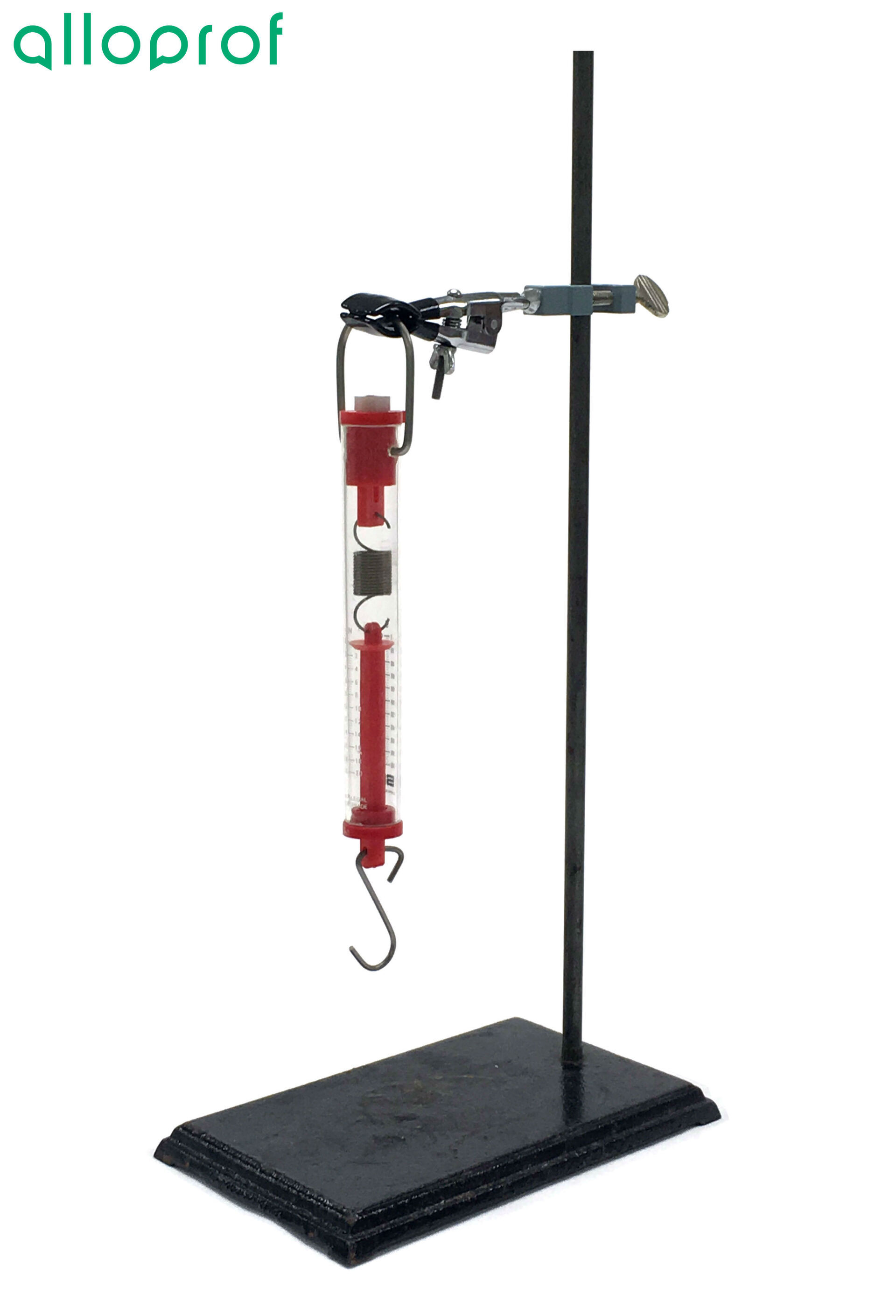 100%
100%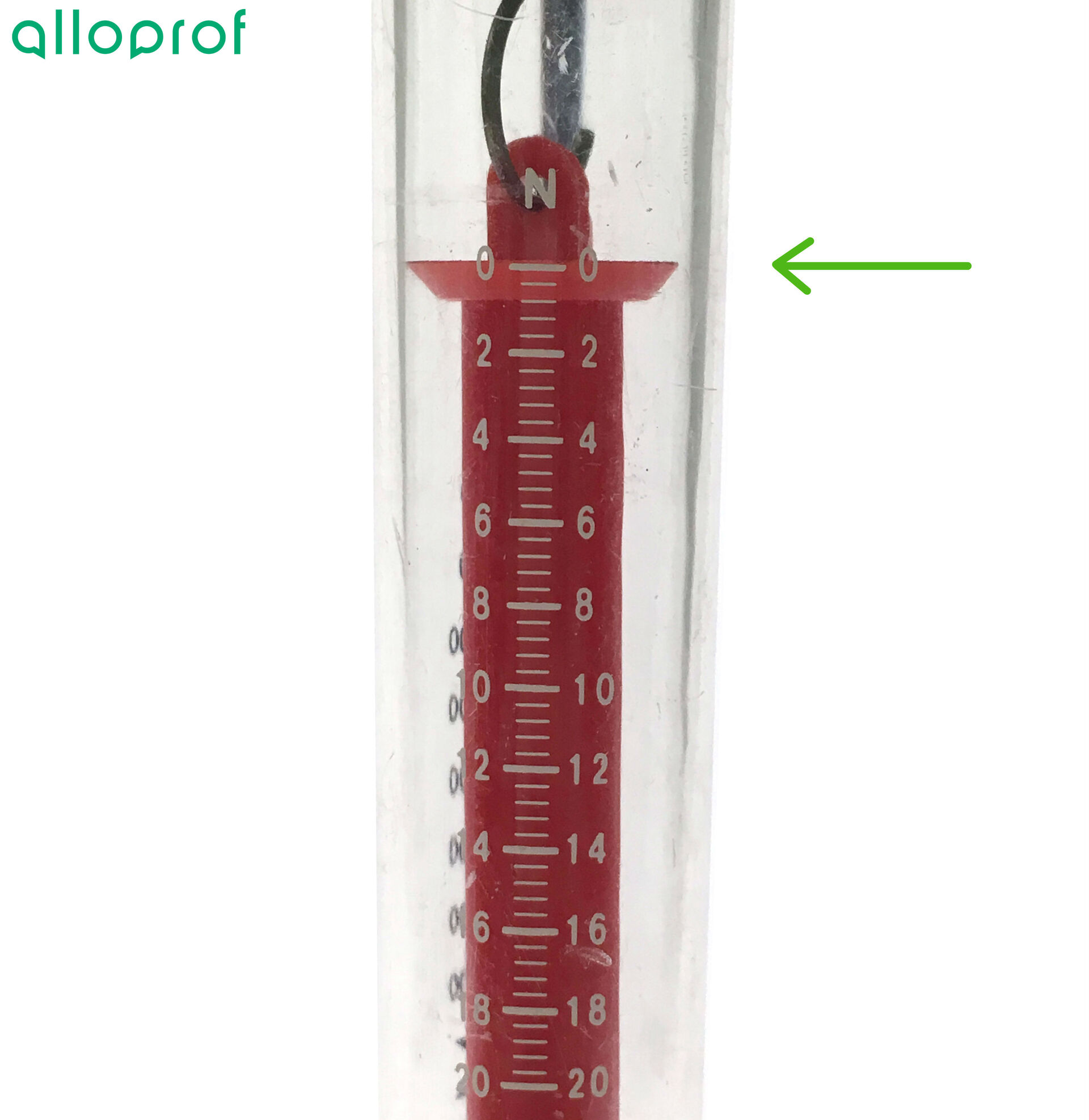 100%
100%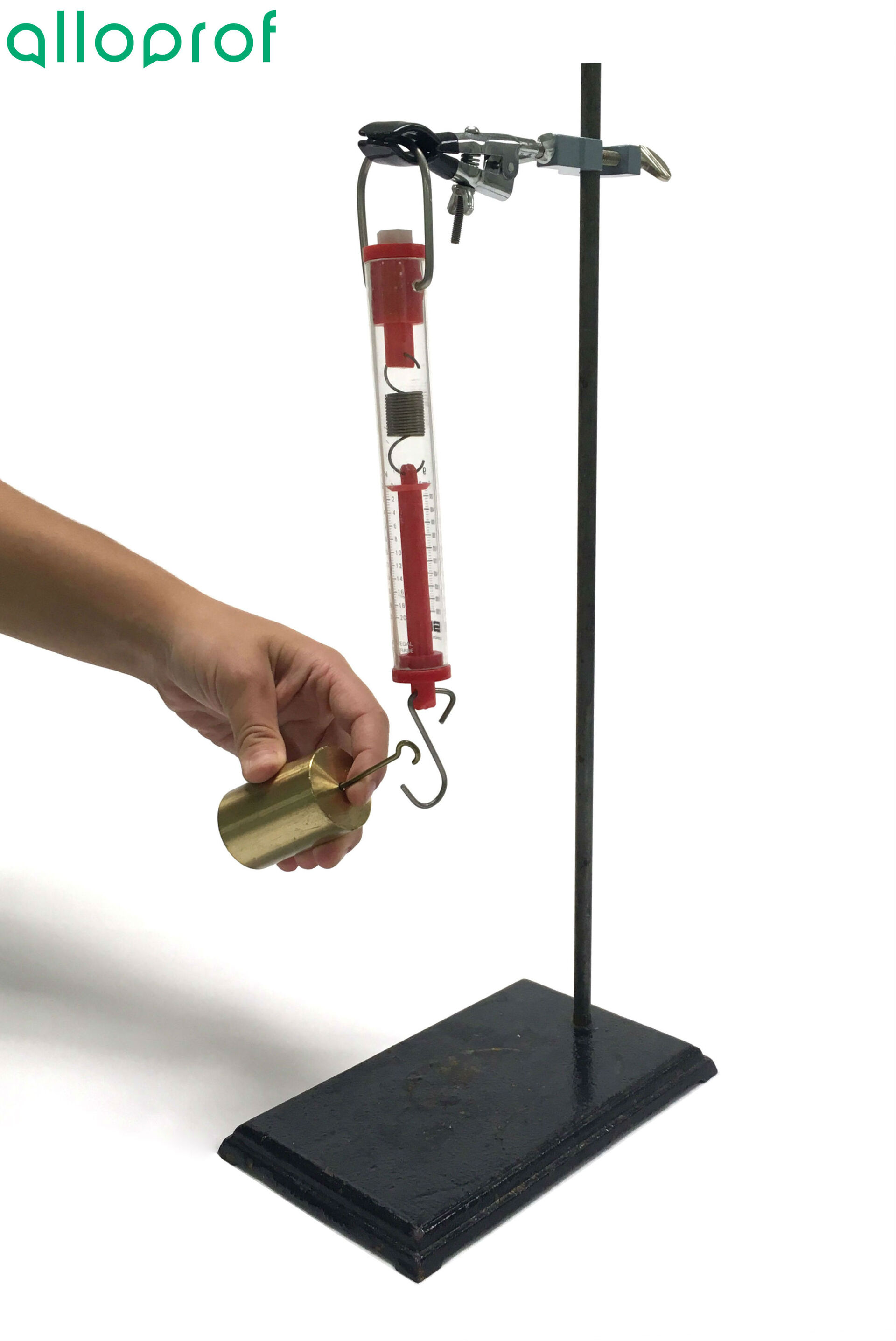 100%
100%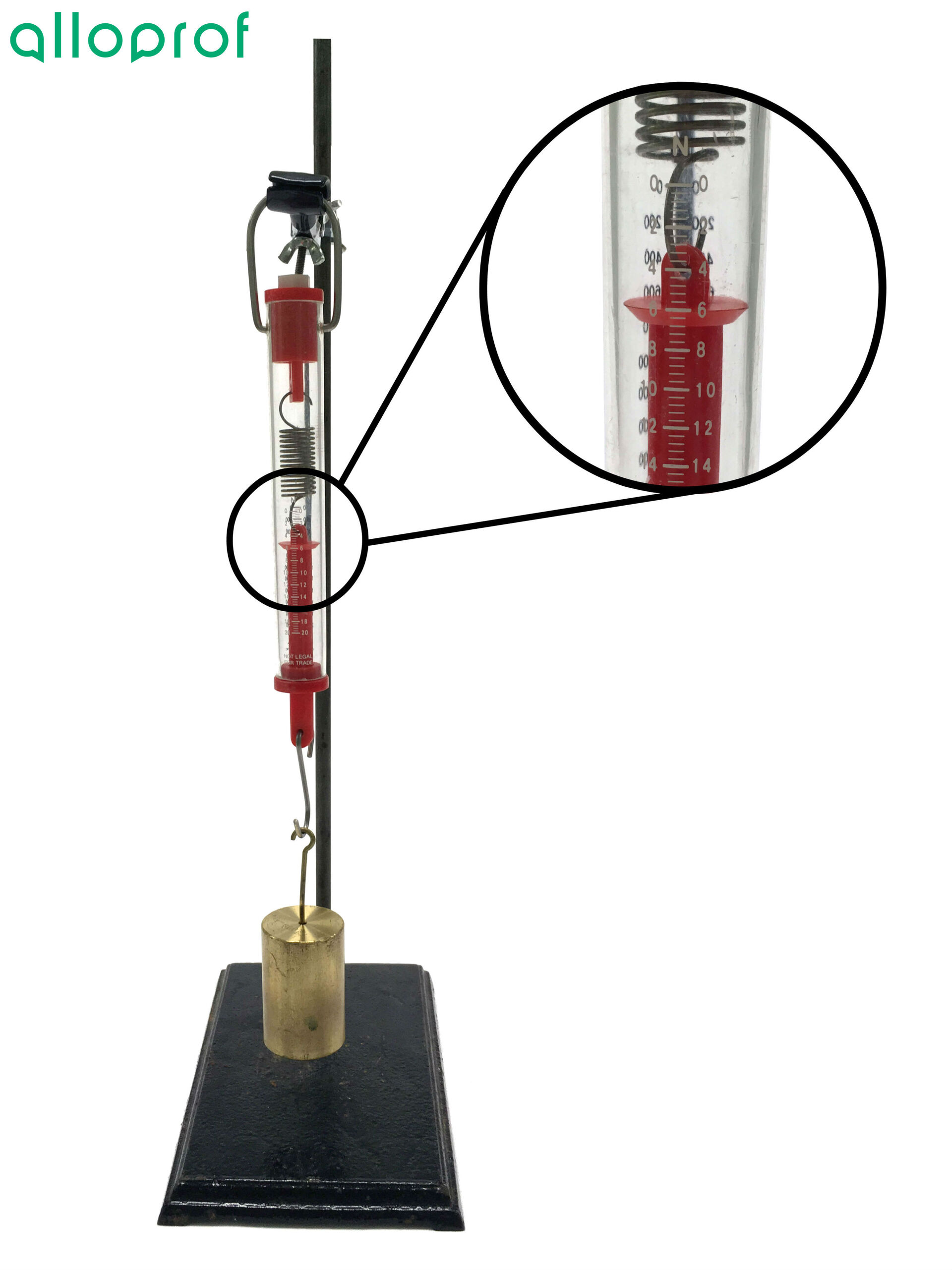
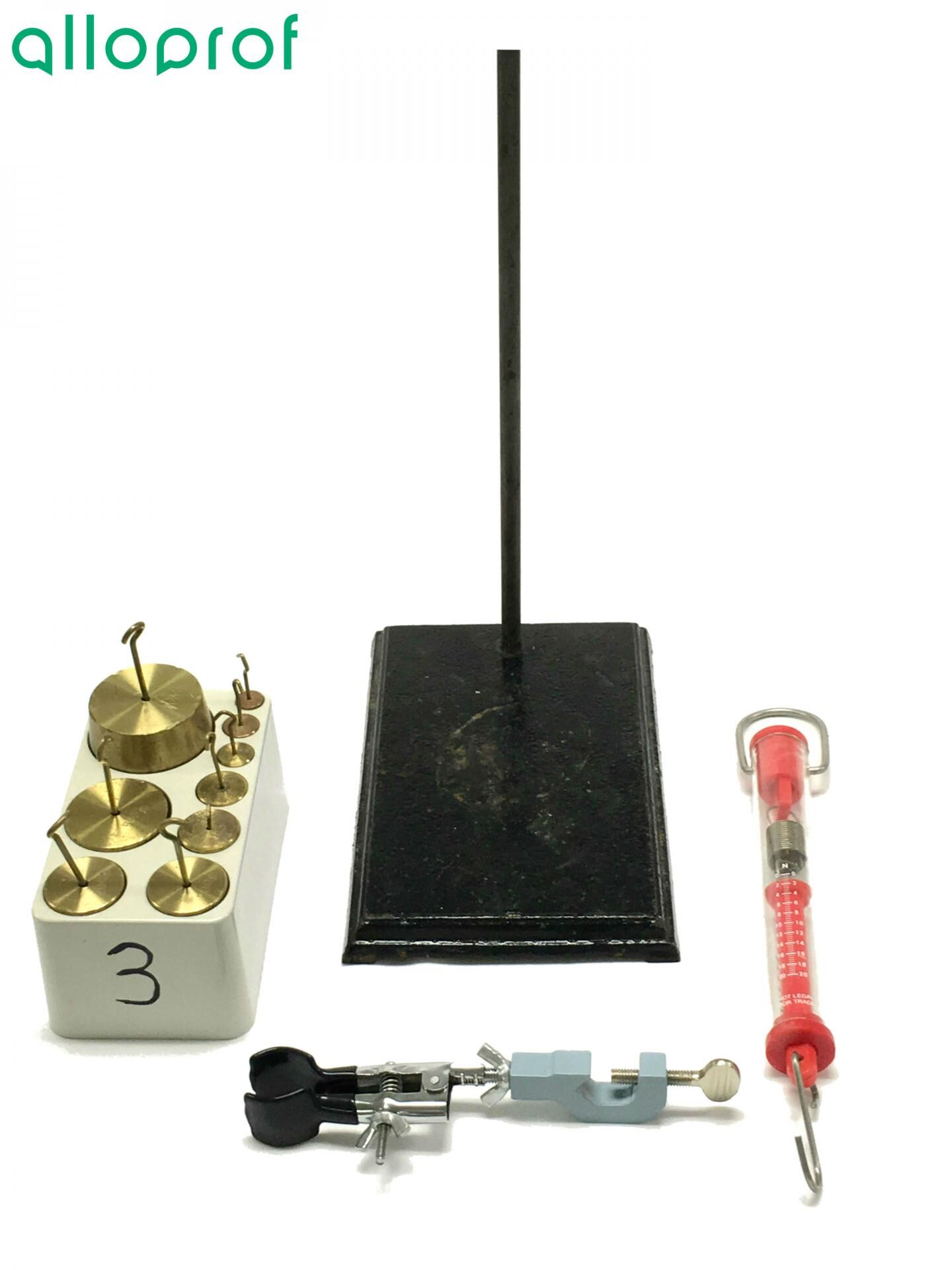
This worksheet explains how to use a dynamometer.
A dynamometer is an instrument for measuring force. The dynamometer consists of a spring and a scale calibrated in newtons |\text{(N)}.|

1. Install the hook clamp on the universal support and place the dynanometer on the clamp.
2. Check that the dynamometer is correctly calibrated: when no object is attached to the spring, the cursor should be positioned opposite zero on the measurement scale.
3. Hang the object to be measured on the hook of the dynanometer.
5. Put the equipment away.
The force measured by the dynamometer represents the gravitational force. This force is the attraction that exists between the suspended object and the Earth. By knowing this force, it is possible to determine the object's mass if it was not known before the experiment.
||F_{g} = m \times g||
où
|F_{g}| represents the gravitational force in Newtons |(\text {N})|
|m| represents the mass of the body in kilograms |(\text {kg})|
|g| represents the intensity of the gravitational field in Newtons per kilogram |(\text {N/kg})|
What is the mass of an object that exerts a force of |\small 6,0 \: \text {N}| ?
First of all, we need to identify the variables in this situation.
||\begin{align}F_{g} &= 6,0\: \text{N} \\
g &= 9,8 \: \text{N/kg} \\ m &= \: x \end{align}||
Since there is only one unknown variable, it can be determined mathematically.
||\begin{align} F_g = m \times g \quad \Rightarrow \quad m &=\displaystyle\frac{F_g}{g}
\\ \\
&= \displaystyle\frac{6,0\: \text{N}}{9,8\: \text{N/kg}}\\ \\
&= 0,61 \:\text{kg}\end{align}||
The mass is therefore |0,61 \:\text{kg}|.