Subjects
Grades
 100%
100%
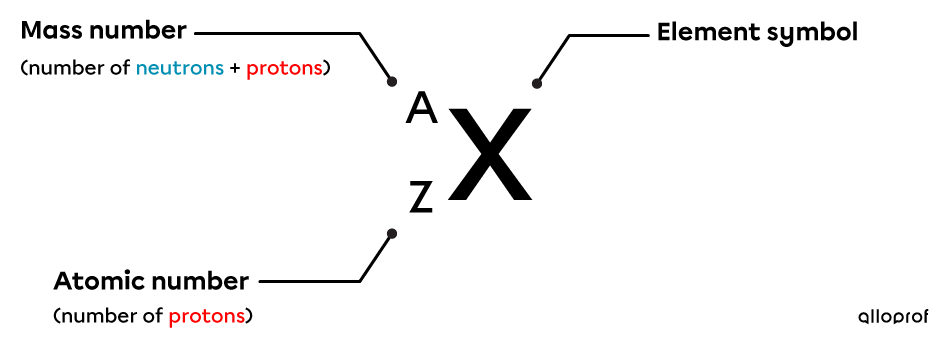
A/Z notation is used to distinguish isotopes of the same element. It displays the symbol of the element (|X|), its atomic number (|Z|), and its mass number (|A|).
A/Z notation has the following structure:

The following table summarizes the information that A/Z notation provides regarding the composition of atoms in terms of the number of neutrons, protons, and electrons. Two isotopes of carbon, namely carbon |12| and carbon |13|, are chosen to illustrate their composition.
|
Carbon 12 |
Carbon 13 |
|
|---|---|---|
|
A/Z isotope notation |
|_{6}^{12}\text{C}| |
|_{6}^{13}\text{C}| |
|
Mass number |
|12| |
|13| |
|
Atomic number |
|6| |
|6| |
|
Number of neutrons |
|6| |
|7| |
|
Number of electrons |
|6| |
|6| |
We see that the atomic number (|Z|) from |2| carbon isotopes is |6|, as they both have |6| protons. In fact, the number of protons of an atom never changes. Carbon isotopes, therefore, always have |6| protons in their nucleus.
Also, because atoms are neutral, they both have the same number of electrons as protons. So there are |6| protons and |6| electrons. Positive charges and negative charges cancel each other out.
On the other hand, the mass number (|A|) varies (either |12|, or |13|), as the isotopes of the same element do not have the same number of neutrons (here, |6| and |7| neutrons).
The A/Z notation for an oxygen isotope is as follows: |_{8}^{17}\text{O}|.
What is the composition of this isotope (number of protons, neutrons, and electrons)?
What is the A/Z notation for magnesium-|26|?
An isotope of palladium consists of |46| protons, |46| electrons, and |62| neutrons. What is the A/Z notation for this isotope?
Sometimes the distribution of electrons is added to A/Z notation.
The A/Z notation for oxygen-|16| with its electronic distribution is noted as follows: |_{8}^{16}\text{O}:2e^{-},6e^{-}.|
A/Z notation can also be applied to ions. The only difference with neutral atoms is that the charge is indicated at the top right of the symbol, for example |_{11}^{23}\text{Na}^+| or |_{17}^{35}\text{Cl}^-|.
To illustrate this, the following table shows the composition of carbon-|12| when it is neutral, positive, or negative.
| Atom / Ion | Number of neutrons | Number of protons | Number of electrons |
|---|---|---|---|
| |_{6}^{12}\text{C}| | |6| | |6| | |6| |
| |_{6}^{12}\text{C}^+| | |6| | |6| | |5| |
| |_{6}^{12}\text{C}^-| | |6| | |6| | |7| |
All carbon atoms have |6| protons. When the charge of carbon changes, the number of protons always remains the same; the number of electrons is the varying element. When there are more electrons than protons, the ion is negative (e.g., charge |1-| , |2-| , |3-| , etc). When there are fewer electrons than protons, the ion is positive (e.g., charge |1+|, |2+|, |3+|, etc).