Subjects
Grades
The following table shows the accuracy of measuring instruments mainly used in a laboratory (lab).
In general, the measurement uncertainty is provided by the manufacturer. Otherwise, the uncertainty corresponds to half of the smallest division of the measuring instrument.
Here is the absolute uncertainty for some instruments used in a lab.
| Instrument name | Instrument volume | Absolute uncertainty |
|
Volumetric flasks
 |
|10.00 \: \text {ml}| | | \pm 0.02 \: \text {ml}| |
| |25.00 \: \text {ml}| | | \pm 0.06 \: \text {ml}| | |
| |50.00 \: \text {ml}| | | \pm 0.05 \: \text {ml}| | |
| |100.00 \: \text {ml}| | | \pm 0.08 \: \text {ml}| | |
| |200.0 \: \text {ml}| | | \pm 0.1 \: \text {ml}| | |
| |250.0 \: \text {ml}| | | \pm 0.1 \: \text {ml}| | |
| |500.0 \: \text {ml}| | | \pm 0.2 \: \text {ml}| | |
|
Graduated cylinders
 |
|10.0 \: \text {ml}| | | \pm 0.1 \: \text {ml}| |
| |25.0 \: \text {ml}| | | \pm 0.3 \: \text {ml}| | |
| |50.0 \: \text {ml}| | | \pm 0.4 \: \text {ml}| | |
| |100.0 \: \text {ml}| | | \pm 0.6 \: \text {ml}| | |
| |250 \: \text {ml}| | | \pm 1 \: \text {ml}| | |
| |500 \: \text {ml}| | | \pm 3 \: \text {ml}| | |
|
Burettes
 |
|10.00 \: \text {ml}| | | \pm 0.02 \: \text {ml}| |
| |25.00 \: \text {ml}| | | \pm 0.03 \: \text {ml}| | |
| |50.00 \: \text {ml}| | | \pm 0.05 \: \text {ml}| | |
| |100.0 \: \text {ml}| | | \pm 0.1 \: \text {ml}| | |
|
Graduated pipettes
 |
|0.100 \: \text {ml}| | | \pm 0.005 \: \text {ml}| |
| |0.200 \: \text {ml}| | | \pm 0.008 \: \text {ml}| | |
| |0.50 \: \text {ml}| | | \pm 0.01 \: \text {ml}| | |
| |1.00 \: \text {ml}| | | \pm 0.01 \: \text {ml}| | |
| |2.00 \: \text {ml}| | | \pm 0.02 \: \text {ml}| | |
| |5.00 \: \text {ml}| | | \pm 0.02 \: \text {ml}| | |
| |10.00 \: \text {ml}| | | \pm 0.06 \: \text {ml}| | |
| |25.0 \: \text {ml}| | | \pm 0.1 \: \text {ml}| | |
|
Volumetric pipettes
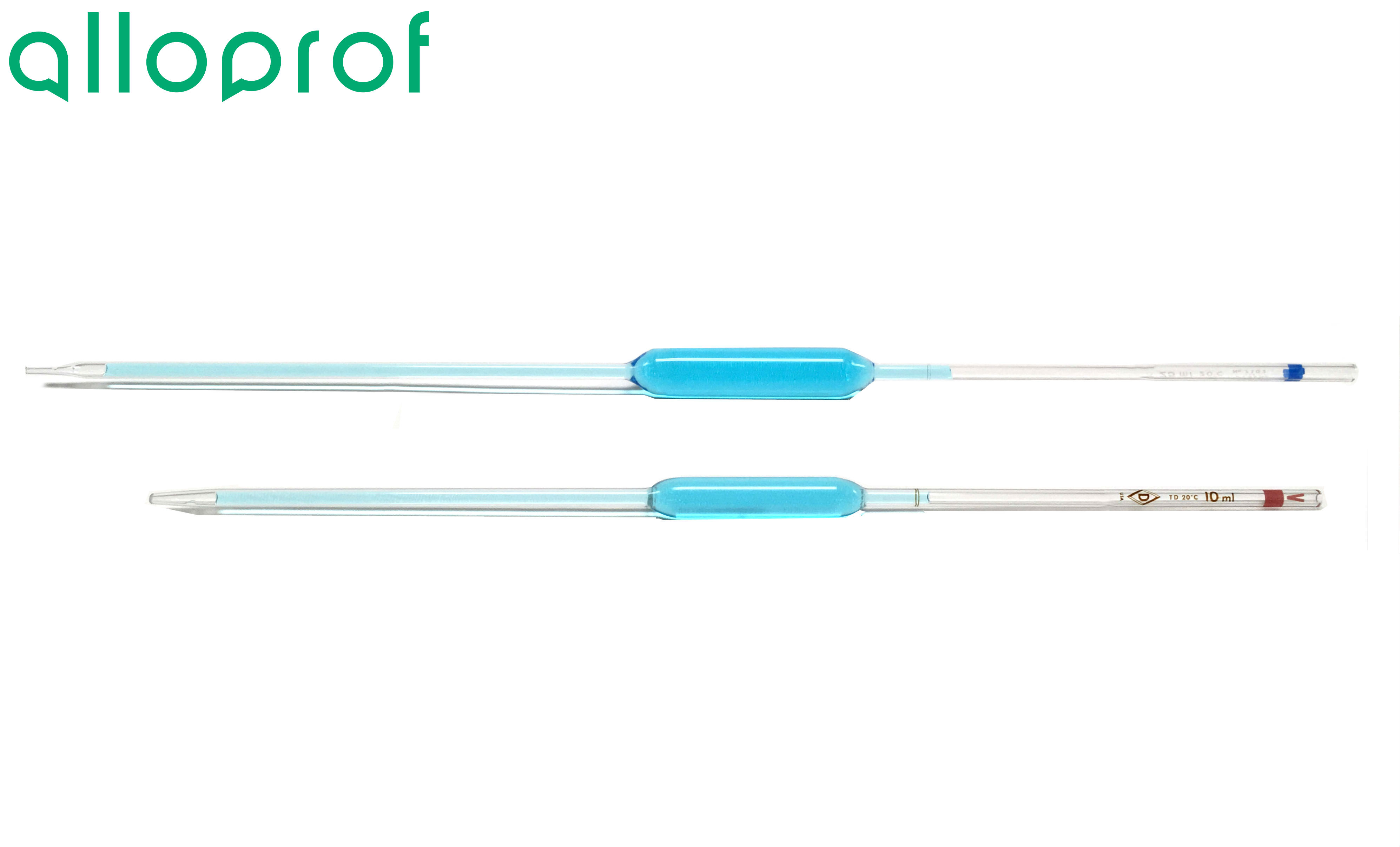 |
|1.000 \: \text {ml}| | | \pm 0.006 \: \text {ml}| |
| |2.000 \: \text {ml}| | | \pm 0.006 \: \text {ml}| | |
| |3.00 \: \text {ml}| | | \pm 0.01 \: \text {ml}| | |
| |4.00 \: \text {ml}| | | \pm 0.01 \: \text {ml}| | |
| |5.00 \: \text {ml}| | | \pm 0.01 \: \text {ml}| | |
| |6.00 \: \text {ml}| | | \pm 0.02 \: \text {ml}| | |
| |7.00 \: \text {ml}| | | \pm 0.02 \: \text {ml}| | |
| |8.00 \: \text {ml}| | | \pm 0.02 \: \text {ml}| | |
| |9.00 \: \text {ml}| | | \pm 0.02 \: \text {ml}| | |
| |10.00 \: \text {ml}| | | \pm 0.02 \: \text {ml}| | |
| |20.00 \: \text {ml}| | | \pm 0.03 \: \text {ml}| | |
| |25.00 \: \text {ml}| | | \pm 0.03 \: \text {ml}| | |
| |50.00 \: \text {ml}| | | \pm 0.05 \: \text {ml}| | |
| |100.00 \: \text {ml}| | | \pm 0.08 \: \text {ml}| |
Some instruments can contain liquids without being designed to measure volumes accurately. This is the case for beakers and Erlenmeyer flasks. The beaker is used more as a container to carry volumes that will be measured with other instruments (such as the graduated cylinder), while the Erlenmeyer is generally used for acid-base neutralizations. Although both of these instruments are graduated, the graduations only serve to give an approximation of the amount of liquid they contain.