Subjects
Grades
Ecological succession is the process by which gradual change in the composition of a community occurs following a disturbance (natural or caused by human activity). This process, made up of a series of changes in the ecosystem, goes on until equilibrium is reached again in the environment.
During the first stage of succession, the first plants, called pioneer plants or pioneer species, settle in a newly created environment. Pioneer plants, such as mosses and lichens, aerate the soil and soften it while increasing its organic matter content. Other species, such as grasses and ferns, will then settle in the environment and compete with the pioneer species. As the soil is colonized by grasses and ferns, species of shrubs and trees integrate to form a new forest. It is important to keep in mind that this process can unfold over hundreds of years.
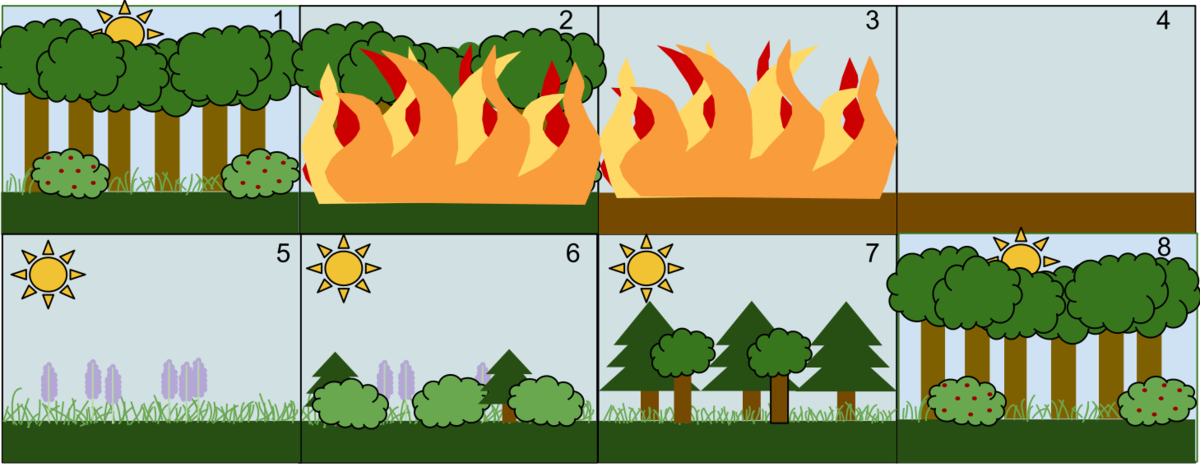
The most common example to illustrate ecological succession is that of plant development following a forest fire.
1. The forest, in its initial state.
2-3. Fire disturbance.
4. The fire creates a vacuum. However, there are seeds left in the soil and the wind, water and animals bring new seeds.
5. Grasses and other herbaceous plants grow back. These are usually short-rooted plants whose seeds germinate easily. They are also perennials whose roots have not been completely burned.
6. Small bushes and young trees begin to recolonize the environment.
7. Rapid growth of conifers and slow growth of shade-tolerant deciduous trees.
8. Progressive disappearance of pioneer and shade-intolerant species since access to light becomes more and more difficult.
Climax is the final state of an ecological succession, that is to say the state where equilibrium has been reached.