Subjects
Grades
 100%
100%
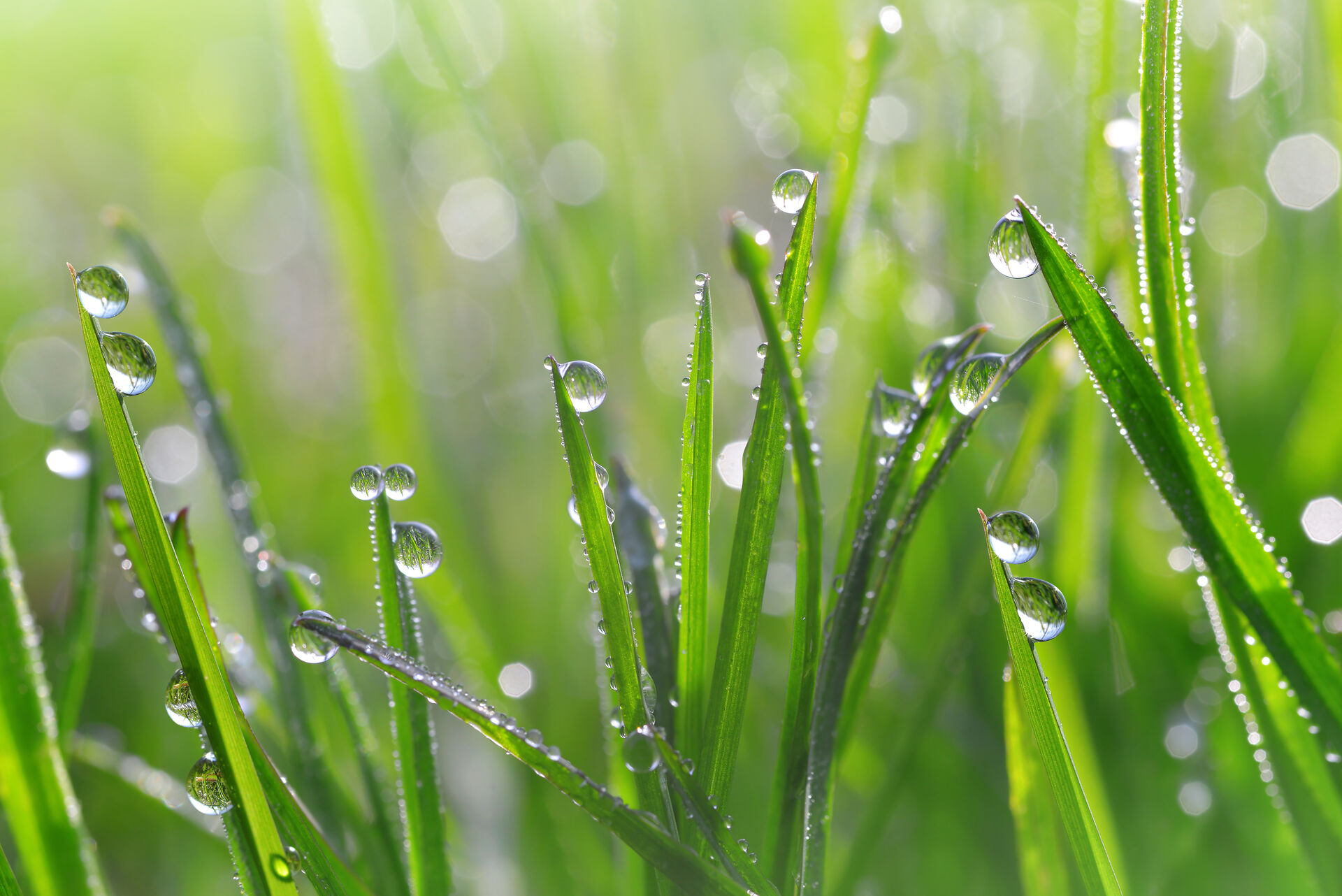
Atoms, molecules, ions, and subatomic particles are very small particles, which means that there are billions and billions of them.
A |0.05\ \text{mL}| drop of water contains approximately |2 \times 10^{21}| particles, which is |2\ 000| billions of billions of particles.

Drops of Water
It is not easy to count billions of particles! Chemists have, therefore, invented a unit of measurement to make their life easier: the mole.
The mole is a unit of measurement that corresponds to a group of |6.022 \times 10^{23}| particles. The particles involved can be atoms, molecules, ions, electrons, etc.
In a mathematical formula, the mole symbol is written |n| and its unit is written |mol|.
If a sample contains |6.022 \times 10^{23}| of methane particles (|\text{CH}_4|), it is the same as saying that it contains |1\ \text{mol}| of |\text{CH}_4.|
To indicate this value in a process or a calculation, write |n_{{CH}_4}= 1\ \text{mol}.|
Just as a dozen eggs do not weigh the same as a dozen elephants, |1\ \text{mol}| of hydrogen does not weigh the same as |1\ \text{mol}| of carbon. The mass of one mole of an atom or molecule corresponds to its molar mass.

Moments in the video :
The mole and Avogadro's number are two closely related concepts.
Avogadro's number, symbolized by |N_{\text{A}}|, corresponds to the number of particles found in one mole, that is, |6.022 \times 10^{23}| particles.
Avogadro's number was determined by a chemist named Jean Perrin in the early 20th century. At the time, the value of this constant corresponded to the number of particles contained in |1\ \text{g}| of hydrogen (|\text{H}|). For the sake of precision, this method has been revised and the value used today corresponds to the number of particles in a sample of |12\ \text{g}| of carbon-|12.|
Therefore, in several reference manuals, we find a more accurate definition of Avogadro's number: it corresponds to the number of particles found in exactly |12\ \text{g}| of carbon-|12.| Also, the mole is the amount of matter found in |12\ \text{g}| of carbon-|12.|
In terms of mathematics, there are several ways to represent Avogadro's number.
|N_{\text{A}}=6.022 \times 10^{23}|
|N_{\text{A}}=6.022 \times 10^{23}\ \text{mol}^{-1}|
|N_{\text{A}}=6.022 \times 10^{23}\ \text{particles/mol}|
The units selected depend on the context.
To determine the number of moles based on Avogadro's number and the number of particles, the following formula can be used.
|n=\dfrac{N}{N_{\text{A}}}\qquad \text{or}\qquad N=n \times N_{\text{A}}|
where
|n| represents the number of moles (|\text{mol}|)
|N| represents the number of particles (atoms, molecules, ions, etc.)
|N_{\text{A}}| represents Avogadro's number
How many atoms are there in |2.0\ \text{mol}| of potassium (|\text{K}|)?
How many molecules are there in |0.50\ \text{mol}| of carbon dioxide (|\text{CO}_2|)?
How many moles correspond to |1.807\times10^{24}\ \text{molecules}| of disinfectant alcohol (|\text{C}_3\text{H}_8\text{O}|)?
How many moles correspond to |2.71\times10^{22}| of aluminum atoms (|\text{Al}|)?