Subjects
Grades
AI is a powerful new technology and a fantastic tool. Like anything of the sort, it relies on us to think critically about the results it provides.
AI simulates conversation and recognizes patterns; it doesn’t understand context or truth in the way a human does.
This technology is evolving very quickly: What is true today might not be true tomorrow. Here is a glimpse into what is AI at this very moment.
AI is the abbreviation for Artificial Intelligence.
Artificial intelligence is a technology made to imitate human intelligence. It allows computer systems to perform tasks such as learning, reasoning and decision making.
Moments in the video:
AI has been around for quite some time. To name just a few examples:
It suggests what show to watch next.
It builds your social media feed.
It autocorrects what you write.
It makes personalized shopping suggestions.
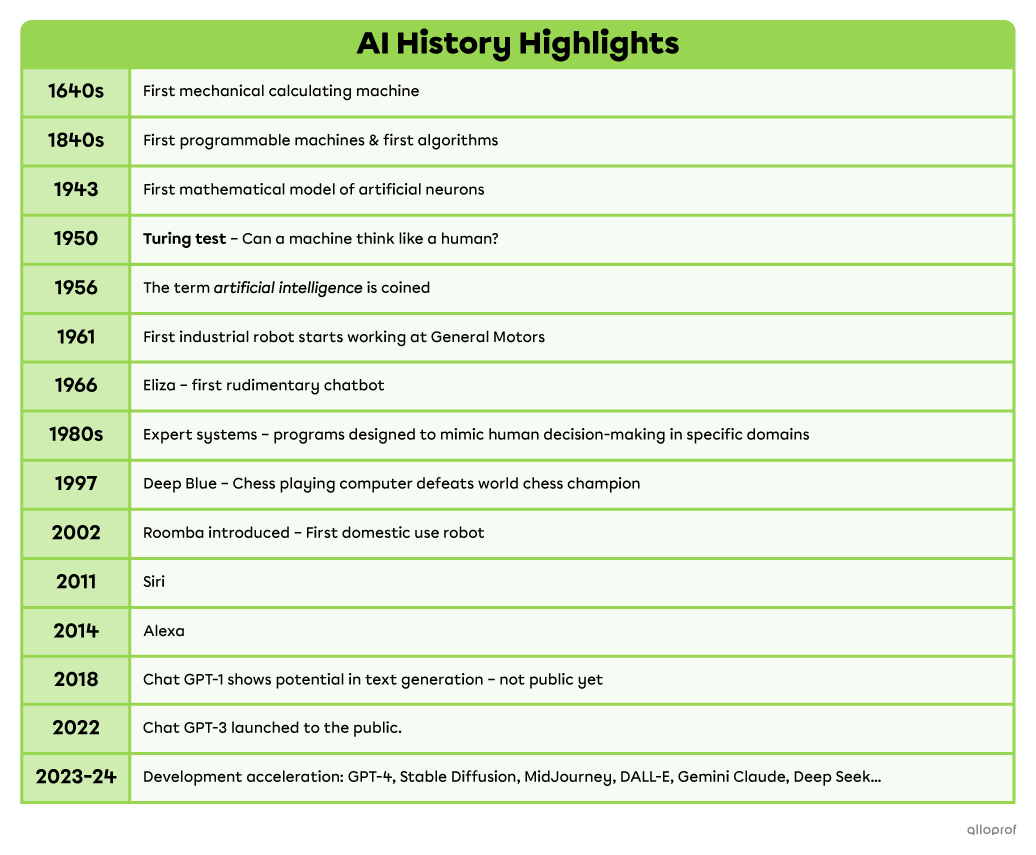
Here are some highlights of the history of AI.
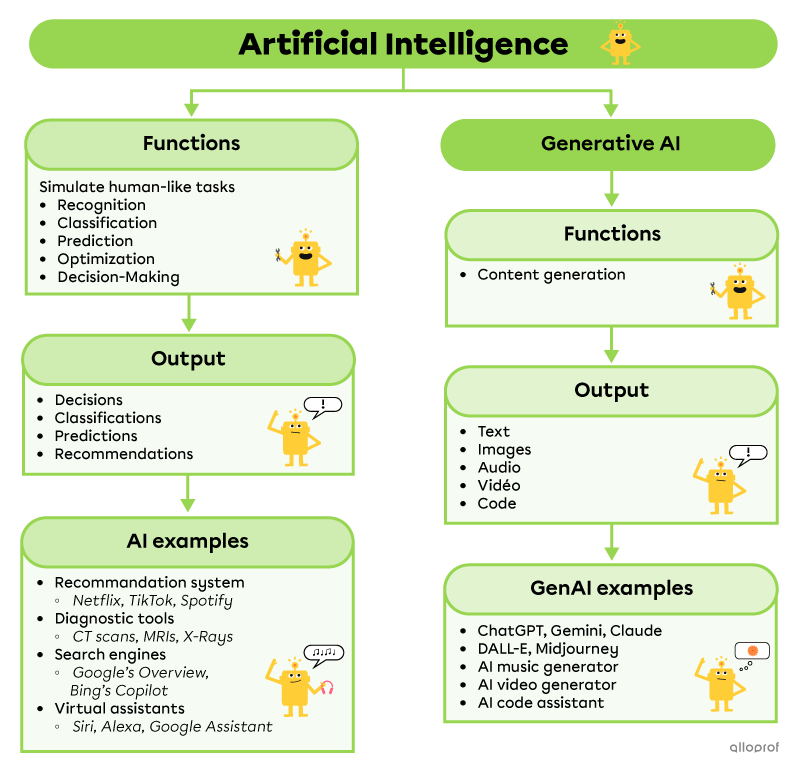
Artificial intelligence (AI) is a broad field of computer science that focuses on creating intelligent machines.
Generative AI (GenAI) is a specialized type of AI. It is an application of AI.
Here is a comparative of AI and GenAI:
Functions: what it can do
Output: what kind of results it provides
Examples of systems that use it
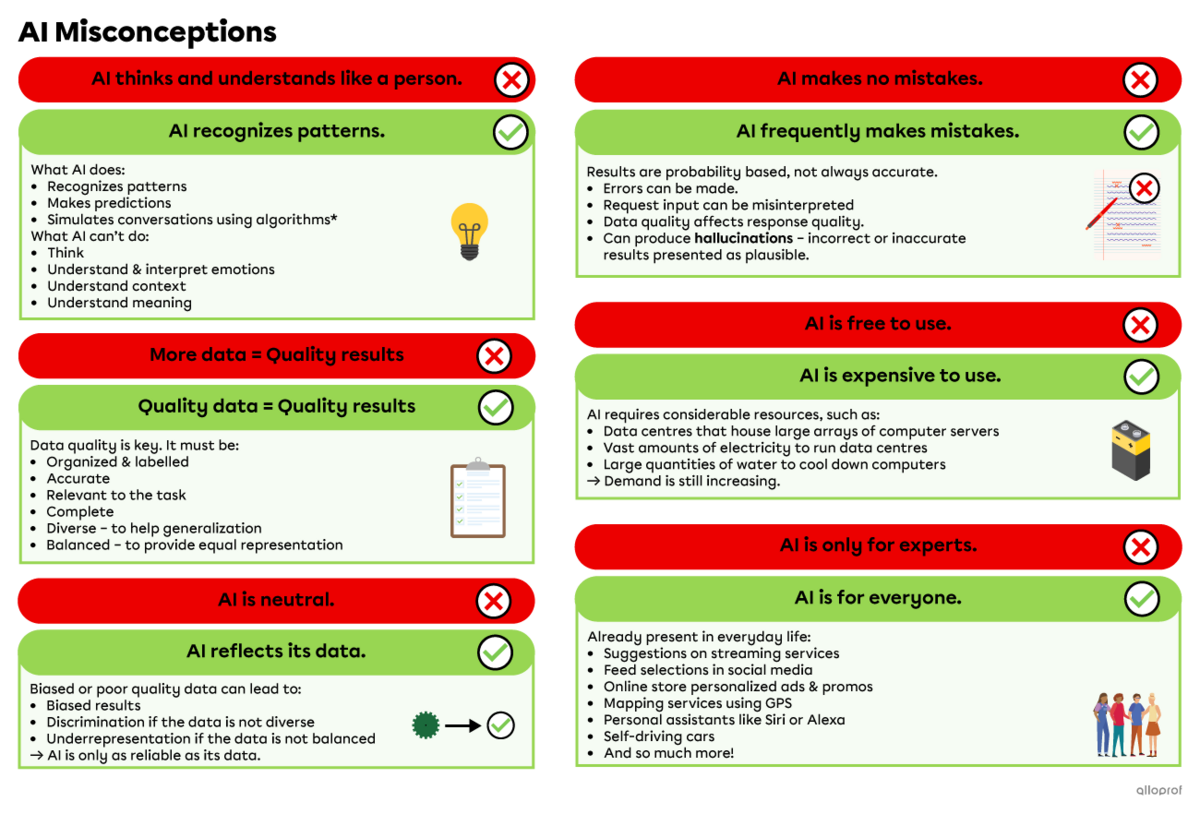
Artificial intelligence (AI) is very efficient at getting lots of tasks done, so much so that we might believe it thinks like a human.
In reality, AI works by following specific instructions and calculating probabilities to guess the best answer. This is what we call an algorithm.
Human intelligence uses much more than just rules. It uses life experience, intuition, judgment, and common sense. AI can try to imitate these processes, but it doesn't truly have them. It doesn't feel or understand things the way people can.
Here are some examples of common misconceptions.
AI, especially chatbots like Chat-GPT, Gemini or Claude, are designed to produce plausible-sounding answers.They can be very convincing. However, sounding plausible and convincing is very different from being accurate and factual.
When used appropriately, AI tools can be very useful.
Here are a few examples:
Medical diagnostic aids (CT scans, MRIs, X-Rays)
Accessibility apps (text to speech, live captions)
Personalized learning tools (Khanminog, DreamBoxLearing)
Real-time language translation and autocorrect
Precision agriculture (smart irrigation, pest and disease detection)
AI can help you with homework, but…
Making AI do your school work for you is not only unethical, but it can have repercussions on your learning. There are ways you can use AI to assist you, while remaining in control of your learning. For example, to understand a complex concept, to create a study plan or to brainstorm ideas.
To get good results, split tasks into simple ones instead of one complex task.
Try to go step by step, one thing at a time. Think of it as if you were asking a person who isn’t familiar with what you are talking about: take your time.
Remember to always:
Ask your teacher before using AI for an assignment and be transparent in the ways that you used it.
Double-check any information, particularly when dealing with topics that are somewhat unfamiliar to you.
Here are some useful AI-related words and expressions:
|
Artificial intelligence (AI) |
Technology that imitates human intelligence. |
|
AI applications |
Use of AI models for specific tasks |
|
Algorithms |
Set of rules and instructions that guide AI in processing data |
|
Chatbot |
Computer program designed to simulate a conversation |
|
Hallucination |
Incorrect or inaccurate results generated by AI |
|
Generative AI |
A specialized application of AI models focused on generating content: text, images, video, audio, code. |