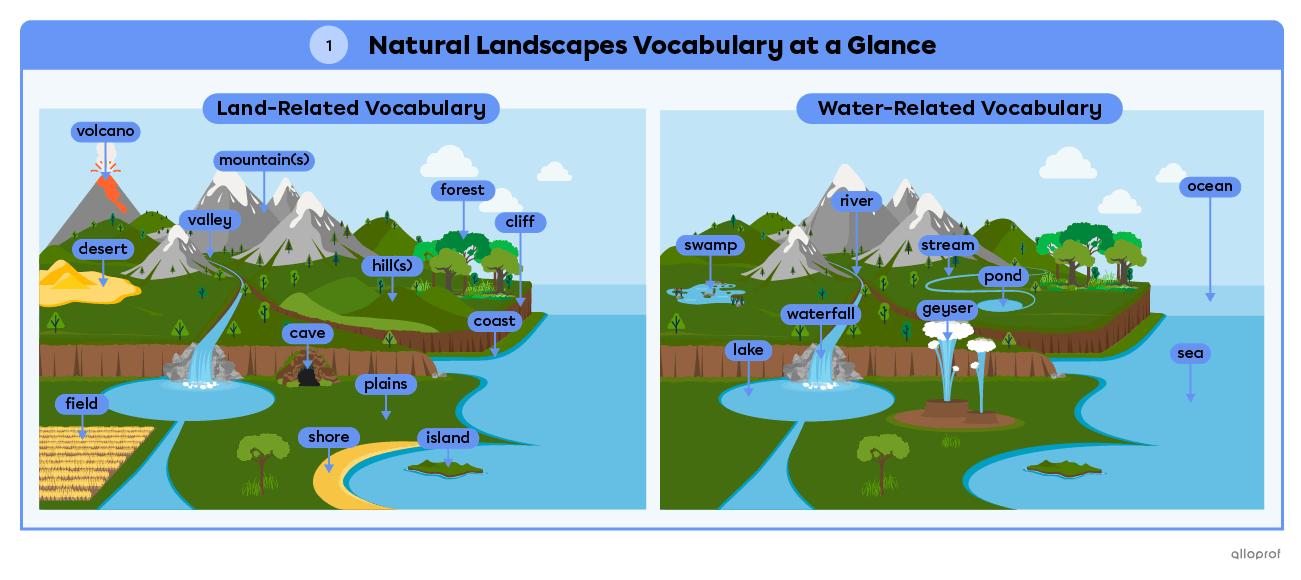
An area of land where the main plants are grasses rather than trees.
savanna
A hot, open grassland with only a few scattered trees. It is found in tropical regions (like Africa or South America).
steppe
A large, dry, flat area of land covered in short grass. It does not have enough rain for trees to grow, and it is usually found in cold regions.
tundra
A flat, frozen land with no trees. It is located in the far North, around the Arctic Circle.
prairie
A large, flat area of land covered in tall grasses and wildflowers. It has very few trees and is usually found in the middle of a continent where the climate has hot summers and cold winters.
meadow
An open field of grass and wildflowers. Unlike a massive prairie, a meadow is usually found near a forest or a stream.
plateau
A large area of high land that is flat on top. It is like a mountain with the top cut off.
peninsula
A piece of land that is almost completely surrounded by water, but it is still connected to the main land by a narrow strip.
riverbank
The land along the edge of a river.
archipelago
A group or a chain of many islands clustered together in a body of water, usually the ocean.
Natural Features
mountain range
A long row or a group of mountains that are connected together.
foothills
The low, rolling hills located at the bottom (the "foot") of a mountain range.
peak
The very top or the highest point of a mountain. Also called the “summit.”
summit
The very top or the highest point of a mountain. Also called the “peak.”
alpine
Used to describe high mountains.
ridge
A long area of land that is on top of a mountain.
canyon
A deep, narrow valley with very steep, rocky sides. It is created by the flow of water over millions of years.
ravine
A small, deep valley with steep sides. It is usually created by a stream or running water.
crater
A large, deep hole in the ground. It is usually found at the top of a volcano or in the ground where a meteorite crashed.
dune
A large hill of sand that has been piled up by the wind.
glacier
A massive, thick body of ice that moves very slowly over the land.
iceberg
A massive piece of ice that has broken off from a glacier that floats in the sea or ocean.
cavern
A large type of cave, sometimes connected into a series of rooms.
stalagmite
A rock formation that grows upward from the floor of a cave.
stalactite
A rock formation that grows downward from the ceiling of a cave.
Forest-related
rainforest
A dense, green forest that stays warm and wet all year long.
tropical forest
A forest that grows near the Equator.
conifer
Trees with needles instead of leaves that produce cones. Like pine, spruce and fir.
coniferous forest
A type of forest dominated by conifers, like pines, spruce or fir.
taiga
A cold forest dominated by conifers, situated in the Arctic regions.
canopy
The upper layer of a forest formed by interlocking branches.
undergrowth
The mix of small plants, bushes, and young trees that grow on the forest floor, underneath the tall trees.
Advanced Water Vocabulary
Coastal & water landscapes
coastline
The line where the land meets the ocean or a sea.
bay
A body of water that is partly surrounded by land. It is shaped like the letter “C.” It is smaller than a gulf.
gulf
A very large area of the ocean that is almost completely surrounded by land. It is larger than a bay.
fjord
A long, narrow arm of the sea that reaches deep into the land. It is surrounded by high cliffs.
estuary
A partially enclosed body of water, where a freshwater river meets the salty ocean.
delta
A low, flat area of land shaped like a triangle that forms at the mouth of a river.
inlet
Small arm of the sea or lake extending into the land.
lagoon
A shallow body of saltwater that is separated from the deeper, open ocean by a narrow landform, such as a coral reef, a sandbar or a barrier island.
reef
A ridge or a "wall" of rock, coral or sand that sits just below or right at the surface of the water.
coral reef
An underwater structure built by millions of tiny living animals called "coral polyps."
mangrove
A type of tree or shrub that grows in saltwater along tropical coasts.
trench
A deep, narrow, and long depression (like a giant "crack") on the floor of the ocean.
Freshwater & wetlands
underground river
A body of flowing water that runs completely beneath the Earth's surface, usually through a network of caverns or caves.
spring
A natural source of water flowing from the ground or out of a rock.
hot spring
A natural source of hot water.
cascade
A type of waterfall where the water flows down a series of rocky "steps" or stages.
rapids
The sections of a river where the water moves very fast and becomes turbulent.
creek
Small, narrow stream of fresh water. It is larger than a tiny "brook" but smaller and shallower than a river.
brook
A very small, natural stream of fresh water. It is the smallest type of "river.”
oasis
A fertile, green area in the middle of a desert where there is a source of fresh water.
wetland
An area of land where the soil is covered by shallow water or is completely soaked with water.
bog
A type of wetland characterized by vegetation, like living and decaying moss.
marsh
A type of wetland characterized by vegetation, like grasses, reeds and sedges, rather than trees.
Advanced Natural Phenomena Vocabulary
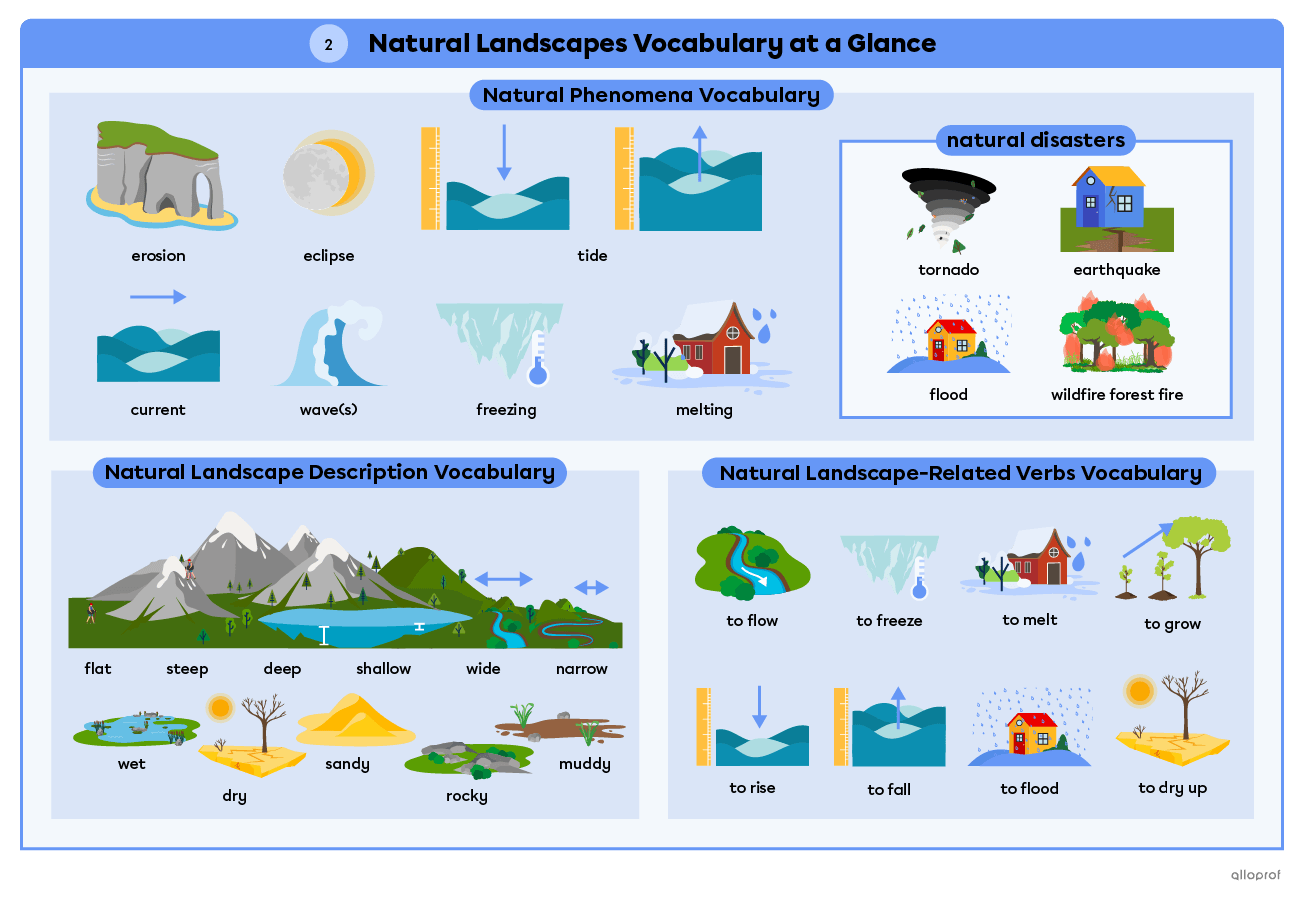
mirage
A trick of light creating an optical illusion.
photosynthesis
The process plants use to convert sunlight into food energy.
aurora borealis
Colourful light display in the Earth's sky. Also called “Northern Lights.”
Northern Lights
Colourful light display in the Earth's sky. Also called “aurora borealis.”
halo
A ring of light that forms around the Sun or the Moon.
growth
The natural process where a living thing increases in size or develops more complex structures over time.
decomposition
The natural process of dead plants and animals breaking down into much smaller pieces of organic matter.
weathering
The natural process that breaks rocks down into smaller and smaller pieces (like pebbles, sand, and mud).
water cycle
The process of water going through precipitation, collection, condensation and evaporation in a continuous cycle.
precipitation
Water cycle step where water falls from the sky in the form of rain, snow hail or sleet.
collection
Water cycle step where water is collected in bodies of water on the ground or soaked into the ground after precipitation.
evaporation
Water cycle step where liquid water heated by the sun turns into water vapour and rises up into the sky.
condensation
Water cycle step where water vapour cools down and changes back into liquid water droplets and forms clouds.
landslide
The movement of a large mass of earth, rocks or other material.
Advanced Natural Landscape Verbs
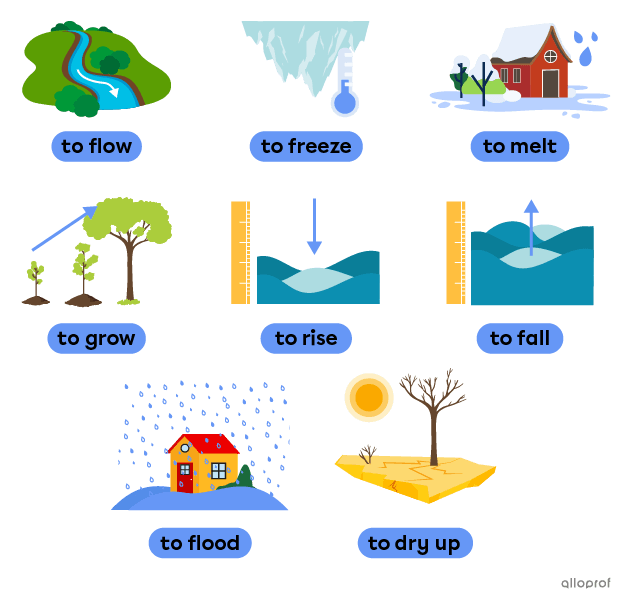
to shine
To give off or reflect light; to be bright.
to form
To be created or developed over time through natural processes.
to spread
To cover a surface gradually.
to stretch
To extend over a larger area.
to surround
To encircle.
to bloom
To produce flowers or to open into a flower.
to wither
To become dry and shrivelled; to lose freshness or vitality.
to drain
To cause water or another liquid to run off or flow away from an area.
to overflow
To flow over the edge of a body of water, leading to flooding.
to erode
To gradually wear away through the action of wind, water or ice.
to carve
To cut into or shape natural formations through erosion.
Advanced Natural Landscape Description Vocabulary
wild
Refers to an area that is rugged, unmanaged and governed by the laws of nature.
green
A very rich, thick and healthy landscape.
rural
Relating to the countryside rather than the town or city.
vast
Very great in size.
scenic
Impressive or beautiful natural views.
panoramic
A wide-reaching view of an entire surrounding area.
breathtaking
So magnificent, beautiful or astonishing that it takes your breath away.
picturesque
Visually attractive, especially in a quaint or charming way; resembling a picture or a painting.
pristine
That has no pollution, no trash, no buildings, and no signs of human interference.
peaceful
Free from disturbance; quiet; like still water, a slow breeze or the soft lighting at dusk or dawn.
calm
Pleasant and free from large waves or high winds.
turbulent
Water or air moving in a chaotic way, like rapids, stormy skies or crashing waves.
harsh
With extreme physical conditions; difficult to live in.
remote
Distant and difficult to access.
fresh
It has a crisp quality that can be felt, tasted or smelled. Like fresh mountain air, freshwater or freshly grown plant life.
lush
Abundant, thick vegetation growing richly.
rugged
Ground with a rocky, broken and uneven surface.
fertile
Capable of producing abundant vegetation or crops. The opposite of “barren.”
barren
Producing little to no vegetation due to poor conditions. The opposite of “fertile.”
arid
Having little or no rain; too dry or barren to support much vegetation.
dense
Thick, compact (vegetation, forest, undergrowth) or difficult to see through (fog, smoke, mist).
towering
Extremely tall, especially in comparison to the surroundings.
 100%
100%