Matières
Niveaux
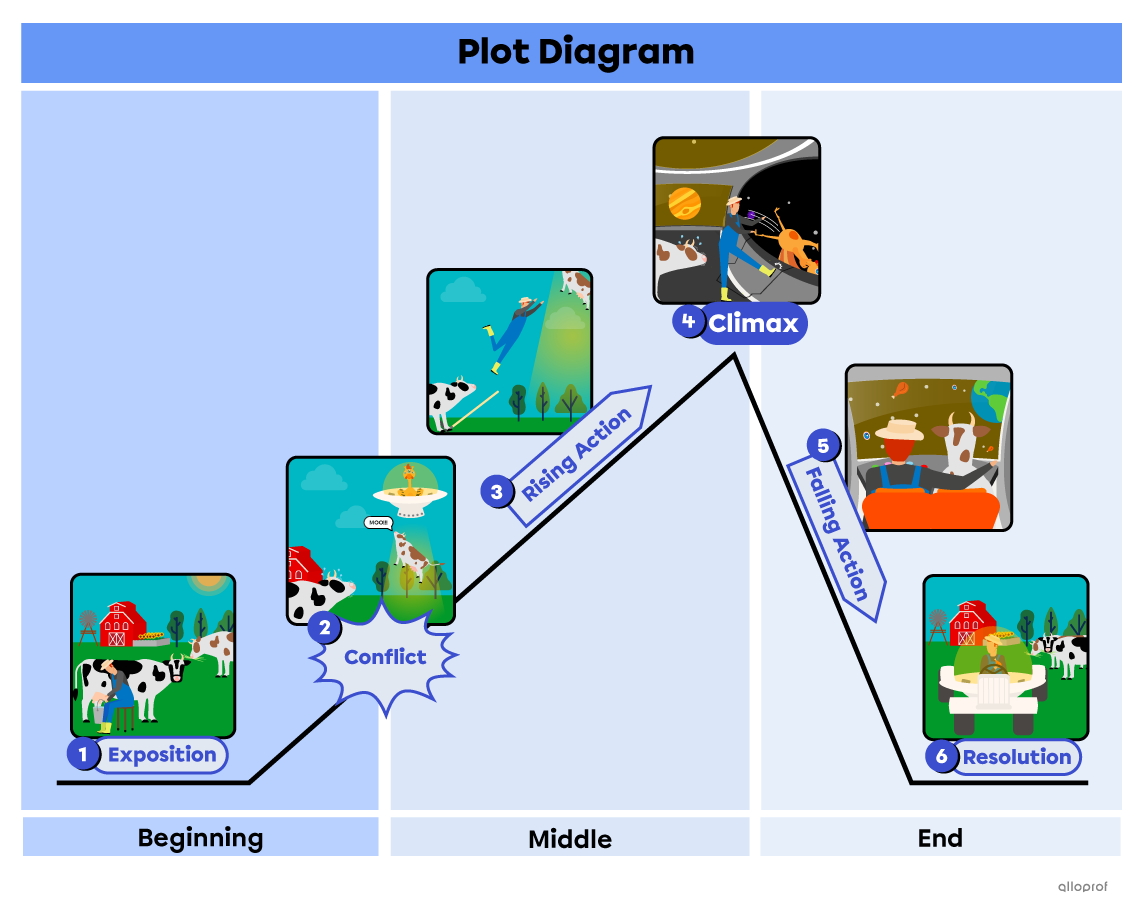
A plot diagram is a tool outlining the main events of a story.
Readers and writers can easily visualize, organize, understand and plan the key features of a story with it.
There are six main stages:
The exposition introduces the story’s setting. It tells us about:
|
Who |
When |
Where |
What |
|
The people |
Time period |
The place(s) |
The main character’s initial situation |
|
main character |
season |
home |
occupation(s) |
|
year |
workplace |
marital status |
|
|
Supporting characters |
present/past/future |
city |
economic context |
|
holiday |
country |
social context |
|
|
historical period |
another planet/world |
everyday life |
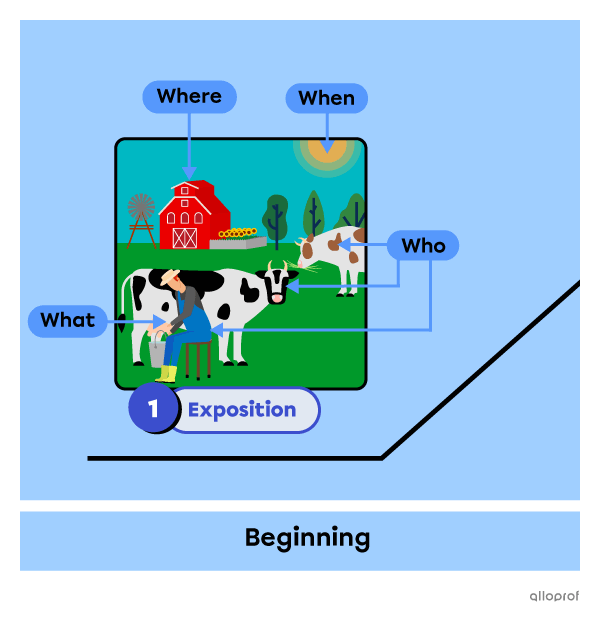
The exposition of our story would reveal:
The conflict (also called inciting event) is the moment the main character’s life is turned upside down.
During this stage, the main character is presented with an internal or external conflict, such as:
|
A dilemma |
The character has to choose between two or more important choices. |
|---|---|
|
An obstacle |
The character’s progress is stopped. |
|
A challenge |
The character's skills and actions are put to the test. |
|
A problem |
The character has to overcome a situation. |
|
A crisis |
The character’s world is affected by dramatic events. |
Overcoming the conflict becomes the protagonist’s main goal.
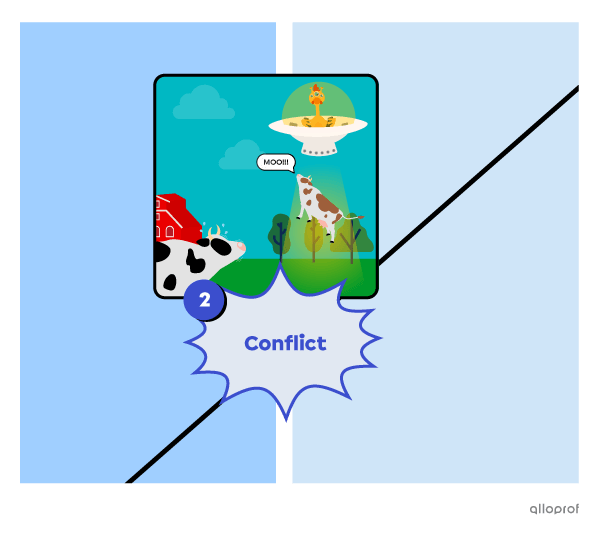
In our example story, the conflict is the alien abducting one of the cows.
When a story has a villain (also called the antagonist), he/she/it is introduced or revealed during this stage.
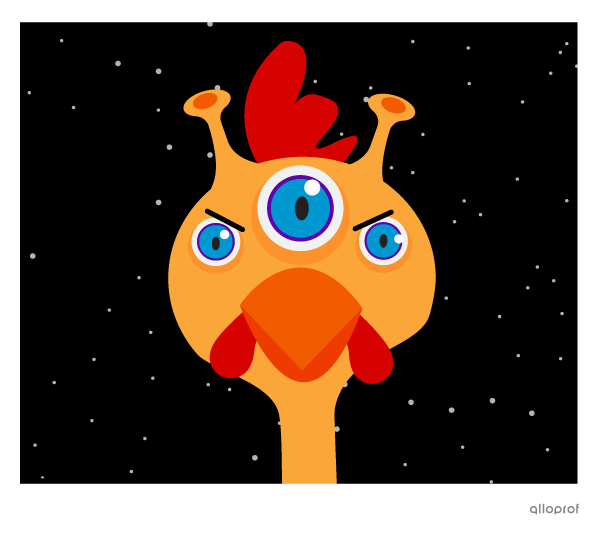
In our story, the antagonist is the chicken alien who abducted the cow.
The rising action is the series of events and actions bringing the story to its main event (the climax).
This stage starts when the protagonist makes decisions to solve the main conflict. Then:
suspense builds through a series of events.
the main character’s life gets harder.
the conflict becomes harder to solve.
A story can have more than one rising action. This stage of the story ends when the climax starts.
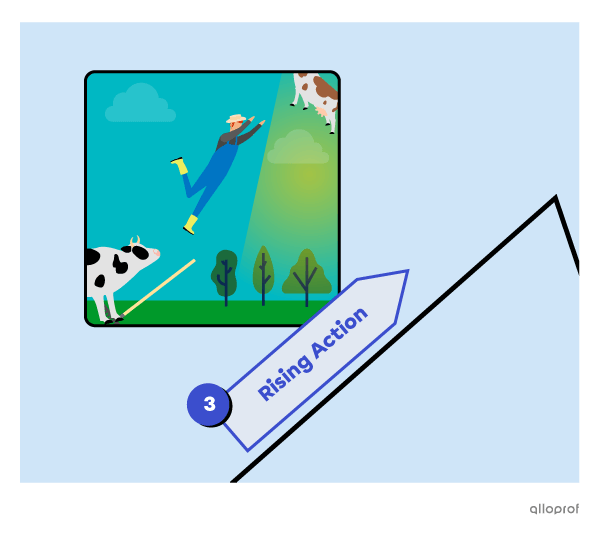
During the rising action of our story, the farmer:
uses a rake as a lever to catapult himself.
flies to the spaceship.
The climax is the most exciting point of the story. It is the result of all the tension built during the rising action.
During the climax, the main character must:
face his/her/its antagonist.
make critical decisions impacting his/her/its life.
solve the story’s conflict.
The climax ends when the main conflict is resolved. The result can be positive or negative for the protagonist.
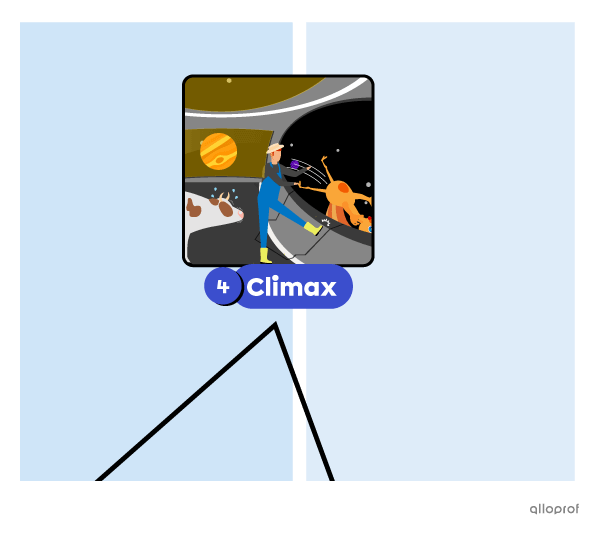
The climax of our story is the battle between the villain and the farmer. It ends when the alien is defeated.
The falling action is the beginning of the end.
It leads us into the story’s conclusion and:
shows the results of the climax and its effects on the character(s).
gives the audience time to process the story’s events.
allows a smooth transition between the climactic event and the resolution.
During this stage, some action and character development can still happen. However, no new conflict should be introduced.
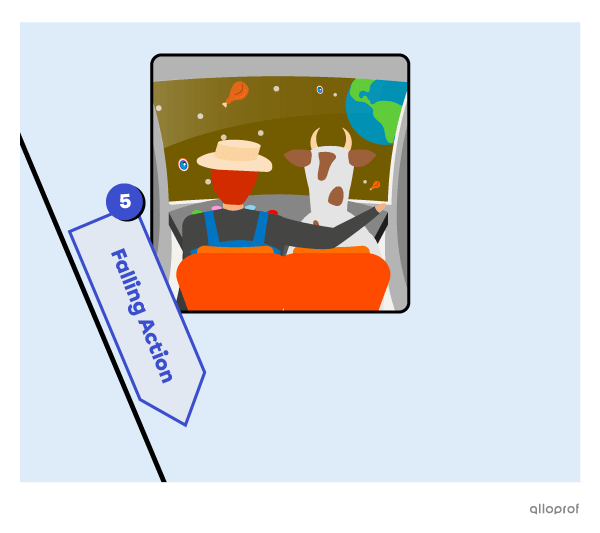
During the falling action of our story, the farmer:
comforts his cow
learns how to fly the spaceship to return to the farm.
The resolution (also called the denouement) is the outcome of the story.
It reveals:
how things have turned out for the main character.
how life has changed for the main character.
During the final part of the story, the author establishes the protagonist’s new normal.
The resolution is not always happy. It can leave the audience with questions or answers, positive or mixed feelings.
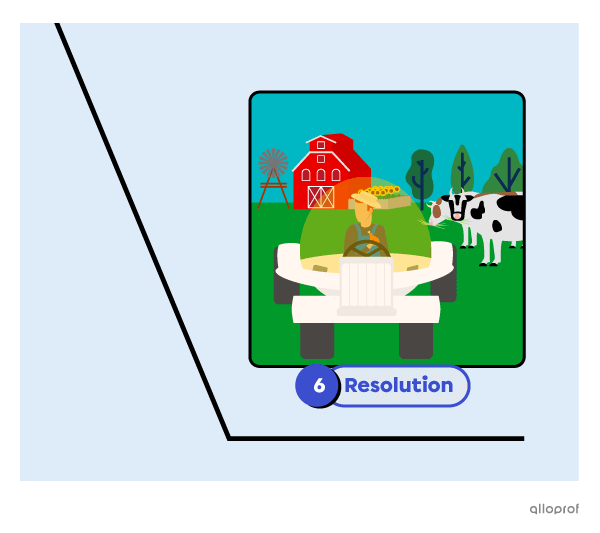
During the resolution of our story:
the cows happily graze.