Weather & Climate Vocabulary

| Anglais

Vocabulary on the theme of weather and climate.

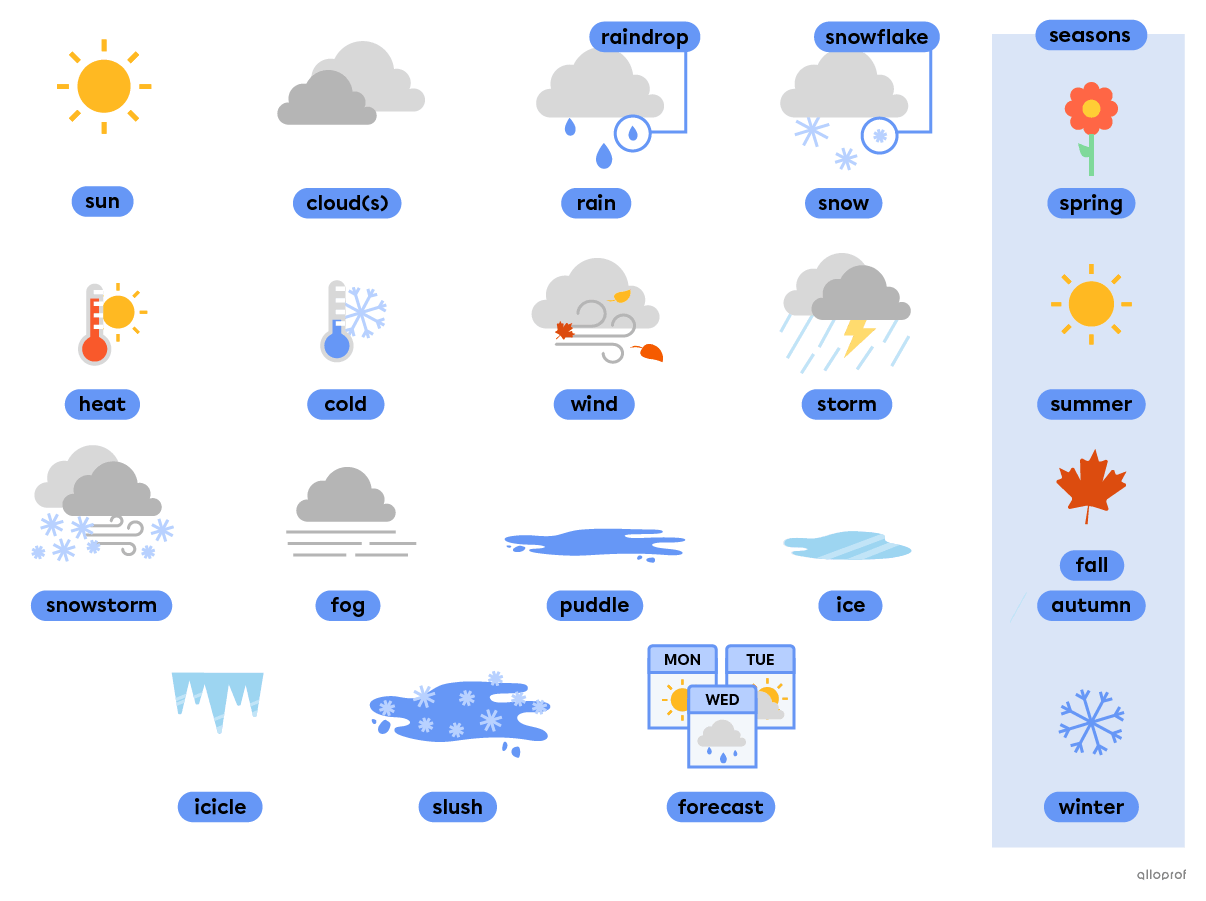
Types of Skies

  • a0304i-clearsky.jpg
    clear sky
  • a0304i-cloudy.jpg
    cloudy
  • a0304i-partlycloudy.jpg
    partly cloudy

Weather Phenomena

  • a0304i-breezy.jpg
    breezy
  • a0304i-cyclone.jpg
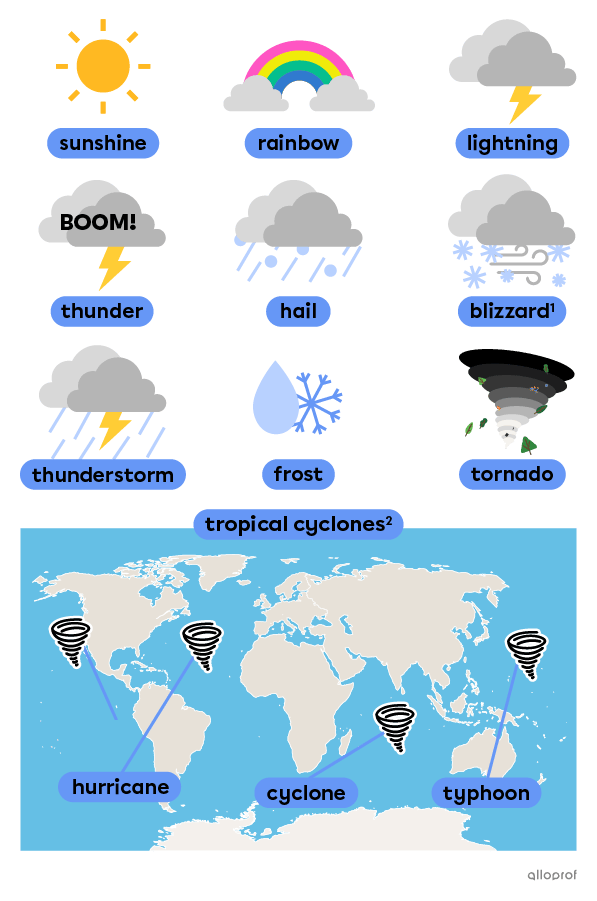
    cyclone
  • a0304i-drought.jpg
    drought
  • a0304i-flood.jpg
    flood
  • a0304i-heatwave.jpg
    heat wave
  • a0304i-humid.jpg
    humid
  • a0304i-hurricane.jpg
    hurricane
  • a0304i-lightning.jpg
    lightning
  • a0304i-rainbow.jpg
    rainbow
  • a0304i-thunder.jpg
    thunder
  • a0304i-tornado.jpg
    tornado
  • a0304i-tsunami.jpg
    tsunami
  • a0304i-typhoon.jpg
    typhoon
  • Image
    wind
  • Image
    windy
Find out more!

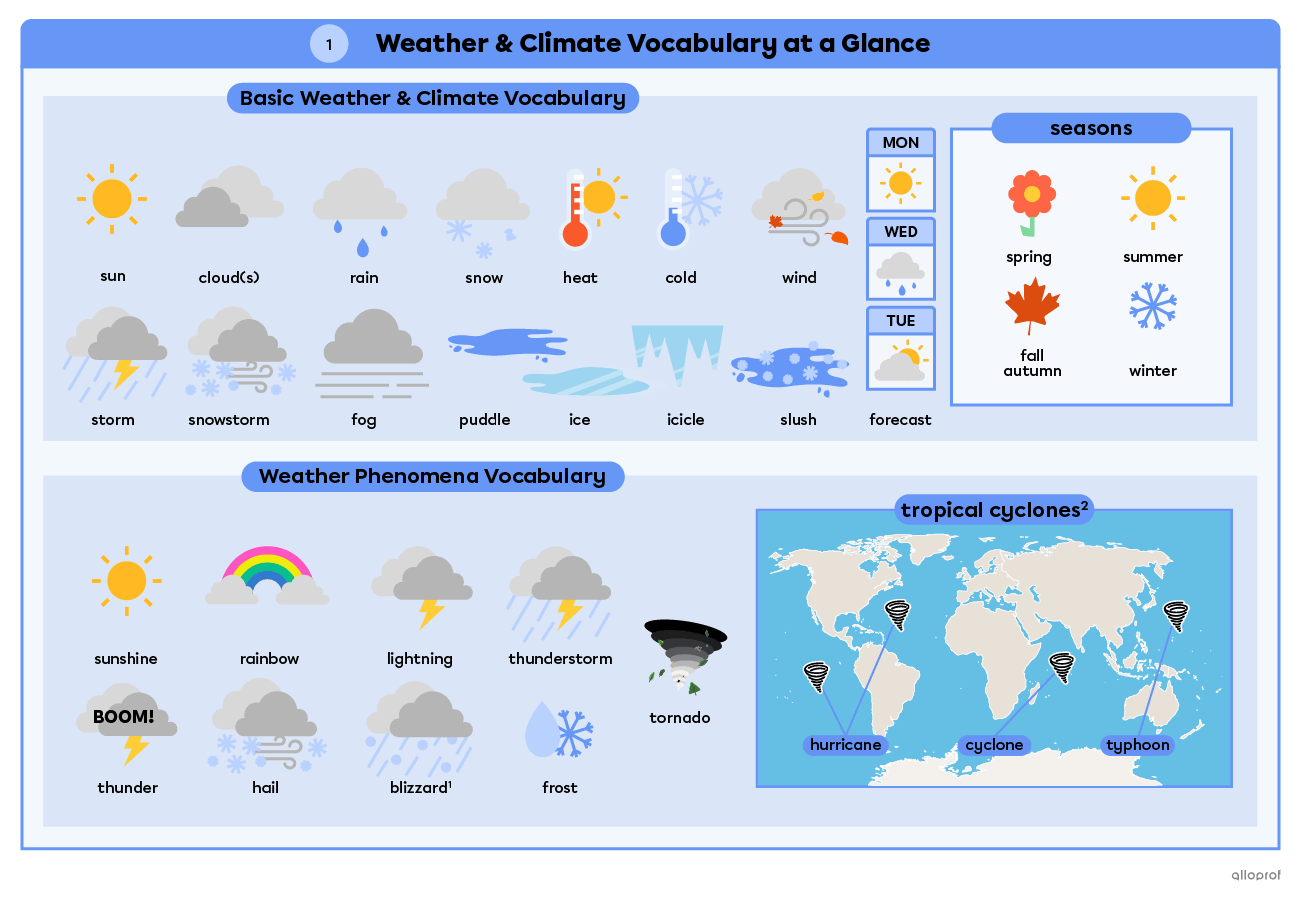
A hurricane, typhoon and cyclone are all the same thing! Their name changes depending on which part of the world they happen.

Hurricane   - Atlantic and Northeast Pacific oceans
Typhoon     - Northwest Pacific ocean
Cyclone      - South Pacific and Indian oceans

Be careful!

Thunder and lightning go together!

Thunder is the sound.
Lightning is what you see.

Precipitation

  • a0304i-blizzard.jpg
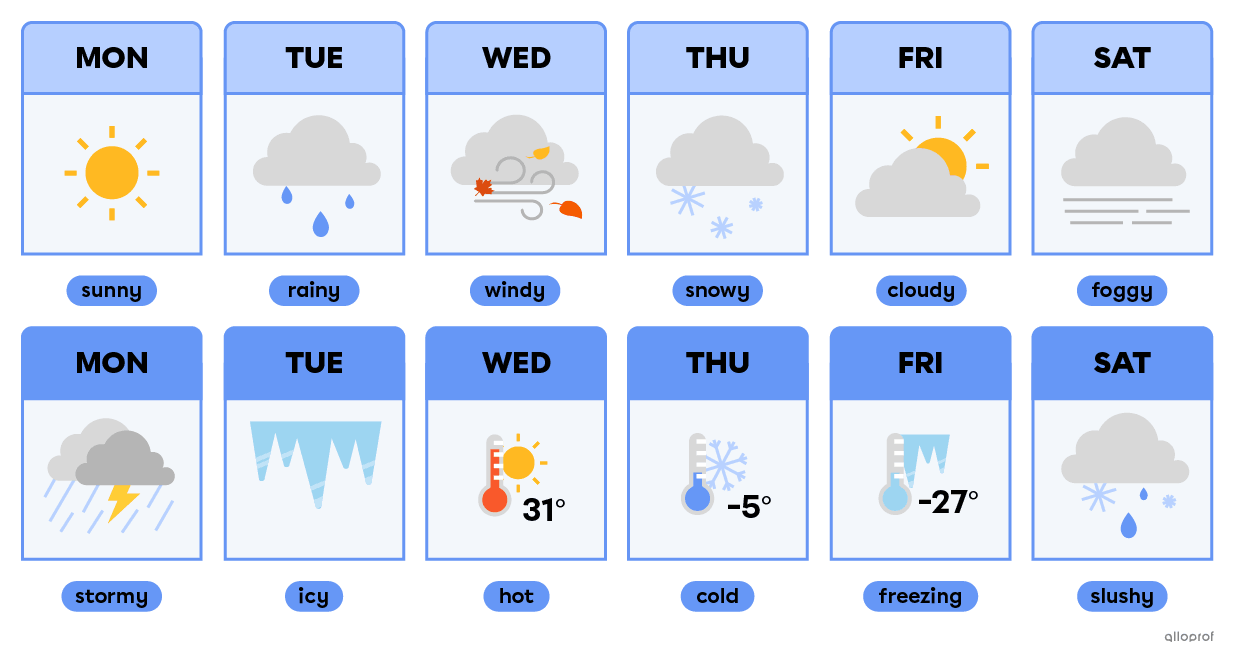
    blizzard
  • a0304i-drizzle.jpg
    drizzle
  • a0304i-dry.jpg
    no precipitation
  • Image
    dry
  • a0304i-flurries.jpg
    flurries
  • a0304i-fog.jpg
    foggy
  • Image
    fog
  • a0304i-freezingrain.jpg
    freezing rain
  • a0304i-hail.jpg
    hail
  • a0304i-rain.jpg
    rain
  • a0304i-snow.jpg
    snow

Temperature

  • a0304i-cold.jpg
    cold
  • Image
    cool
  • a0304i-chilly.jpg
    chilly
  • a0304i-hot.jpg
    hot
  • a0304i-warm.jpg
    warm

Exercices

Exercice

Exercise - Weather

Anglais Primaire1-6

Advanced Weather & Climate Vocabulary

Advanced Weather Phenomena Vocabulary

  • downpour
    A very heavy, sudden and intense rainfall.
  • shower
    A short period of rain.
  • drizzle
    Very light rain with tiny, fine drops that look like a mist.
  • snowfall
    The amount of snow that falls during a specific period of time.
  • flurry
    A very light and brief snowfall.
  • icy rain
    Rain that falls as liquid but freezes instantly when it hits a cold surface. Also called “freezing rain.”
  • freezing rain
    Rain that falls as liquid but freezes instantly when it hits a cold surface. Also called “icy rain.”
  • sleet
    A mixture of rain and snow or rain that freezes into small ice pellets before it hits the ground.
  • smog
    A thick, dirty type of air pollution that looks like a mixture of smoke and fog.
  • breeze
    A gentle, light and refreshing wind.
  • gale
    A very strong, powerful wind.
  • temperature
    A measurement of how hot or cold the air is.
  • humidity
    The amount of water vapour in the air.
  • pressure
    The weight of the air pressing down on the Earth. It is measured with a barometer.
  • precipitations
    Any form of water—liquid or solid—that falls from the sky. This includes rain, snow, sleet and hail.
  • spring thaw
    The period in spring when the snow and ice finally melt because the temperature stays above 0°C.
  • summer solstice
    The day of the year with the most hours of daylight and the shortest night. Around June 20 or 21.
  • autumn foliage
    A season when the leaves on trees and plants change colour and fall off.
  • winter freeze
    The period of time when the temperature stays below 0°C.

Advanced Weather Description Vocabulary

  • light (rain, wind, snow)
    Small in amount, force or intensity. It is the opposite of "heavy" or "strong."
  • strong (wind, storm)
    Having a lot of power, force or intensity. It is the opposite of "light."
  • heavy (rain, wind, snow)
    Great in amount, force or density. It is the opposite of "light."
  • gentle (rain, wind)
    Light and not strong.
  • clear
    A sky with no clouds, fog or smoke.
  • overcast
    A sky covered in clouds.
  • partly cloudy
    A sky with some clouds and some blue sky.
  • below zero
    The temperature is colder than 0°C.
  • minus
    To indicate the temperature is below 0°C. (Ex: minus 10°C.)
  • negative
    To indicate the temperature is below 0°C. (Ex: negative 10°C.)
  • mild
    Weather that is not too cold and not too hot. Weather that feels comfortable.
  • chilly
    Cool, but not freezing weather. You definitely need a sweater or a light jacket to stay comfortable.
  • cool
    Slightly cold in a pleasant and refreshing way.
  • warm
    A comfortable temperature that is between "cool" and "hot."

Weather Expressions

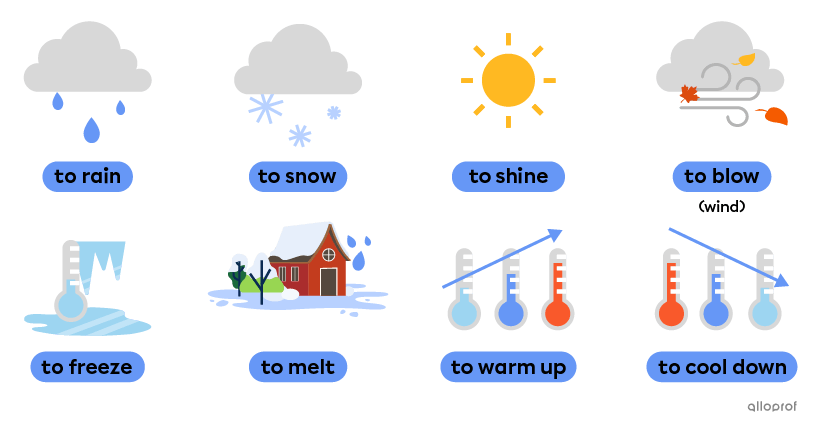
  • to clear up
    When the clouds, rain or fog go away and the sun begins to show.
  • to brighten up
    When the sky becomes lighter because the sun is starting to shine through the clouds.
  • to cloud over
    When the sky becomes covered with clouds, hiding the sun and blue sky.
  • to pour down
    To rain very heavily and continuously.
  • to freeze up
    When something (rivers, lakes, machinery) becomes solid, stuck, or covered in ice so that it can no longer move or work properly.
  • to freeze over
    When the entire surface of a body of water (like a lake, pond or river) becomes covered with a layer of ice.
  • to blow over
    When a storm or bad weather passes by or finishes without becoming serious.
  • snowed in
    When so much snow falls that you cannot leave your home or town.
  • cold spell
    A sudden, short period of time when the weather is much colder than normal. Shorter than a cold wave.
  • cold wave
    A weather phenomenon where the air temperature drops very rapidly and stays extremely cold over a large area for several days.
  • freezing cold
    Extremely cold.
  • scorching
    Extremely hot.
  • heatwave
    A period of several days when the weather is much hotter than normal.
  • dry spell
    A period of time (usually several weeks) with very little or no rain.
  • raining cats and dogs
    To rain very heavily and continuously. A synonym of “pour down.”

Climate Zones

  • tropical
    A climate that is hot all year round, with no winter season.
  • temperate
    A climate that is mild and moderate, with no extreme heat or extreme cold for long periods.
  • arid
    A climate or land that is extremely dry because it receives very little rain or snow.
  • polar
    A climate that is extremely cold all year, with very short, cool summers and long, dark winters.
  • mediterranean
    A climate characterized by hot, dry summers and mild, wet winters.
  • continental
    A climate characterized by extreme differences between a very cold winter and a hot summer.
  • polar
    A climate characterized by extremely cold temperatures, ice-covered waters and treeless land.
  • alpine
    A climate zone found at high altitudes (on mountains), characterized by cold temperatures, thin air and a lack of trees.
  • oceanic
    A climate influenced by the ocean, characterized by cool summers and mild winters, with rain spread throughout the year.

Extreme Climate Effects

  • global warming
    The slow and steady increase in the average temperature of the Earth’s atmosphere and oceans.
  • greenhouse effect
    A process where the Earth's atmosphere traps some of the Sun's energy to keep the planet warm enough for life.
  • sea level rise
    The increase in the average level of the world's oceans.
  • flood
    An overflow of a large amount of water onto land that is normally dry.
  • drought
    A long period of time (months or even years) with very little or no rain or snow, leading to a severe shortage of water.

Weather Measurement Vocabulary

  • thermometer
    An instrument or tool used to measure how hot or cold it is.
  • barometer
    An instrument used to measure the air pressure (also called atmospheric pressure”).
  • hygrometer
    An instrument used to measure the amount of humidity (water vapour) in the air.
  • anemometer
    An instrument used to measure the speed and direction of the wind.
  • rain gauge
    A tool used to measure the amount of rain received.
  • snow gauge
    A tool used to measure the amount of snow received.
  • Celsius
    The metric scale (°C) used to measure temperature, where water freezes at 0° and boils at 100°.
  • Fahrenheit
    A scale (°F) for measuring temperature where water freezes at 32° and boils at 212°.
  • wind chill factor
    A measure of how much colder the air feels on your skin because of the wind.

Exercise – Advanced Weather & Climate Vocabulary

(Coming soon)