"I’m in history class. Looking at the board, I see that there are three tasks to do, but I can’t figure out where to begin. What order should I do them in? I’m so confused. I look at my backpack, take out my notebook, then put it away again, as if that’s going to help me.
It looks like we’re supposed to be working in teams. All around me, people are splitting into groups. The substitute teacher asks me to join one, but I’ve never worked with them before. The sub doesn’t explain things like my usual teacher does. It’s time to start working. There are too many instructions, I feel lost. Everyone’s talking at the same time. I have an idea, but when it comes time to say it, I hesitate. What if my idea sucks? What if I’m wrong? I force myself to listen, but the sound of a falling chair distracts me and I lose my train of thought. My brain is getting overloaded and I’m tired. My mind feels a bit like a maze full of doors that keep closing suddenly, without warning. Ugh, I can’t believe it’s only first period! It’s going to be such a long day.
It’s finally 3:30 p.m. and the bell rings. I’m proud of myself for making it through such a long day! I can finally go home and rest. What?! My bus is cancelled. Oh no! What am I supposed to do? My anxiety level goes through the roof, I feel like I’m going to explode!"
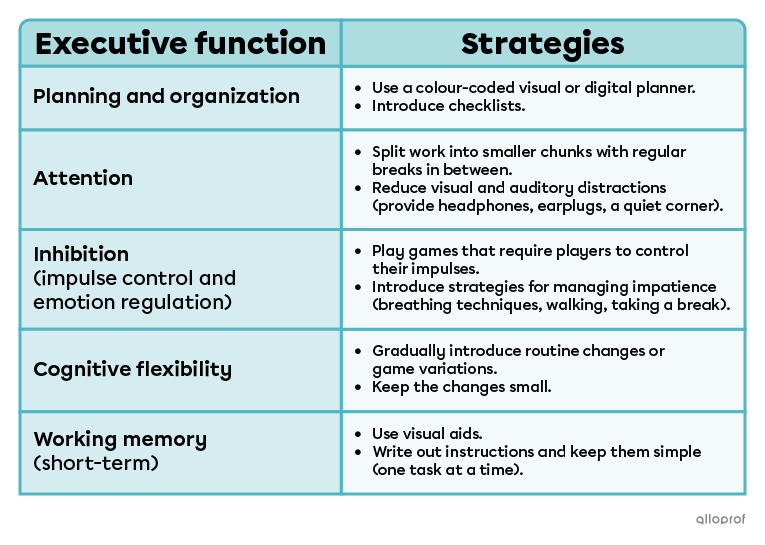
- Leo’s planning and organization functions are tested right from the beginning of his class: He has three tasks to do, but struggles to prioritize them, structure his work, and get started.
- Between the teacher’s instructions, the background noise, and the teamwork requirement, Leo’s selective attention function is constantly “on.” He struggles to stay focused.
- Leo also feels the effects of inhibition, which hinders his spontaneity. He has an idea, but uncertainty and doubt keep him from sharing it. He freezes, afraid of saying something wrong or inappropriate.
- His working memory is overloaded. With too much information to process simultaneously, he forgets some of it before he can put it to use (too many instructions at once, an idea chased away by an unexpected noise). Having a substitute teacher also adds to Leo’s sense of overload.
- The unexpected event at the end of the day tests Leo’s cognitive flexibility. The bus cancellation disrupts his routine. Because he hasn’t had time to prepare for this unexpected change, his stress levels go through the roof.