How to Use AI to Support Your Child’s Academic Success

Article

Artificial intelligence (AI) may seem complex and intimidating, but if used properly, it can become a valuable tool for supporting your child’s academic success. The important thing is to understand both its potential and its drawbacks so you can manage its use well, just as you have learned to do with screen use. 

This article is full of ideas for guiding and supporting your child in using AI for educational purposes.


Learning to Use AI: An Essential Skill for the Future of Our Youth

In our constantly changing world, mastering AI tools has become an essential skill. AI is a natural aspect of digital skills development and information literacy, because to get good output from the technology, you need to know exactly what you’re looking for and how to ask the question. 

AI can also foster autonomy by teaching children to solve problems adapted to their needs and giving them the means to self-assess, for example. 

Effective interaction with AI can help your child build strong research strategies and critical thinking skills, as the answers it provides need to be validated and checked against reliable sources.

Definition

Artificial intelligence (AI) is a vast field of computer science that aims to create machines that can simulate tasks that usually require human intelligence. Here are a few examples of AI that you’re probably already using.
 

  • Algorithm-driven recommendation systems
    • Netflix, TikTok, Spotify
  • Diagnostic tools
    • CT scans, MRIs, X-rays
  • Search engines
    • Google’s Overview, Bing’s Copilot 
  • Virtual assistants
    • Siri, Alexa, Google Assistant


Generative AI (GenAI) is a specialized type of artificial intelligence. It’s an AI application capable of generating content (text, images, videos, sound, etc.) from the data stored in its information bank. This is the type of AI used in chatbots like ChatGPT and Gemini.

Here are a few examples of GenAI:

  • ChatGPT, Gemini, Claude
  • DALL-E, Midjourney
  • AI music generators
  • AI video generators
  • AI code assistants

How to Use AI for Educational Purposes

AI can be used to assist learning and thinking processes. As a parent, you can show your child tangible ways to use AI for educational purposes.

  • Planning

GenAI can help with organization by creating a study schedule or planning out their work and priorities. 

  • Brainstorming

GenAI can help with writer’s block by suggesting writing prompts or creating a mind map of ideas that your child can then develop.

  • Studying assistance 

GenAI can help with studying by creating review sheets, personalized questions, and quizzes.

  • Complex concepts 

GenAI can help break down complex concepts in a language that’s easy to understand. It can also translate word or sentences, and even read texts out loud to provide reading support.

  • Creation 

AI can convert audio notes to written notes (speech-to-text). It can also do the opposite, reading your child’s written work out loud so they can hear what the audience will hear and use the information to improve their speech or presentation. AI can also generate summary diagrams, tables, infographics, songs or stories containing elements that your child needs to memorize and study, and more.


How to Formulate a Prompt for Educational Purposes

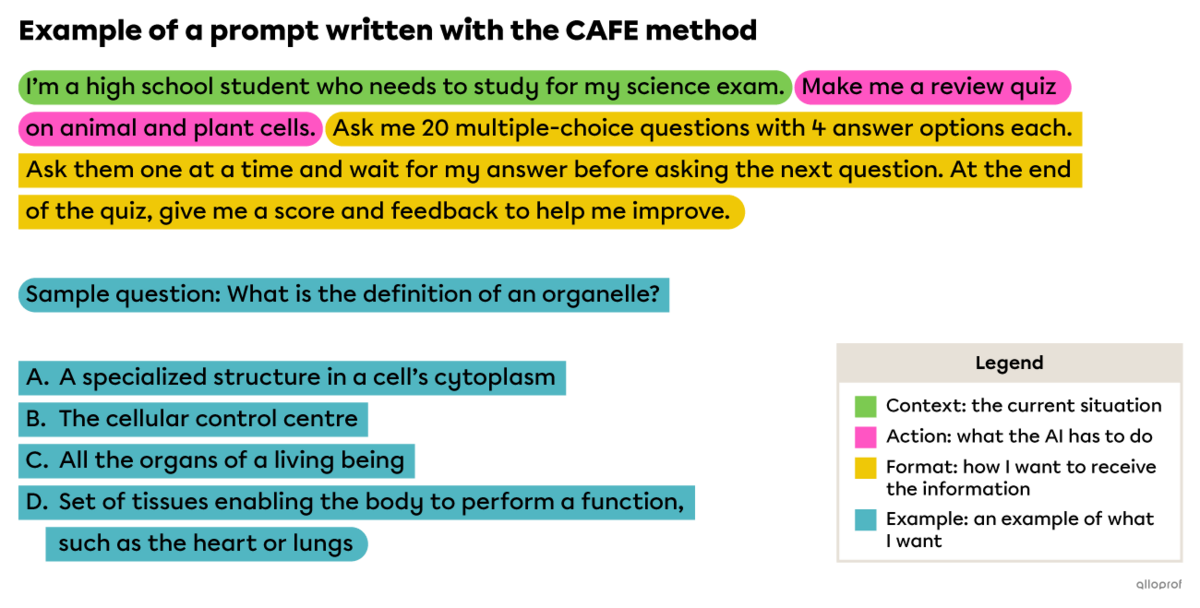
To help your child interact effectively with GenAI, they need to learn how to formulate good prompts. The CAFE method, with its easy-to-remember acronym, is a checklist designed to help your child structure their thoughts before asking AI to help with something. A good prompt is the key to accurate and useful results!

C for Context

  • What is it? The context gives the AI all the basic information it needs. This is where we define the situation, the role to be played, the target audience, or the sources to be used.
  • Example: In a prompt for a quiz, the context might be: “I’m a Sec. II student and I need to study for my science exam.”

A for Action

  • What is it? The action is the main task we’re asking the AI to perform. This is the action verb of the prompt.
  • Example: For the quiz, the action would be: “Make me a review quiz on animal and plant cells.”

F for Format

  • What is it? The format specifies how you want the AI to present the information. You can ask for a list, a table, a precise word count, or specific instructions for the answer.
  • Example: “Ask me 20 multiple-choice questions with 4 answer options each. Ask them one at a time and wait for my answer before asking the next question. At the end of the quiz, give me a score and feedback to help me improve.”

E for Example

  • What is it? An example is often the finishing touch that guarantees a quality response. The aim is to provide a model of what is expected. It’s a great way to model your expectations for the AI.
  • Example: “Sample question: What is the definition of an organelle? A. Specialized structure . . . B. Control centre . . .”

Example of the CAFE method in action:

Example of the CAFE method in action

Safety Considerations

As with almost any tool, the way we use AI can make it more or less safe. GenAI tools are very new and the policies governing them are still evolving. So it’s only natural that as a parent, you have concerns about the technology’s safety. Here are a few tips to help you develop safe AI guidelines for your child. 

  • Discuss AI openly with your child. 

If your child sees that you’re interested in AI and that you’re open to talking about it without judgment, they’ll be more likely to share their own opinions, fears, preconceived notions, and so on. Explain to them that AI can sometimes generate inappropriate content or misinformation. AI is a powerful tool, but sometimes it gets things wrong.

  • Talk about cheating.

It’s important that your child understands the difference between assistance and cheating. Make it clear that submitting an assignment written entirely by AI is a form of plagiarism. AI can be great for helping your child practise, get a project started, or structure their thoughts and ideas, but all work they submit must be their own. The goal is not to find a shortcut, but to develop critical thinking skills by interacting with GenAI. Remind your child to cite their sources. If an idea, sentence, or piece of information they use originated from GenAI, they have to mention it. By doing so, your child will develop intellectual integrity and get in the habit of properly documenting their research.

  • Protect personal information. 

Advise your child not to share personal information (name, address, school, etc.) with GenAI platforms, because the tool may not treat the information as confidential.

  • Think about digital sobriety.

The golden rule of environmental responsibility—that the most sustainable approach is to consume fewer resources—applies equally to our relationship with GenAI use. Just think about how much energy it takes to run prompts and all the resources required to operate data centres.

Digital sobriety also focuses on our mental well-being, which means rethinking our relationship with technology. GenAI can be addictive and for some, it can even distort reality. What’s more, over-reliance on GenAI can lead to intellectual laziness. 

  • Contact the school. 

Make sure your child has asked about their existing policies on the use of AI for educational purposes. Each school has its own standards and limits when it comes to using the technology for school work.
 

References