How to Talk to Your Child about AI

Article

Artificial intelligence, or AI, has been on everyone’s lips for some time now. There is a lot of information circulating, but few certainties have emerged. It is only natural that there are many concerns, particularly among parents who are worried about the impact AI could have on their children’s education and development. This article offers a quick overview of AI and a few tips on how to talk about it with your child.
Understanding the Basics of Artificial Intelligence

What Is Artificial Intelligence?

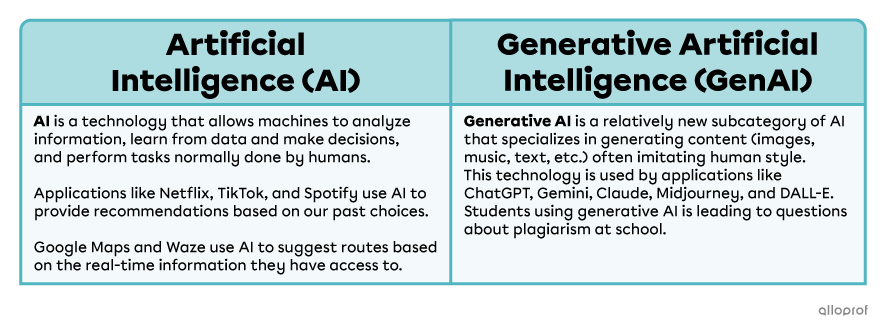
AI is a set of technologies designed to mimic human intelligence. Artificial intelligence analyzes huge quantities of information and generates complex mathematical calculations (algorithms) to make decisions. It learns from its mistakes and from the information it is given. The more information provided, the better and more complete the machine becomes.

Did you know

You and your child probably use AI without even realizing it, for example, when you do the following:

  • Use a navigation app to calculate the fastest route to another location
  • Browse social media
  • Ask a voice assistant to play a particular song
  • Get recommendations on which show or song to play next

Is AI New?

No, artificial intelligence is not a new phenomenon. In fact, it was in the 1950s that the Turing Test was first used to test the intelligence of a computer.

Generative AI platforms like ChatGPT and Midjourney, which automatically generate text and images, attract a lot of attention these days—but these new applications are based on decades of research and development. Here are a few other milestones in the history of AI:

  • In 1997, the world chess champion was defeated by a supercomputer named Deep Blue.
  • In 2011, the virtual assistant Siri made its debut.
  • In 2022, generative AI was made available to the public with the launch of ChatGPT.
Definition

AI vs. Generative AI: What’s the Difference?

AI vs GenAI

Discussing the Impact of AI

Artificial intelligence is a bit like fire—very useful if you know how to use it properly, but dangerous if you don’t take the necessary precautions. Knowing that AI will be used in an increasing number of contexts over the next few years, it is a good idea to discuss the benefits and risks of this technology with your child and answer any questions they may have.

As with social media, the recommended approach is to educate and supervise your child, rather than banning them from using AI. Here is an overview of what you need to know.

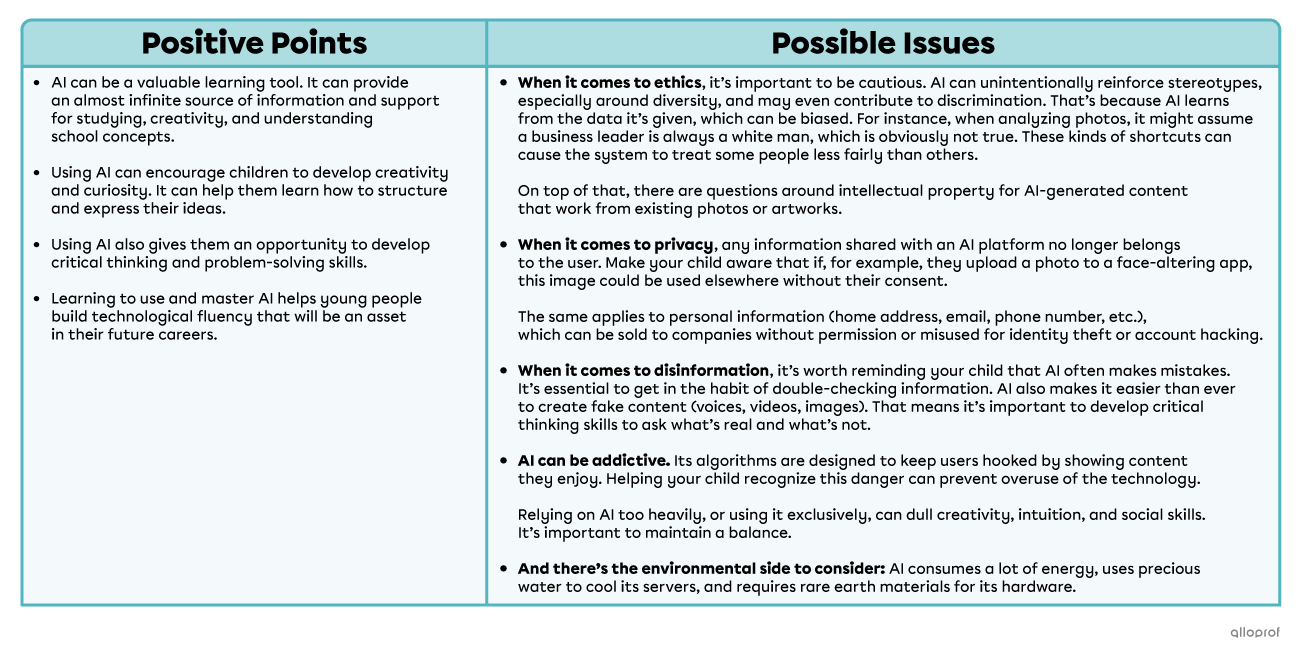
AI has many upsides. On the other hand, artificial intelligence also presents some risks if it is not used responsibly. There is no clear regulation yet guiding the use of AI, but here are some points that you and your child should pay particular attention to. 

Discussing AI's Pros and Cons
Be careful!

Are you worried about your child using artificial intelligence to do their schoolwork? Check out this article on how to help your child avoid plagiarism.

Discussing AI with Your Child

Whatever your level of knowledge, discussing artificial intelligence with your child can be very beneficial for developing their critical thinking skills. There is no need to give a 10-minute oral presentation on the subject—understanding the basics is enough to start a discussion with your child. You can also explore AI together. And who knows? Maybe your child will teach you a few new things.

How to start the discussion:

  • If your child has already brought up AI, ask them about what they know and correct their understanding if necessary.

  • Observe how AI works together. For example, test out its image recognition or voice recognition capabilities.

  • Put yourself to the test by trying to identify AI-generated images (available in French only).

  • Read books together, or suggest a book from our reading lists for elementary and high school students.

  • Explore generative AI together by asking your child this question: “Do you have any ideas about how artificial intelligence could help you?” Based on their answer, test out some ideas and talk about the results together.

Here are some more tips:

  • Be proactive. Rather than ignoring the existence of AI, teach your child how to use it responsibly.

  • Highlight your child’s human abilities (curiosity, creativity, empathy, sensitivity, etc.) compared to artificial intelligence, which is basically just a machine.

  • Make your child aware of the risks discussed above, but try not to dampen their enthusiasm for the possibilities of AI.

  • Remind them that AI is a useful tool, but that there are also many other resources that can help them succeed: Alloprof, search engines, online encyclopedias, books, peers, parents, teachers, etc. Encourage variety.

  • Remind your child that generative AI can have biases and that it offers a perspective that is not necessarily representative of the experience of everyone in the world.

  • Encourage your child to think carefully before entering data into AI tools in order to limit the amount of personal information they share.

Did you know

References