Using elections to discuss school concepts: Mission possible!
During an election campaign, candidates’ signs start cropping up everywhere you look and political debates become a hot topic as the election turns into front-page news. Politics can also find its way into your day-to-day conversations. Kids pay attention to what goes on around them, so it should come as no surprise if your child starts asking questions. Talking to them about elections is simpler than it sounds, and you can make connections with a number of school subjects in the process. Read on to find out how!

Start with some history
Consider broaching the topic of elections by summarizing key moments in history. For example, did you know that before 1875, voting was conducted orally and publicly in front of the candidates and their supporters? Today, voting is done freely by secret ballot. In addition, people have often had to fight for their voting rights. It was not until 1940, for instance, that women obtained the right to vote in provincial elections. For other important dates, check out the One hundred years of supporting democracy on the Elections Canada website.
See geography in a new light
Elections can be a chance to explore local geography in a new way. There are tourist maps of Quebec and maps of its administrative regions, but there is also an electoral map of the province. This map divides Quebec into 125 electoral divisions, each comprising about 48,000 voters. During provincial elections, citizens vote to elect the person who will act as the representative for their electoral division. You can find the name of your electoral division on the electoral map of Quebec.
Build vocabulary
Democracy, candidate, returning officer, ballot box, and polling booth are all words that have to do with elections. The election period is a good excuse to enrich your child’s vocabulary with terms that will help them better understand certain texts on the subject. Élections Québec has a vocabulary page (available in French only) that defines 130 key concepts! You can also test your family’s knowledge with the activity A close look at democracy.
Learn about the media
During elections, a lot of information is communicated through newspapers, radio and television, political parties’ websites, and, of course, social media. There are also news sources geared specifically toward young people, such as MAJ and Les As de l’info (both available in French only). All of these are great examples of reading material to suggest to your child, who will not only learn more about current events but also develop their media literacy, an increasingly important academic skill.
Put math into practice
Elections produce a lot of data. There are the voting results of course, but there is also voter turnout. Calculating this information is an original way to analyze numbers and figures and make sense of mathematical concepts such as percentages, statistics, graphs, and more. You can use the election results to make math exciting and relevant!
What if your child asks you what the voting process is like?
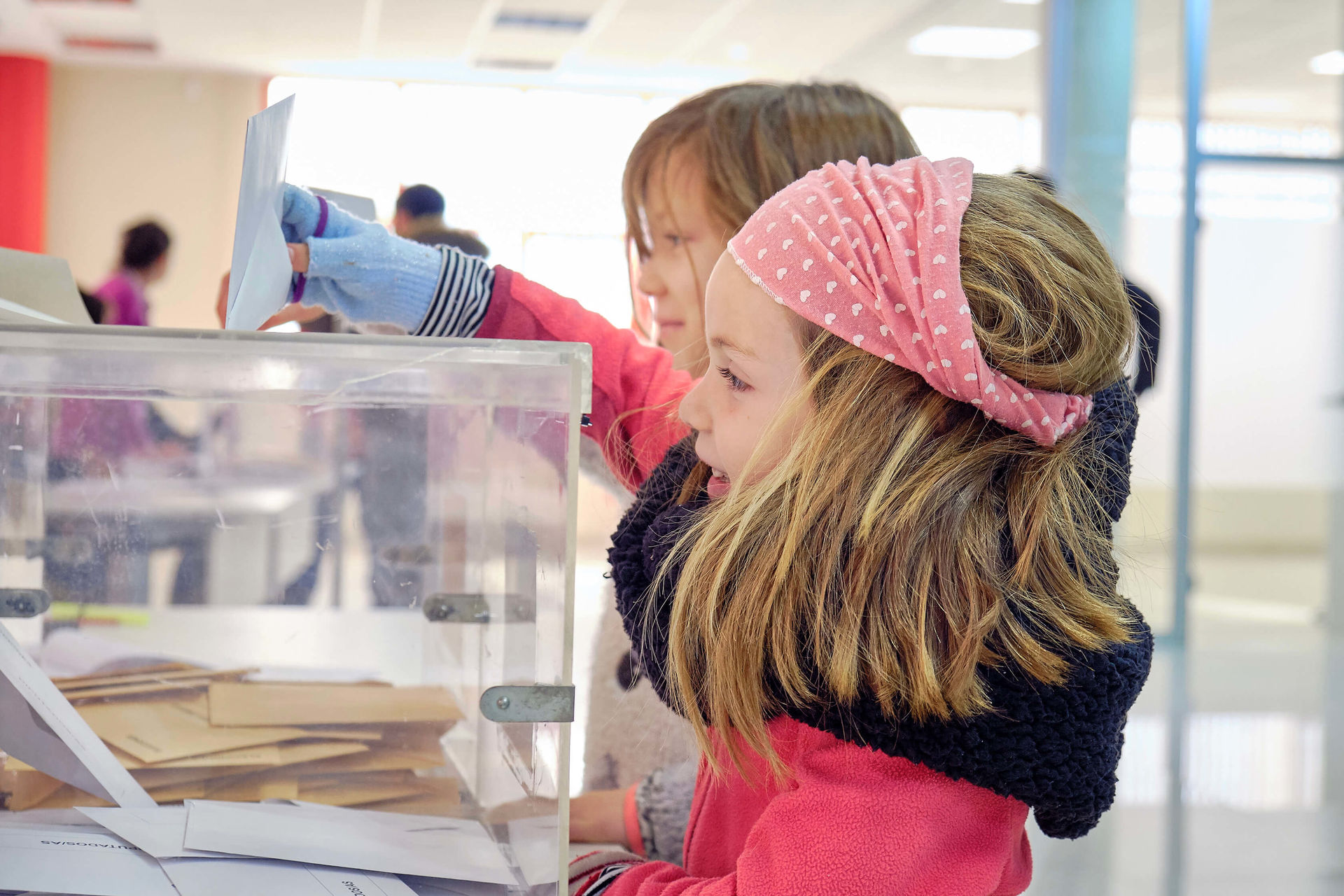
Simple: bring them with you when you vote in the next election! Take your children to the small polling stations. This “Voters in training” program gives kids the chance to vote at small polling stations. Your child will receive a ballot and get to answer a question designed for children.
Elections allow people over the age of 18 to vote for individuals who will represent them and make important decisions for the future of our society. Discussing this topic with your child will help them better understand the way our democracy works and gradually prepare them to become a responsible citizen!