Plays & Scripts – Types of Texts | Elementary

Concept sheet | English Language Arts

What Are Plays & Scripts?

Plays & Scripts are stories written to be performed or acted out.

Are Plays & Scripts the Same Thing?

Plays & Scripts share a lot of similarities, but also have important differences.

Similarities in Plays & Scripts

Here are some examples of things found in both plays and scripts.

Written to be acted out
• Story that is meant to be performed by actors
• Will involve actors and an audience

Contain
• A lot of dialogue
• Some directions on
→ Where and when the story is taking place
→ How the story unfolds

Organized
• Story is split into smaller parts called scenes
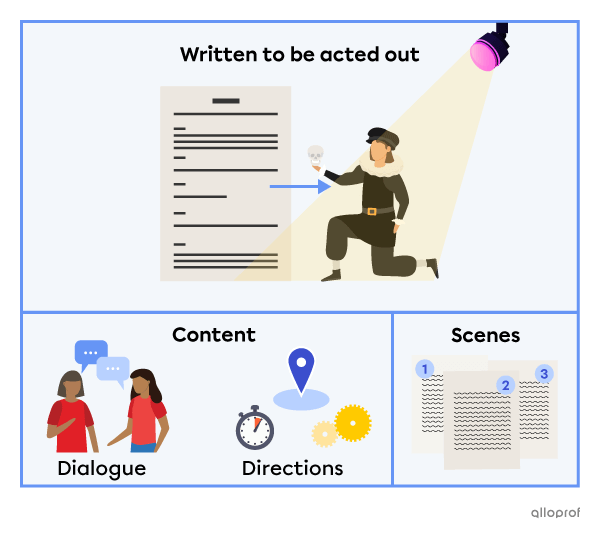
Picture of a script and an actor performing to show that scripts and plays are written to be acted out. Two characters with speech bubbles to represent dialogue. Directions are represented by a clock, a map pin and a gear. The senses are represented by a stack of numbered pages.

Differences Between Plays & Scripts

Differences

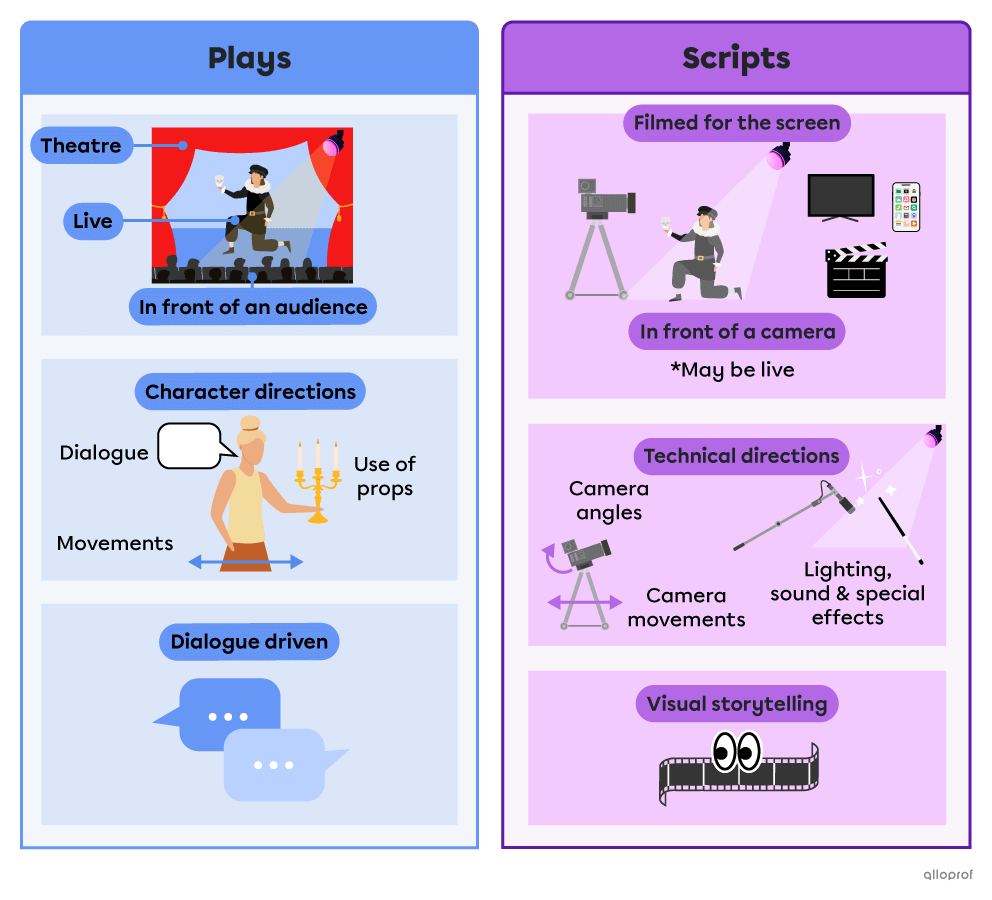
Plays

Scripts

Performance

• In a theatre
• Live on stage
• In front of an audience

• Filmed for the screen
• In front of a camera
*May be live in some cases (Newcasts, morning shows, award shows…)

Directions & instructions

Character oriented
• Dialogue
• Movement
• Use of props

Technical
• Camera angles
• Camera movements
• Lighting, sound & special effects

Storytelling type

Dialogue-driven

Visual storytelling

A comparison between plays and scripts. For plays, an actor is performing on stage in front of an audience in a theatre, and for scripts an actor is performing in front of a camera for the screen. For directions in a play, an actor is speaking (speech bubble), holding a candlestick (a prop) and walking (movement). For directions in scripts, a camera is tilted and moving (camera angles & movements), a spotlight shines, a microphone is recording and a magic wand is making special effects. Two speech bubbles i

What Can We Expect to Find in Plays & Scripts?

Here are some of the most common elements you can find in plays and scripts.

Dialogue
→ Identified by character names

Short scene descriptions to explain:
→ Where the scene takes place
→ How the characters are feeling or behaving
→ The mood, focus or meaning of the scene
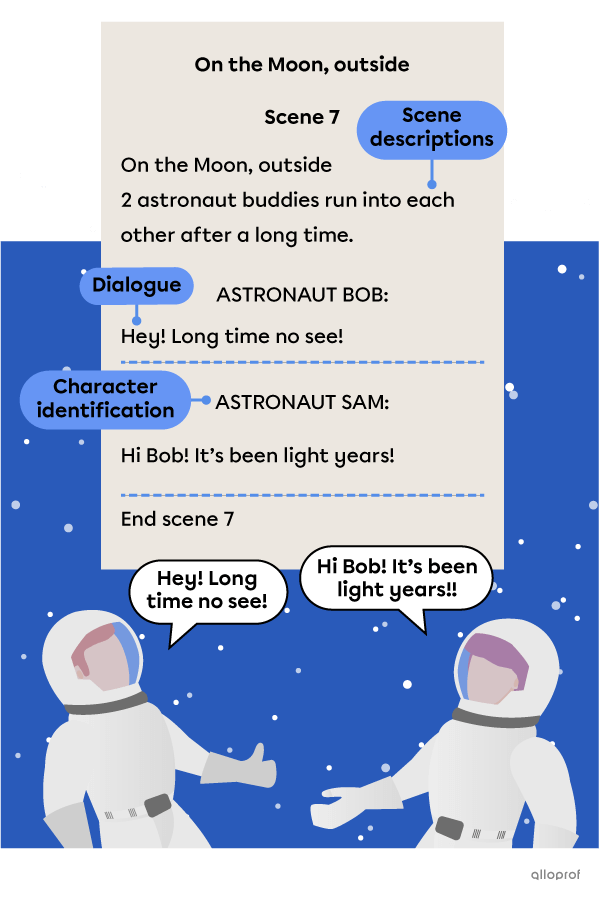
Picture of a script titled: “Tale of the Moon Base, Scene 7.” A description says: On the Moon, outside; 2 astronaut buddies run into each other after a long time. Labels identify the dialogue and the character names. The character named Astronaut Bob says: “Hey! Long time no see!” and the one named Astronaut Sam says: “Hi Bob! It’s been light years!” Below, 2 astronauts are illustrated playing that exact scene.

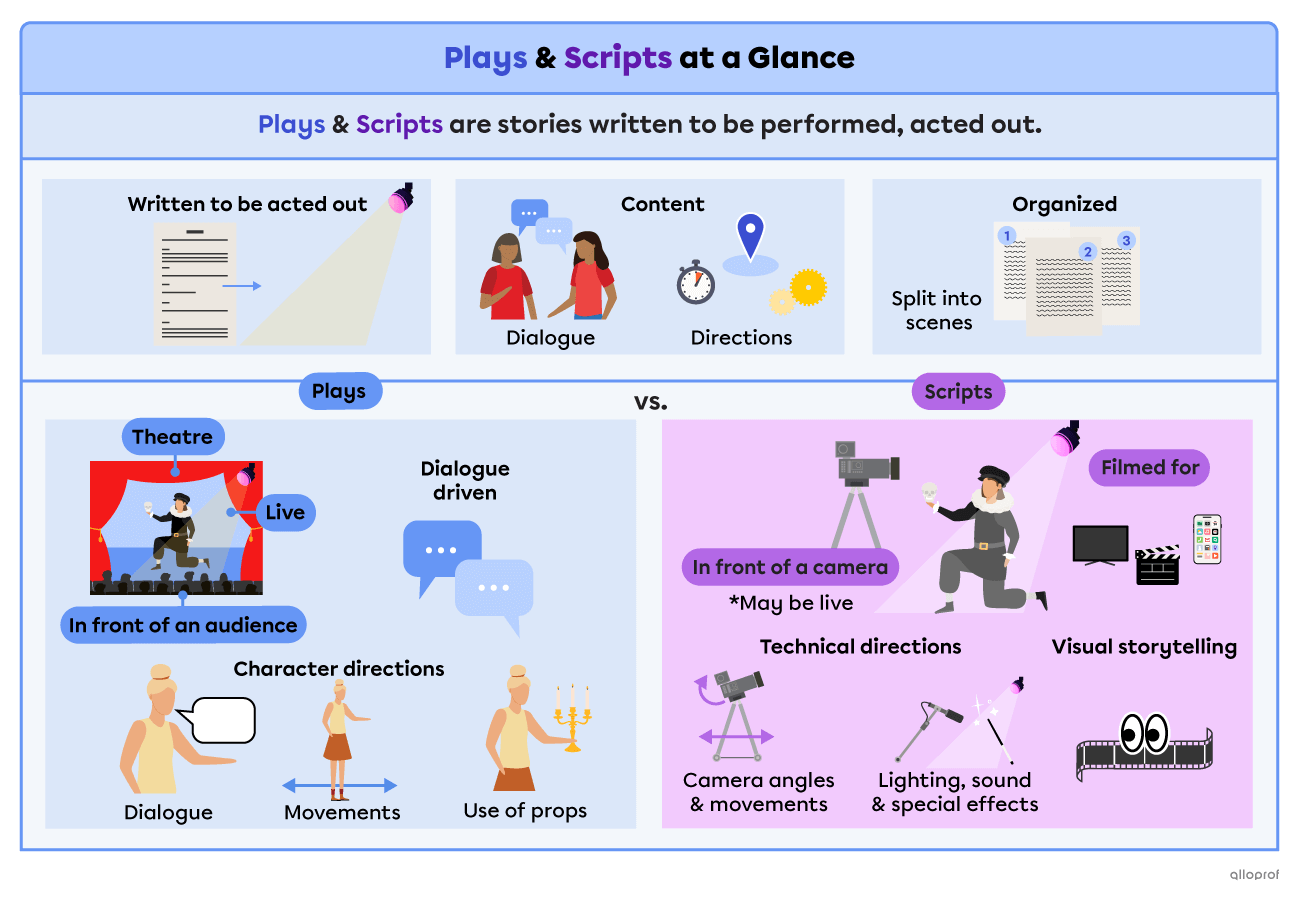
Plays & Scripts at a Glance

Summary of the features and differences between plays and scripts. The first part is a picture of a script and an actor performing to show that scripts and plays are written to be acted out. Two characters with speech bubbles to represent dialogue. Directions are represented by a clock, a map pin and a gear. The senses are represented by a stack of numbered pages. The second part is a comparison between plays and scripts. For plays, an actor is performing on stage in front of an audience in a theatre and fo