Procrastinate no more with help from Alloprof!

Concept sheet | Study tips

Ever find yourself lingering over picking the right font for your essay or browsing social media instead of studying for a test? Everyone is guilty now and then of choosing easier or more enjoyable tasks over those that need to get done. Sometimes, however, procrastination can have a detrimental effect on your academic progress and success. Read on for some helpful tips on how to break the cycle of procrastination.

Procrastinate no more with help from Alloprof!

Understanding procrastination

Procrastination means putting things off that need to get done. For example, you might avoid cleaning your room even though you can’t find your favourite T-shirt, or you might decide to start a new exercise routine next week instead of today. When it comes to schoolwork, dragging your feet can mean having to cram for a test or being forced to pull an all-nighter to finish a 1000-word essay due the next day.

Important!

Procrastination often stems primarily from performance anxiety and perfectionism rather than issues with time management. This is especially true for chronic procrastinators—those who constantly postpone tasks. Chronic procrastinators often put things off because they’re afraid they won’t do a good job, choosing instead to do something that lifts their spirits.

Procrastination can also lead to feelings of shame, guilt, and anxiety. And tasks don’t simply go away! Instead, they accumulate into a seemingly endless to-do list. You wind up in a vicious cycle of procrastination: you shelve a task, which brings on negative feelings, which leads you to find something fun to do to forget your guilt and anxiety. Wash, rinse, repeat! Of course, when it comes to school, procrastination can mean a failing grade on a test or project. So what can you do to get motivated?

What to do

There are many strategies you can use to work towards breaking the cycle of procrastination. Here are some suggestions to help you get started:
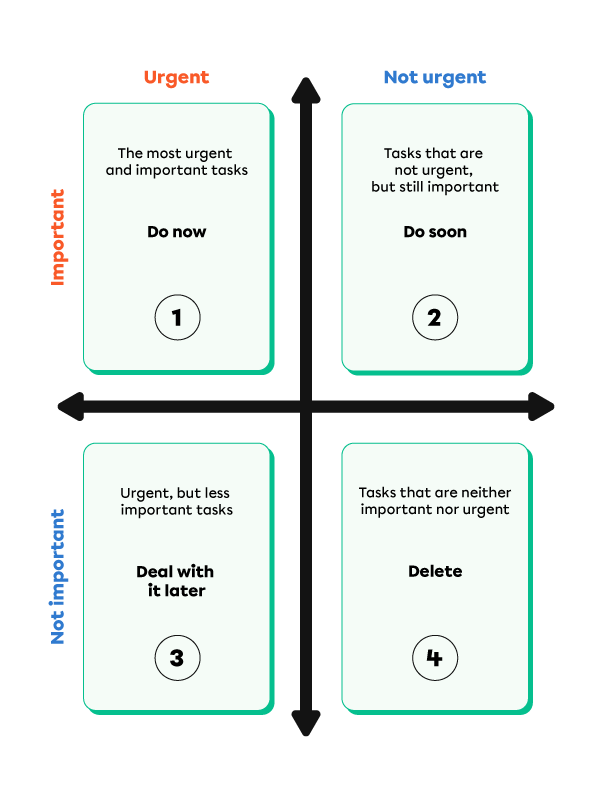
  • Prioritize what needs to get done. It’s important to distinguish between activities that are both urgent and important and activities that can be set aside for the time being. An effective tool for making this distinction is the Eisenhower Matrix, which has four quadrants. Each quadrant determines the priority level of tasks. The upper left quadrant is reserved for activities that are both urgent and important, meaning they should be done first. A good example is studying for an end-of-unit test. The upper right quadrant is for tasks that are important but not urgent, such as an essay due in three weeks. You have to write it eventually, but it doesn’t need to be done right away. The bottom left quadrant is for tasks that are urgent but less important. Perhaps you need a new graph book for math class because the one you have is almost full. This is a task that you can delegate to someone else; perhaps a parent can pick one up for you on their way home from work. Lastly, the bottom right quadrant is for tasks that are neither important nor urgent. It’s still a necessary part of the matrix, however—and, for that matter, your life! Think of it as the place where you can take breaks, have a nap, hang with friends, and simply chill out.

aider-enfant-prendre-decisions-quotidien-EN

  • Make a plan. Once you’ve established a list of priorities, the next step is to break down each task into smaller, more manageable steps. For example, when studying for an end-of-unit test, don’t try to do everything at once. Instead, spread the content you need to study over several days.
  • Use your agenda or a calendar. Agendas and calendars are great tools for setting priorities. By writing things down, you can get a sense of the big picture, and it will be that much harder for you to sweep things under the rug. Still, remember to be realistic with your time and to schedule all-important study breaks.
  • Establish how long you can stay focused and productive. One great approach is the Pomodoro (yep, as in tomato!) Technique. Set a timer for 25 minutes of work, then take a 10 minute break. Repeat four times. Afterwards, assess your level of concentration. Can you increase the amount of time spent on work, or do you need a longer break between tasks? Our Motivational Timer is a handy tool for this exercise!
  • Reward yourself. For example, turn your to-do list into a fun activity. Write each of your tasks, as well as various rewards (drawing, checking your social media, watching a funny video, reading a chapter from your book, etc.), on pieces of paper and put them all in a bowl. Then, draw one at random and complete the task or reward. Keep going until the bowl is empty, which could be by the end of the day or your study session.

What to avoid

It’s easy to get discouraged when attempting to change a habit, especially when it involves procrastinating on school tasks. To avoid losing motivation, keep the following in mind:

  • Don’t label yourself. Remind yourself that you are not lazy or indifferent. Try to pinpoint the reasons why you are delaying a task. Are you afraid of failing? Are you worried your work won’t be good enough? Are you less confident in this particular school subject? Acknowledging your emotions will help you better manage your workload. You can also try training your brain to see school challenges differently.
  • Don’t be hard on yourself. Change takes time. If you fumble, then try again the next day, or for the next test or school assignment. It’s important to forgive yourself. Remember: Slow and steady wins the race! Here are some motivational quotes that may help you.
  • Don’t jump in without a plan. Remember to break down your tasks into smaller steps. Both your motivation and your confidence will increase as you cross off each smaller sub-task from your to-do list.

One final tip: Ask for help if you’re feeling overwhelmed. Turn to a parent, a sibling, your BFF, a teacher, or a member of the school community. Alloprof also has two support services for you—the Help Zone and Ask a teacher!

References