Subjects
Grades
To access the other concept sheets in the Cities Subject to Natural Hazards module, check out the See Also section.
 100%
100%
 100%
100%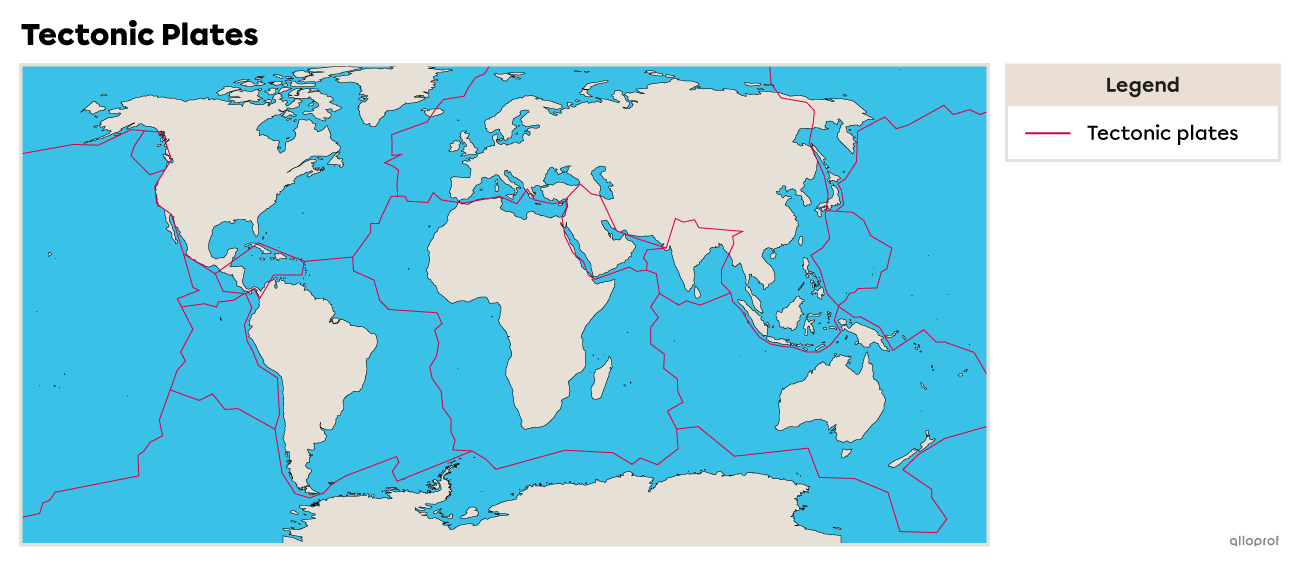 100%
100%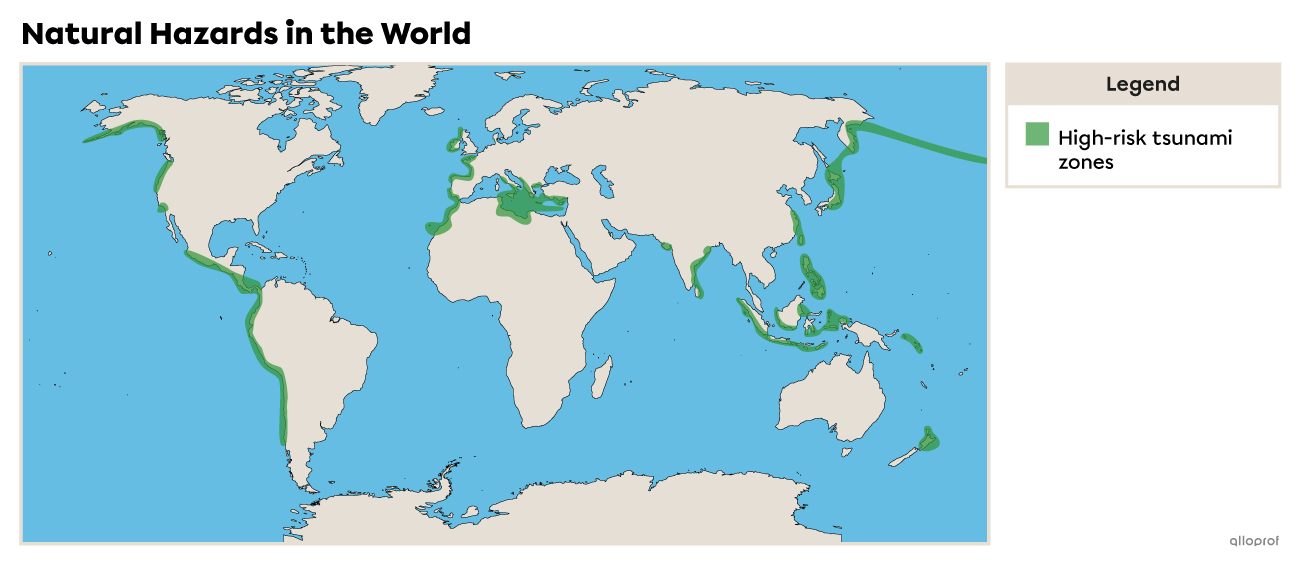
| Causes | Earthquake or underwater volcano |
|---|---|
| Wave speed | Up to 800 km/h |
| Wave height | When they reach the coast, they can be up to 30 metres high |
| Consequences | Serious material damage and loss of life because the waves can reach many kilometres inland |
| Location | 80% of tsunamis occur along the Ring of Fire |
Source: National Geographic, (s.d.)[8]. |
|
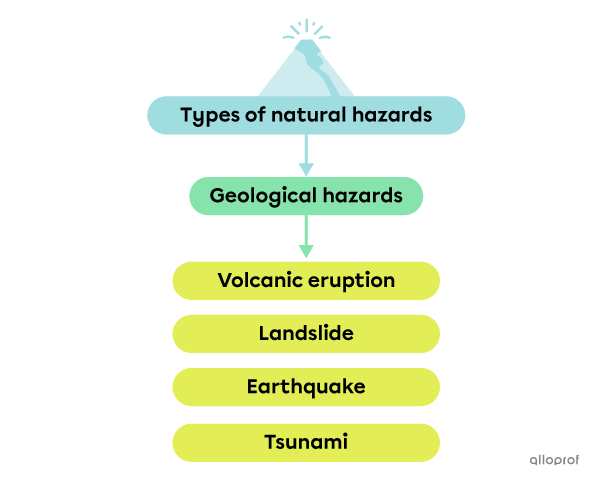
Geological hazards are natural hazards related to the movement of tectonic plates and the Earth’s crust.

A volcanic eruption is the expulsion of lava, gas and/or ashes by a volcano.
A volcanic eruption can cause lava flows as well as clouds of ash and toxic gases. All of these elements represent a hazard for the populations living near a volcano. People who live several kilometres from a volcano can also be at risk, since winds can carry clouds of ash and toxic gases over great distances.
Volcanic eruptions take different forms.
These volcanic eruptions cause many lava flows, which can reach an average speed of 25 km/h and attain a temperature of 1200°C. They are referred to as “red volcanoes”[1].
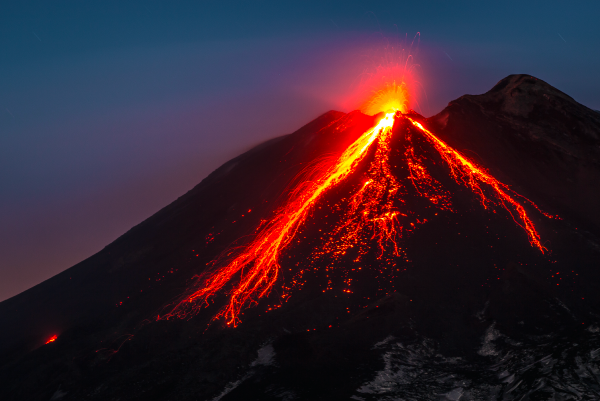
Eruption of Mount Etna in Sicily, Italy
Explosive volcanic eruptions are generally much more dangerous since they are often unpredictable. Lava, ash and rocks are projected into the air and can land hundreds of kilometres away. These are referred to as “grey volcanoes” because of the huge grey cloud formed by the ash and toxic gases.
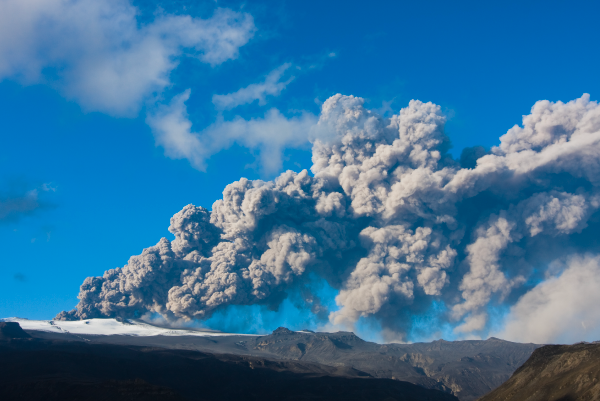
Eruption of the Eyjafjöll volcano in Iceland in 2010
The duration of a volcanic eruption can vary from a few minutes to a few hours, a few days, a few weeks, a few months and, in some cases, a few years. The average duration of a volcanic eruption is one-and-a-half months. The Kílauea volcano, in Hawaii, is the most active volcano in the world, with a volcanic eruption that has been ongoing for 39 years. Even more impressive, Stromboli, in Italy, has been spitting lava approximately every 15 minutes for over 2400 years.[2]
There are more than 1500 active volcanoes on Earth and most of them are located along the Ring of Fire. There are also approximately 1.5 million volcanoes hidden under the oceans[2].
The Pacific Ring of Fire is a path along the Pacific Ocean with a lot of earthquake and volcanic activity because there are more than a dozen tectonic plate boundaries there. The Ring of Fire is:
40,000 km long
the site of 75% of the world’s volcanoes
the site of 90% of the world’s earthquakes[7]
An earthquake is more or less violent shaking of the Earth’s crust caused by the movement of tectonic plates.
Each year, there are millions of small earthquakes. Most are too small to feel[3]. In Canada, there are 4000 earthquakes a year, but most of them are not felt[4].
The scale most commonly used to measure the magnitude of an earthquake is called the Richter scale.
| Magnitude of an earthquake | Impact |
|---|---|
| Less than 3.5 | An earthquake of this magnitude is detected by seismographs, but is not usually felt by people. |
| 3.5 - 5.4 | At this magnitude, an earthquake is often felt, but rarely causes damage. |
| Less than 6.0 | An earthquake of this strength can cause slight damage to buildings and solid infrastructure. However, it can cause major damage to people close to the epicentre, where the movement originates. |
| 6.1 - 6.9 | Between these magnitudes, an earthquake can cause damage over an area up to 100 km around the epicentre. |
| 7.0 - 7.9 | An earthquake with a magnitude of 7.0 or more is considered major and can cause serious damage to infrastructure over hundreds of kilometres. |
| 8.0 - 8.9 | An earthquake of these magnitudes causes very serious damage and loss of life over an area of hundreds of kilometres. |
| 9.0 and above | An earthquake with a magnitude of 9.0 or more is rare. It causes serious material damage and can lead to great loss of life over a 1000-km area. |
Source: Government of Canada, 2021[5]. |
|
Magnitude is the strength of an earthquake. It is measured using the Richter scale, which ranges from 1 (the weakest) to 9 (the strongest).
A tsunami is a series of huge waves triggered in the ocean that can cause major damage to inhabited areas along the coast.
| Causes | Earthquake or underwater volcano |
|---|---|
| Wave speed | Up to 800 km/h |
| Wave height | When they reach the coast, they can be up to 30 metres high |
| Consequences | Serious material damage and loss of life because the waves can reach many kilometres inland |
| Location | 80% of tsunamis occur along the Ring of Fire |
Source: National Geographic, (s.d.)[8]. |
|
A landslide occurs when the soil along a slope becomes unstable. The soil collapses and can lead to the downward movement of mud, earth, rocks and debris.
Landslides are the most widespread geological hazard and can occur anywhere in the world. Between 1998 and 2017, 4.8 million people around the world were affected by landslides, causing 18 000 deaths[10]. Landslides that occur in cities can cause serious damage to buildings, roads, bridges and other infrastructure.
Many factors can cause landslides:
erosion
heavy rainfall
rapid snow melt
angle of the slope
soil properties (clay, sand)
drainage work, tree cutting or other types of work