Subjects
Grades
The concepts covered in this factsheet go beyond those seen in secondary school. It is intended as a supplement for those who are curious to learn more.
Today, most countries are democratic. However, some countries have more authoritarian political systems. There are also different degrees of democracy. Since 2006, the British magazine The Economist has been compiling data on all countries to calculate their democracy index.
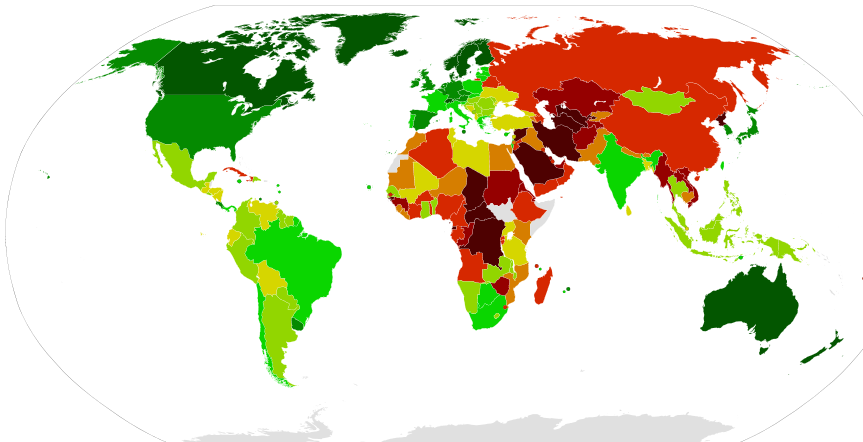
Note : English image coming soon!
It is possible to see the regions of the world where the democracy index is lower. The colour green is used to identify countries with a high level of democracy, yellow for an average level and red for non-democratic, authoritarian states.
Countries with a high democracy index respect four basic principles:
A constitutional monarchy like Canada's is very different from that of countries like Jordan, Morocco, Kuwait and the United Arab Emirates (U.A.E.). In these countries, the king has a great deal of power, which is not the case here in Canada.

In countries such as Saudi Arabia, Oman, Brunei, Qatar and Swaziland, the king holds all powers and passes them on to an heir. The population therefore has no power to elect representatives or influence politics.
In these countries, only the political party in power is permitted, the others are illegal. People can still vote for their representatives, who must come from the single party. This situation exists in China, Vietnam, Cuba, North Korea, Laos and Turkmenistan.