Subjects
Grades
Various laws passed in the early 1960s changed the trade union landscape in Quebec. For example, the Labour Code adopted in 1964, and the Public Service Act of 1965. The latter granted employees in the public and parapublic sectors the right to unionize and strike.
What followed was a rapid unionization among civil servants, teachers, and hospital employees. In fact, the total number of union members in Quebec increased from 400,000 in 1960 to more than 850,000 in 1984.[1]
At the same time, trade unions were becoming more secular. Therefore, the Confédération des travailleurs catholiques du Canada (CTCC) became the Confédération des syndicats nationaux (CSN).
In the 1970s, the relationship between unions and governments became increasingly strained. Several labour conflicts happened that led to strikes and lockouts. Unions were demanding higher wages and better working conditions for public-sector employees in order to narrow the gap between working conditions in the public and private sector.
To achieve that aim, the 3 main labour confederations decided to join forces to create a united front.
In 1971, the government was in the midst of negotiations with the three main labour confederations (CSN, FTQ, CEQ) to renew the collective agreements of more than 200,000 employees in the public and parapublic sectors.
In 1972, the Bourassa government rejected the unions’ demands. To strengthen their position against the government, the three main labour confederations decided to join forces and create a united front.
And so, on April 11, 1972, 200,000 members of those three labour confederations voted in favour of an unlimited general strike. All affected services came to a standstill. That strike impacted hospitals as well as Crown Corporations such as Hydro-Québec.
On April 20, 1972, 9 days into the strike, the government imposed a special law that prevented employees from striking and forced them back to work. The union members grew more frustrated. Some union leaders encouraged their members to disobey the stop-strike orders and continue striking.
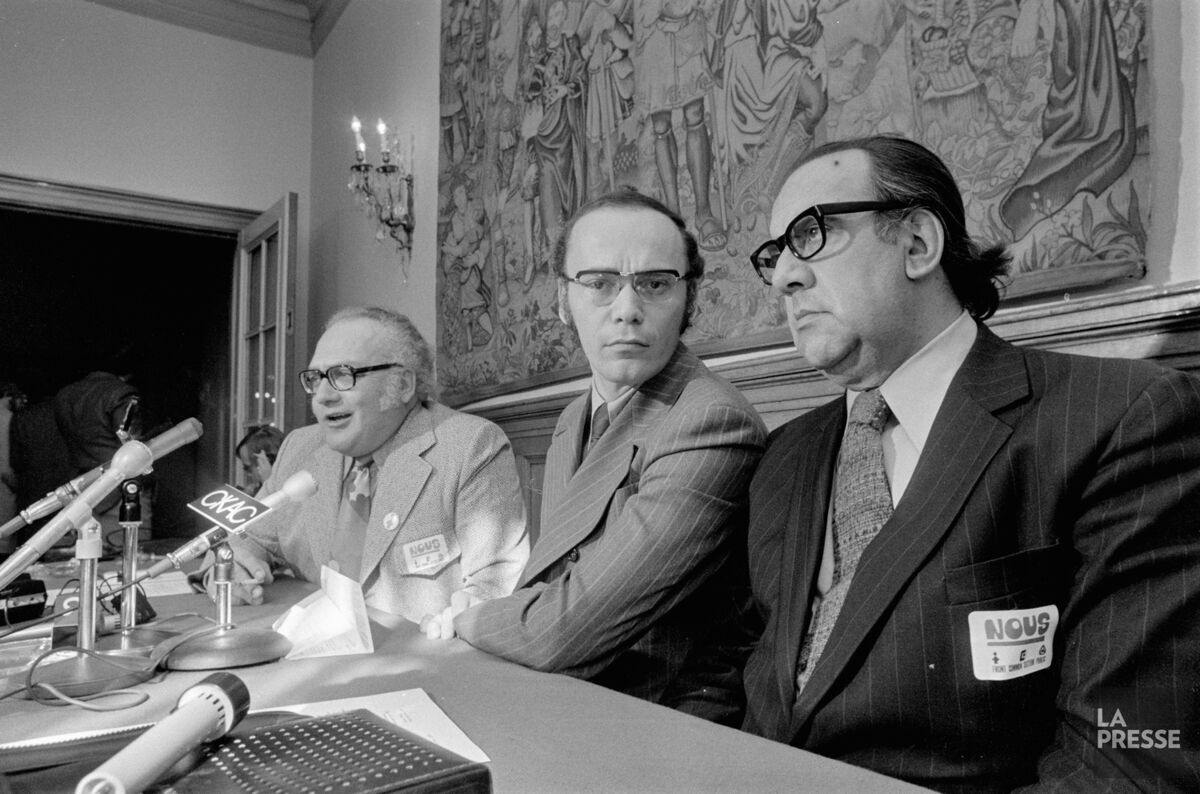
Louis Laberge, Yvon Charbonneau, and Marcel Pepin were the presidents of the 3 main labour confederations during the 1972 Front commun.
In late May, negotiations between the unions and the government resumed.
| Outcome of the Negotiations Between the Unions and the Government | |
| The unions’ achievements |
|
| Government measures |
|
Social and Political Action by the Unions
In the 1970s, several groups in Quebec, including unions, were calling for greater social justice. Three main labour confederations represented the majority of the province’s unionized employees:
The unions became increasingly involved in social and political activism, calling for greater equality among people and a fairer distribution of wealth. To make their demands heard, the unions joined forces with certain social justice groups, such as feminist groups. On the political front, unions supported parties such as the Parti Québécois that promoted social democratic policies.
Unions also stepped up their pressure tactics, including organizing strikes and protests. They succeeded in securing significant benefits for their members, such as the following: