Subjects
Grades
The Patriote rebellions of 1837 and 1838 were part of a broader historical context. In Europe, political liberalism and republicanism were widespread ideologies that gained traction in many nations. These new perspectives would push some countries to revolt, most notably the United States, France as well as Latin American nations. The newspapers of Lower Canada published news about these revolutions and the ideologies that drove them, arousing the interest of Canadien elected members and the public.
Liberal ideas emerged in the 17th and 18th centuries in Europe. At that time, Enlightenment philosophers were questioning the way societies were governed. They promoted values such as equality, freedom, the right of people to govern themselves, freedom of expression and the separation of church and state.

Network of Concepts of Liberal Ideology
Political liberalism challenged the concept of a monarchy, in which a monarch (king or queen) held all the power. It also promoted the separation of powers (legislative, executive and judicial) and the idea that all citizens should have a say in politics.
Since the Constitutional Act was adopted, the people elected representatives. However, these representatives still had very limited power. Under the established structure, the real decision-making power was held by the governor and the members he appointed to the Executive and Legislative councils. This meant that the political system of both Canadas was not democratic nor consistent with the ideals of liberalism.
Republicanism is a more radical form of political liberalism. This ideology opposes the monarchy and the sovereignty of the people. This means that citizens would have the power to make their own decisions, without having the will of another person or nation imposed on them. According to this doctrine, the people should elect representatives to power. For this reason, republicanism is opposed to any monarchical or colonial governance.
In the 1830s, the Parti patriote, with Louis-Joseph Papineau at the helm, became more radical under the influence of republican ideals. The party called for more active participation of citizens in politics and more representation of the population in government. Establishing a responsible government to create ministerial responsibility and electing the Legislative Council became major talking points for Canadien members of the Legislative Assembly.
Ministerial responsibility or responsible government means the members of the Executive Council are chosen from the members of the Legislative Assembly, who have all been elected already. The members of the Executive Council are then accountable to the Legislative Assembly for their decisions.
Between 1815 and 1830, Europe was shaken by popular uprisings. The people demanded that liberal and republican ideas be adopted. Despite attempts by the monarchs to suppress the uprisings, these transformed into revolutions in the 1830s.
Popular uprisings occur when the people engage in revolts that lead to sudden and significant changes in the structure of a government.
These revolutions gained attention in Lower Canada through print media as Canadien elected members and the Canadien population took a keen interest in them.
The creation of newspapers in the colony helped spread liberal and republican ideas. The British Party and the Parti canadien, which later became the Parti patriote, used these newspapers to spread their ideas and criticize their respective opponents, fueling tensions between the two parties.
For example, as early as 1805, the Quebec Mercury and Montreal Herald spoke against the demands of elected members who were promoting liberal ideas, especially if they were Francophones. By opposing their demands, they showed their support for the governor and for French Canadian assimilation.
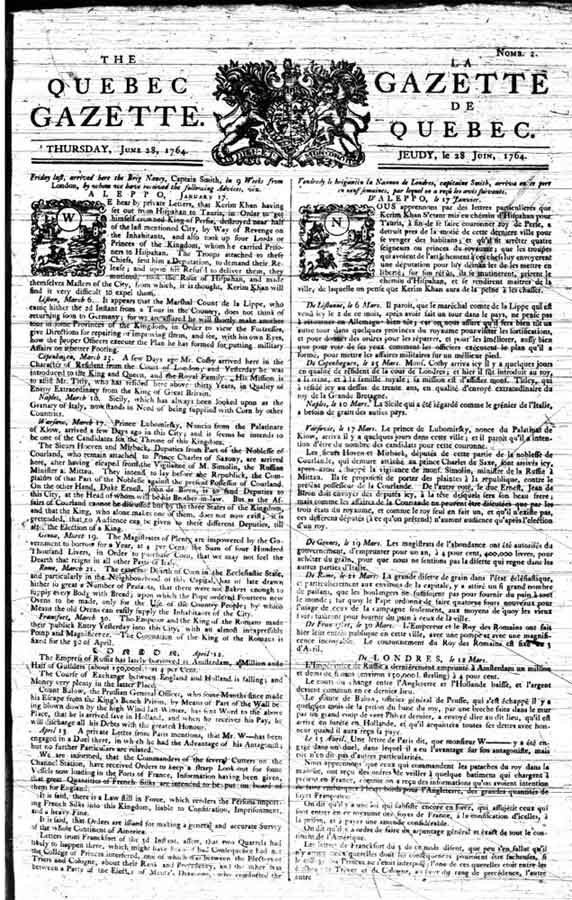
The Gazette de Québec, Lower Canada’s first newspaper (1764 edition)
In response, the Parti canadien founded Le Canadien in 1806. This newspaper helped spread liberal ideas and supported the demands of Canadien elected members by advocating for equality between Canadiens and the British, and criticizing the current governor. The governor reacted by cracking down on the editors and employees of this newspaper.