Subjects
Grades
 100%
100%
Approximation means finding a value that is as close as possible to a given number.
There are many ways to approximate a number or quantity.
Estimating consists of determining an approximate value for an unknown quantity.
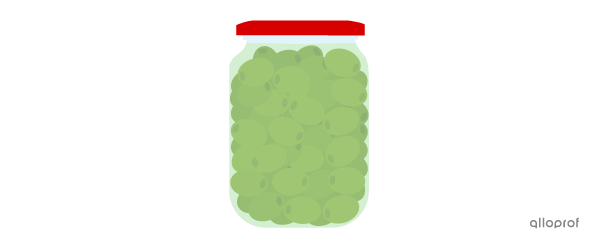
If we count the number of visible olives in this jar, we count around |35.| We can then estimate that there are twice as many in the whole jar, so around |70| olives.

Estimation is also a way of approximating the answer of an operation before even calculating it.
Rounding means giving a value that is close to a certain number.
A rounded number is less precise than the actual number, but easier to reuse later. It is rounded to a certain place value (units of thousands, tens, hundredths, etc.). To do this, first locate the digit at the place value being rounded. Then, analyze the digit directly to its right.
If it's a 0, 1, 2, 3 or 4, the number at the place value to be rounded does not change.
If it's a 5, 6, 7, 8 or 9, add 1 to the number in the position being rounded.
All digits to the right of the selected place value are replaced by |0.|
Round |27\ 841| to the nearest hundred.
Locate the number in the hundreds position.||27\ \boldsymbol{\color{#3b87cd}8}41||
The digit directly to its right is a |4.| Since this digit is less than |5,| we don't add a hundred. We now change all the digits to the right of the hundreds to |\boldsymbol{\color{#3a9a38}{0}}.|||\begin{align}27\ &\boldsymbol{\color{#3b87cd}{8}}\underline{4}1\\ &\:\!\Big\downarrow \\27\ &\boldsymbol{\color{#3b87cd}{8}} \boldsymbol{\color{#3a9a38}{00}}\end{align}||
Answer: The number |27\ 841| rounded to the nearest hundred is |27\ 800.|
Round |299| to the nearest ten.
Locate the digit in the tens position.||2\boldsymbol{\color{#3b87cd}9}9||
The digit directly to its right is a |9.| Since this digit is greater than or equal to |5,| we add a ten. Since we end up with |10| tens, we carry over to the hundreds position. Then we change the digit to the right of the tens with a |\boldsymbol{\color{#3a9a38}{0}}.|||\begin{align}\overset{\boldsymbol{\color{#fa7921}{\large1}}}{2}&\boldsymbol{\color{#3b87cd}{9}}\underline{\boldsymbol9}\\&\Big\downarrow\small{+1}\\3&\boldsymbol{\color{#3b87cd}{0}}\boldsymbol{\color{#3a9a38}{0}}\end{align}||
Answer: The number |299| rounded to the nearest ten is |300.|
Note: The number |299| rounded to the nearest hundred is also |300.|
When we round a number, we need to determine if it is closer to a lower limit or an upper limit.
We find the lower limit by truncating the number at the desired place value.
We then get the upper limit by adding |1| to the desired place value.
We then decide whether to round up or down, depending on the value of the number.
If it is closer to the lower limit, we round down.
If it is closer to the upper limit, we round up.
Round |17\ 683| to the nearest thousand.
Locate the number in the thousand units position.||1\boldsymbol{\color{#3b87cd}7}\ 683||
Next, we determine the 2 possible limits for rounding. For the 1st, we truncate |17\ 683| to the thousand unit. For the 2nd, we add one thousand to the lower limit.||1\boldsymbol{\color{#3b87cd}{7}}\ 683\begin{cases}\begin{gather}1\boldsymbol{\color{#3b87cd}{8}}\ 000\\\text{or}\\1\boldsymbol{\color{#3b87cd}{7}}\ 000\end{gather}\end{cases}||
The number directly to the right of the thousand unit is a |6.| Since this number is greater than or equal to |5,| we round up.||1\boldsymbol{\color{#3b87cd}{7}}\ \underline{\boldsymbol6}83\begin{cases}\begin{gather}1\boldsymbol{\color{#3b87cd}{8}}\ 000 \\[3pt]\color{#ec0000}{\cancel{\color{black}{17\ 000}}}\end{gather}\end{cases}||
Answer: The number |17\ 683| rounded to the nearest thousand is |18\ 000.|
To round decimal numbers, follow the same steps. However, it is not necessary to add |0|s to the right of the digits after the decimal point.
Round |34.876| to the nearest tenth.
Locate the number at the tenths position.||34.\boldsymbol{\color{#3b87cd}8}76||
The digit directly to its right is a |7.| Since this digit is greater than or equal to |5,| we add one tenth. Because the digits to the right of the tenths are after the decimal point, we can simply remove them instead of replacing them with |0.|||\begin{align}34.&\boldsymbol{\color{#3b87cd}{8}}\underline{7}6\\ &\:\!\Big\downarrow \small{+1}\\34.&\boldsymbol{\color{#3b87cd}{9}} \end{align}||
Answer: The number |34.876| rounded to the nearest tenth is |34.9.|
To round a negative number, follow exactly the same steps as for a positive number. In short, we act as if the "−" sign in front of the number wasn't there.
Round |-457.9| to the nearest hundred.
Locate the number in the hundreds position.||-\boldsymbol{\color{#3b87cd}4}57.9||
The number directly to its right is a |5.| Since this number is greater than or equal to |5,| we add one hundred. Be careful! The "−" is ignored when adding the hundred. There are |4| hundreds, not |-4| hundreds. So, when we add one, there are |5.| We then replace the digit in the tens position and the digit in the units position with |0|s and remove the digit after the decimal point.||\begin{align}-&\boldsymbol{\color{#3b87cd}{4}}\underline{5}7.9\\ &\:\!\Big\downarrow\small{+1} \\-&\boldsymbol{\color{#3b87cd}{5}}\boldsymbol{\color{#3a9a38}{\,0\,0}} \end{align}||
Answer: The number |-457.9| rounded to the nearest hundred is |-500.|
As in earlier examples, sometimes the rounding unit is clearly indicated. However, this is not always the case. Sometimes you have to rely on the context of the problem.
Some contexts almost always call for the same rounding unit. Therefore, it is not specified.
For example, money is often rounded to the nearest cent (¢), or hundredth of a dollar |($).| Therefore, |\$58.988| would be rounded to |\$58.99.|
Also, a number of objects, animals or people must be rounded off to a whole number, since we can't have, for example, |26.8| chairs in a room. Instead, there would be |26| or |27| chairs.
Some contexts always require rounding up.
For example, if we calculate that, for an event, we need |52.4| volunteers, we'd have to find |53| volunteers even if |52.4| is closer to |52| because otherwise, the work won't be completed on time.
Some contexts always require rounding down.
For example, this is what we do when we use the concept of the greatest integer.
Depending on the context, the rounding expected may change.
For example, to find the population of Canada, we round up to the nearest million, or about |40| million. However, the population of a small municipality like Senneterre, with around |2200| inhabitants, is more appropriately rounded to the nearest hundred.
Truncating (cutting) means giving a value close to a number by simply eliminating the digits after a given position, without changing the digit at the chosen position.
If we truncate the number |3.456723134| to |3| decimal places, we get the number |3.456.|
If we had chosen to round this same number to the nearest thousandth, we would instead get |3.457.|
If we truncate the number |765| at the hundreds position, we get |700.|
If we had instead decided to round it to the nearest hundred, we would get |800.|
If we truncate the number |183.1| at the ones position, we get |183.|
If we had instead decided to round it to the nearest unit, we would also get |183.|