Equivalent Fractions | Elementary

3rd and 4th Grade

What is an equivalent fraction?

Definition

A fraction is equivalent to another fraction when it represents the same part of a whole or set.

Be careful!

To fully understand what an equivalent fraction is, first you need to understand the role of the numerator and the denominator. To learn what a numerator and a denominator are, see The Representation of a Fraction.

To be equivalent, fractions must meet two criteria:

  1. The whole, or set of objects, must be equal.

  2. The amounts used, or shaded, should represent the same portion of the whole or set of objects.

Example

It is important for the wholes to be identical - that is to say, they are the same size, as in the following image.
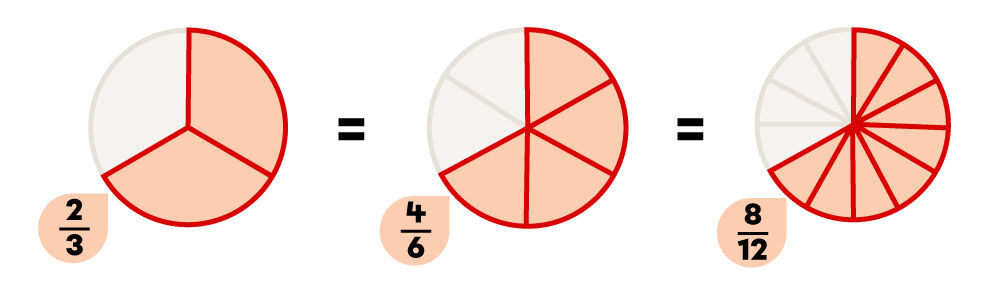
Example of equivalent fractions

In this picture you can see that |2| parts out of |3| is equivalent to |4| parts out of |6| or |8| parts out of |12.| Thus, the amount shaded or used represents the same portion of the whole in each example.

How to verify that fractions are equivalent

Rule

To verify that fractions are equivalent, I need to complete the following steps:

  1. I represent the fraction of my choice.

  2. I represent the second fraction using the same whole or set.

  3. I compare the two fractions by observing the amounts used or shaded.

Example

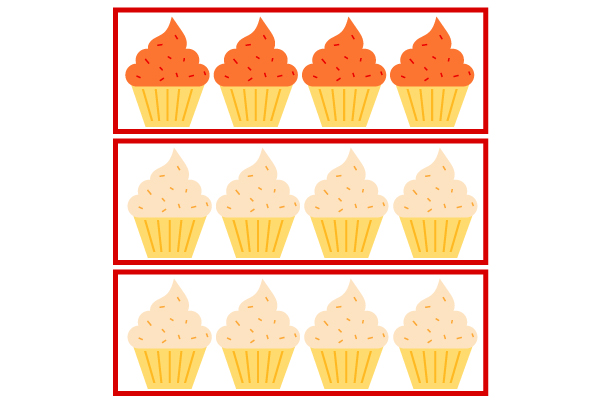
Alicia baked |12| cupcakes. |\dfrac{1}{3}| of her cupcakes have red frosting and  |\dfrac{3}{12}| have blue frosting. All of the remaining cupcakes are white.

Did Alicia bake the same number of red cupcakes as blue cupcakes?

  1. I represent the fraction of my choice.

First, I choose to represent the fraction |\dfrac{3}{12}.| I know the total amount of cupcakes is |12| and the number of blue cupcakes is |\dfrac{3}{12}.|

Exemple de vérification de fractions équivalentes - 1
  1. I represent the second fraction using the same total.

I know the total amount of cupcakes is |12| and that the quantity of red cupcakes is |\dfrac{1}{3}| of the total.

Therefore, I need to divide the total amount of cupcakes into three equal groups and then pick one of the |3| groups.

Exemple de vérification de fractions équivalentes - 2
  1. I compare the two fractions by checking the quantities used or shaded.

The first fraction indicates that Alicia made |3| blue cupcakes and the second fraction indicates she made |4| red cupcakes.

Exemple de vérification de fractions équivalentes - 3

The amount of red cupcakes is not equivalent to the amount of blue cupcakes, because Alicia frosted |4| cupcakes red and only |3| cupcakes blue.

Therefore, |\dfrac{3}{12}| is not equivalent to |\dfrac{1}{3}.|

Exercise - Equivalent Fractions (3rd and 4th grade)

'

5th and 6th Grade

Equivalent Fractions (Grade 5-6)

Equivalent Fractions (Grade 5-6)

Moments in the video:

  • 00:00-Presentation of the situational problem
  • 01:14-Method to find equivalent fractions
  • 02:10-Conclusion

What is an equivalent fraction?

Definition

A fraction is equivalent to another fraction when it represents the same part of a whole or set.

Be careful!

To fully understand what an equivalent fraction is, first you need to understand the role of the numerator and the denominator. To learn what a numerator and a denominator are, see The Representation of a Fraction.

To be equivalent, fractions must meet two criteria:

  1. The whole, or set of objects, must be equal.

  2. The amounts used, or shaded, should represent the same portion of the whole or set of objects.

Example

It is important for the wholes to be identical - that is to say, they are the same size, as in the following image.

Example of equivalent fractions

In this picture you can see that |2| parts out of |3| is equivalent to |4| parts out of |6| or |8| parts out of |12|. Thus, the amount shaded represents the same portion of the whole in each example.

How to find an equivalent fraction using multiplication

Rule

To find an equivalent fraction using multiplication, I need to complete the following steps:

  1. I determine by what number to multiply the fraction.

  2. I multiply the numerator by that number.

  3. I multiply the denominator by the same number.

Example

Find a fraction equivalent to |\dfrac{4}{6}| using multiplication.

  1. I determine by what number I want to multiply the fraction.

Here, I choose to multiply the fraction by |3.|

Exemple de multiplication pour trouver une fraction équivalente-1
  1. I multiply the numerator by that number.

Exemple de multiplication pour trouver une fraction équivalente-2
  1. I multiply the denominator by the same number.

Exemple de multiplication pour trouver une fraction équivalente-3

|\dfrac{12}{18}| is an equivalent fraction to |\dfrac{4}{6}.|

Example of using multiplication to find an equivalent fraction-4

How to find an equivalent fraction using division

Rule

To find an equivalent fraction using division, I need to complete the following steps:

  1. I determine the number I want to divide the fraction by.

  2. I divide the numerator by that number.

  3. I divide the denominator by the same number.

Example

Find a fraction equivalent to |\dfrac{4}{6}| by using division.

  1. I determine the number I want to divide the fraction by.

I need to make sure that the numerator and the denominator are both divisible by the number I choose. I know that both |4| and |6| are divisible by |2.|

Exemple de division pour trouver une fraction équivalente-1
  1. I divide the numerator by that number.

Exemple de division pour trouver une fraction équivalente-2
  1. I divide the denominator by the same number.

Exemple de division pour trouver une fraction équivalente-3

|\dfrac{2}{3}| is an equivalent fraction to |\dfrac{4}{6}.|

Example of using division to find an equivalent fraction-4

Exercise - Equivalent Fractions (5th and 6th grade)

'