Subjects
Grades
In some situations, it may be useful to convert a fraction to a mixed number or vice versa. The following concept sheet suggests methods for performing these conversions successfully.
 100%
100%
 100%
100%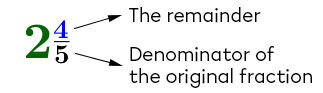 100%
100%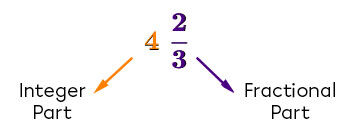 100%
100%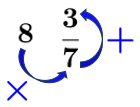
A fraction can be expressed as a mixed number when the numerator is greater than the denominator.
Divide the numerator by the denominator. The result will consist of an integer and a remainder.
Write the integer followed by a fraction whose numerator is the remainder and whose denominator is the same as that of the original fraction.
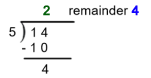
Express |\displaystyle \frac{14}{5}| as a mixed number.
Divide the numerator by the denominator.

The result consists of an integer (|\color{green}{2}|) and a remainder (|\color{blue}{4}|).
Write the integer followed by a fraction whose numerator is the remainder and whose denominator is the same as the original fraction.
Therefore, the fraction |\displaystyle \frac{14}{5}| can be expressed as the mixed number |\displaystyle 2\frac{4}{5}|.
A mixed number can always be expressed as a fraction. Here are two methods.
The first method is based on the fact that an integer can be expressed in the form of a fraction with a denominator of |1|.
Express the integer of the mixed number as a fraction with a denominator of |1|.
Add this fraction and the fractional part of the mixed number.
Express |\displaystyle 4\frac{2}{3}| as a fraction.
Express the integer of the mixed number as a fraction with a denominator of |1|.
Expressing the integer as a fraction results in the following: |\displaystyle4\Rightarrow \frac{4}{1}|
Add this fraction and the fractional part of the mixed number.
||\begin{align}\frac{4}{1}+\frac{2}{3}&=\frac{4\color{red}{\times 3}}{1\color{red}{\times 3}}+\frac{2}{3}& &(\text{Put on the same denominator})\\
&=\frac{12}{3}+\frac{2}{3}\\
&=\frac{14}{3}\end{align}||
Therefore, |\displaystyle 4\frac{2}{3}| is equivalent to the fraction |\displaystyle \frac{14}{3}|
Method 2 consists of the same operations as in method 1, but in a more colourful way.
Multiply the integer of the mixed number by the denominator of its fractional part and then add this result to the numerator.
Write the final result of step 1 as the numerator of a fraction whose denominator is the same as the fractional part.
Express |8\;\displaystyle \frac{3}{7}| as a fraction.
Multiply the integer of the mixed number by the denominator of its fractional part and then add this result to the numerator.
In this example, the integer is |8|, the denominator is |7|, and the numerator is |3|. Thus, the following result is obtained: ||8\times 7+3=59||
Write the final result of step 1 as the numerator of a fraction whose denominator is the same as the fractional part of the mixed number.
The result is |59| and the denominator is |7|. Thus, the final result is: ||\displaystyle 8\;\displaystyle \frac{3}{7}=\frac{59}{7}||
Think of this procedure as resembling a wheel because the order of operations is performed in a circular movement.
Let's take the example above and analyze the operations.
The circular movement enables the mixed number to be expressed as a fraction.
||\displaystyle \frac{8\color{blue}{\times}7\color{blue}{+}3}{7}=\frac{59}{7}||
This is a great way to remember this method!