Subjects
Grades
 100%
100%
To find the rule of a rational function, the simplified standard form should be used, i.e., |f(x)=\dfrac{a}{x-h}+k.|
Find the rule of a rational function with the following 4 steps.
Determine the value of |h| using the vertical asymptote.
Determine the value of |k| using the horizontal asymptote.
Apply the values |h| and |k| and the coordinates of a point |(x,y)| to the rule.
Isolate |a.|
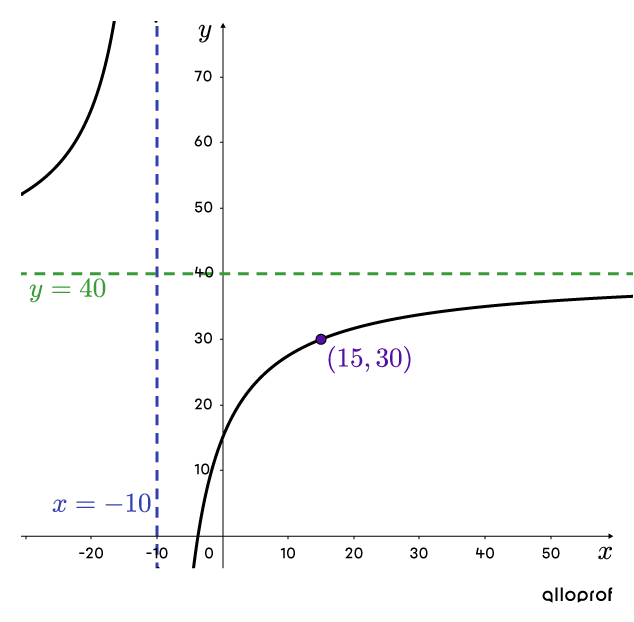
Determine the rule of the following rational function.

Determine the value of |h| using the vertical asymptote
The vertical asymptote’s rule is |\color{#333fb1}{x=-10},| so |\color{#333fb1}{h=-10}.|
Determine the value of |k| using the horizontal asymptote
The horizontal asymptote’s rule is |\color{#3a9a38}{y=40},| so |\color{#3a9a38}{k=40}.|
Apply the values |h| and |k| and the coordinates of a point |(x,y)| to the rule
||\begin{align} f(x) &= \dfrac{a}{x - \color{#333fb1}h} + \color{#3a9a38}k \\ \color{#560fa5}{f(x)} &= \dfrac{a}{\color{#560fa5}x - \color{#333fb1}{-10}} + \color{#3a9a38}{40} \\ \color{#560fa5}{30} &= \dfrac{a}{\color{#560fa5}{15}+10} + 40 \end{align}||
Isolate |a|
||\begin{align} 30 &= \dfrac{a}{25}+40 \\ 30 \color{#ec0000}{-40} &= \dfrac{a}{25}+40 \color{#ec0000}{-40} \\ -10 &=\dfrac{a}{25} \\ -10 \color{#ec0000}{\times 25} &=\dfrac{a}{25} \color{#ec0000}{\times 25} \\ -250 &= a \end{align}||
Answer: The rule of the rational function represented in the graph is |f(x)=\dfrac{-250}{x+10}+40.|
When the equations of the asymptotes are unknown, but the point of intersection of the 2 asymptotes is given, the first 2 steps can be done at the same time. In fact, the coordinates of the intersection point of the asymptotes are |(h,k).|
Find the rule of the rational function with the following characteristics:
the intersection point of the asymptotes is |(5,-3);|
the curve passes through the point |(7,-2).|
Since the intersection point of the asymptotes is given, steps 1 and 2 can be done at the same time.
Determine the value of |h| using the vertical asymptote
Determine the value of |k| using the horizontal asymptote
The intersection point of the asymptotes gives the rule for each asymptote.
||(\color{#333fb1}5,\color{#3a9a38}{-3})\ \Leftrightarrow\ \begin{cases} \color{#333fb1}{x = 5} \\ \color{#3a9a38}{y = -3} \end{cases}||
The equations of the asymptotes correspond to the equation’s parameter values |h| and |k|, so |\color{#333fb1}{h=5}| and |\color{#3a9a38}{k=-3}.|
Apply the values |h| and |k| and the coordinates of a point |(x,y)| to the rule
||\begin{align} f(x) &= \dfrac{a}{x - \color{#333fb1}h} + \color{#3a9a38}k \\ \color{#560fa5}{f(x)} &= \dfrac{a}{\color{#560fa5}x - \color{#333fb1}5} + \color{#3a9a38}{-3} \\ \color{#560fa5}{-2} &= \dfrac{a}{\color{#560fa5}{7}-5}-3\end{align}||
Isolate |a|
||\begin{align} -2 &= \dfrac{a}{2}-3 \\ 1 &=\dfrac{a}{2} \\ 2 &= a \end{align}||
Answer: The rule for the function is |f(x)=\dfrac{2}{x-5}-3.|
You may be asked to find the rule of a rational function in the general form instead of the standard form. To do so, start by finding the rule in the standard form. After it is done, make the transition from the standard form to the general form.

Moments in the video :