Subjects
Grades
 100%
100%
| Number set | Description | Examples |
|---|---|---|
Natural numbers | Numbers used for counting |\mathbb{N} = \{0,1,2,3,4,5,\ldots\}| | |3,\ ||5,\ ||134,\ ||2099| |
Integers | Natural numbers and their opposites |\mathbb{Z} = \{\ldots,-3,-2,-1,0,1,2,3,\ldots\}| | |-133,\ ||-9,\ ||0,\ ||9,\ ||915| |
Rational numbers | Numbers that can be expressed as the ratio of 2 integers | |-5.\overline{3},\ ||-\dfrac{1}{3},\ ||\dfrac{3}{4},\ ||3,\ ||6.4| |
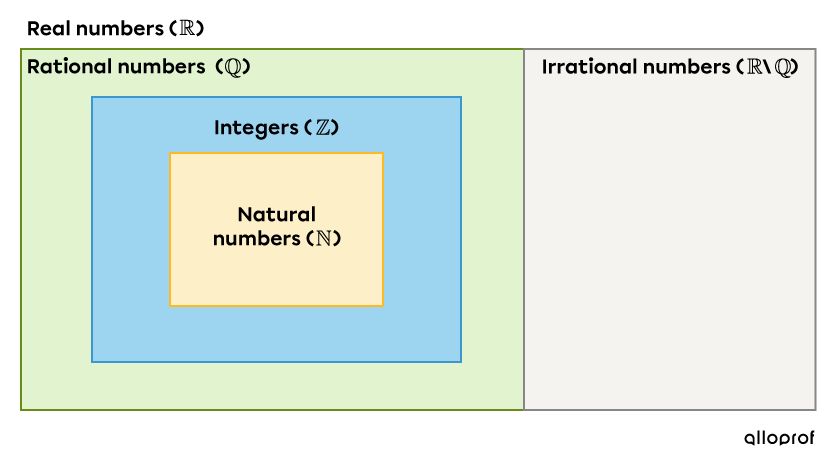
Numbers are classified into different sets according to their characteristics. The diagram below illustrates the relationships between them.

As illustrated in this diagram, the set of natural numbers is included in the set of integers. The set of integers is in turn included in the set of rational numbers. The set of real numbers is composed of the union of the sets of rational numbers and irrational numbers. The following table gives an overview of the different sets.
| Number set | Description | Examples |
|---|---|---|
Natural numbers | Numbers used for counting |\mathbb{N} = \{0,1,2,3,4,5,\ldots\}| | |3,\ ||5,\ ||134,\ ||2099| |
Integers | Natural numbers and their opposites |\mathbb{Z} = \{\ldots,-3,-2,-1,0,1,2,3,\ldots\}| | |-133,\ ||-9,\ ||0,\ ||9,\ ||915| |
Rational numbers | Numbers that can be expressed as the ratio of 2 integers | |-5.\overline{3},\ ||-\dfrac{1}{3},\ ||\dfrac{3}{4},\ ||3,\ ||6.4| |
We sometimes also consider the set of decimal numbers |(\mathbb{D}).| This consists of all the rational numbers whose decimal expansion is finite, rather than periodic. This set forms a subset of the rational numbers, which includes the set of integers.