Subjects
Grades
 100%
100%
 100%
100%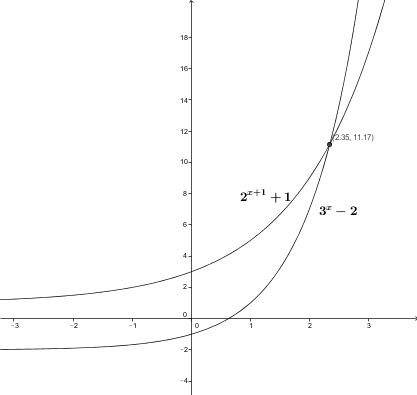
An equation in which the independent variable appears as an exponent of a real number is called an exponential equation.
To solve an exponential equation, you should be familiar with logarithms.
It is important to remember that |a^v=a^w| if and only if |v=w.| Thus, when there are two expressions which are equal and have the same base, the exponents are necessarily equal.
Expressions of the form |a^u=b^v| can be solved. For other expressions, solving will usually be more difficult.
Here are some examples.
We want to find the value of |x| for |f(x)=28| with the function |f(x)=5(2)^x-12.|
Replace |f(x)=28|
||28=5(2)^x-12||
Isolate the base of the exponent
||\begin{align}40&=5(2)^x\\8&=2^x\end{align}||
Switch to the logarithmic form
||\log_2(8)=x||
In other words, we want to know: |2| to the power of what exponent gives a value of |8?|
The answer is |x=3.|
We want to solve the equation |2^{x+1}=3^{x-1}.|
Put a base 10 logarithm on both sides of the equality
||\log(2^{x+1})=\log(3^{x-1})|| Note that |a=b| if and only if |\log_c(a)=\log_c(b).|
Use the appropriate law of logarithms
In this case, use |\log_c(a^n)=n\log_c(a).| Therefore, we obtain |(x+1)\log(2)=(x-1)\log(3).|
Perform the distributive property
||x\log(2)+\log(2)=x\log(3)-\log(3)||
Send the terms containing the variable |x| to one side and the other terms to the other
||\log(2)+\log(3)=x\log(3)-x\log(2)||
All that remains are some calculations
Apply the following two laws of logarithms.
||\begin{align}\log_c(a)+\log_c(b)&=\log_c(ab)\\ \log_c(a)-\log_c(b)&=\log_c\left(\dfrac{a}{b}\right)\end{align}||
Thus, we have:
||\begin{align}\log(2)+\log(3)&=x\log(3)-x\log(2)\\ \log(2)+\log(3)&=x(\log(3)-\log(2))\\ \log(2\times3)&=x\log\left(\dfrac{3}{2}\right)\\ \log(6)&=x\log\left(\dfrac{3}{2}\right)\\ \dfrac{\log(6)}{\log\left(\dfrac{3}{2}\right)}&=x\end{align}||
At this point, the change of base law can be used.
||\begin{align}\log_{3/2}(6)&=x\\4.419&\approx x\end{align}||
We want to find the solution of the equation |3(5^{2x})-4(5^{2x})+1=0.|
Factor out the greatest common factor of |5^{2x}|
||\begin{align}5^{2x}(3-4)+1&=0\\5^{2x}(-1)+1&=0\end{align}||
Isolate the part containing the exponent
||\begin{align}-5^{2x}&=-1\\5^{2x}&=1\end{align}||
Switch to logarithmic form
||\log_5(1)=2x||
Isolate |x|
||\dfrac{\log_5(1)}{2}=x||
It is important to note that |\log_5(1)=0.| Thus, |x=0.|
Consider the following equation.
||27=4\left(\dfrac{1}{3}\right)^{-x+2}+15||
Isolate the base and its exponent
||\begin{align}27-15 &=4\left(\dfrac{1}{3}\right)^{-x+2}\\ \dfrac{12}{4} &= \left(\dfrac{1}{3}\right)^{-x+2}\\ 3 &=\left(\dfrac{1}{3}\right)^{-x+2}\end{align}||
Use the laws of exponents
||\begin{align}3&=(3^{-1})^{-x+2}\\3&=3^{x-2}\end{align}||
Compare the exponents
The bases are identical, therefore:
||\begin{align}1&=x-2\\1+2&=x\\3&=x\end{align}|| Thus, the solution is |x=3.|
Consider the following equation |2=3(8)^{2x+10}-7.|
Isolate the base and its exponent
||\begin{align}2+7&=3(8)^{2x+10}\\\dfrac{9}{3}&=(8)^{2x+10}\\3&=8^{2x+10}\end{align}||
Use the logarithms and their properties
||\begin{align}\log(3)&=\log(8)^{2x+10}\\\log(3)&=(2x+10)\log(8)\\\dfrac{\log(3)}{\log(8)}&=2x+10\\0.53&=2x+10\\0.53-10&=2x\\-9.47&=2x\\\dfrac{-9.47}{2}&=x\\-4.74&\approx x\end{align}||
An inequality where the independent variable appears as the exponent of a real number is called an exponential inequality.
Here is an example.
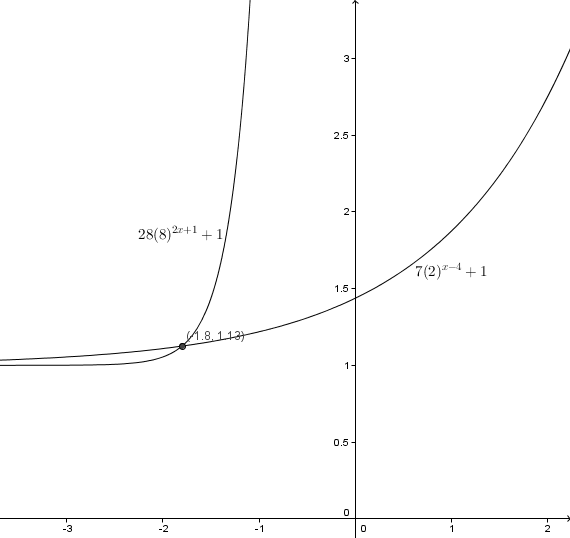
Give the set-solution of the inequality |28(8)^{2x+1}+1\leq7(2)^{x-4}+1.|
Eliminate the 1 on each side
||28(8)^{2x+1}\leq7(2)^{x-4}||
Divide by 7 on each side
||4(8)^{2x+1}\leq2^{x-4}||
Express all bases in base 2 and use the laws of exponents
||\begin{align}2^2(2^3)^{2x+1}&\leq2^{x-4}\\2^2\times2^{3(2x+1)}&\leq2^{x-4}\\2^2\times2^{6x+3}&\leq2^{x-4}\\2^{6x+3+2}&\leq2^{x-4}\\2^{6x+5}&\leq2^{x-4}\end{align}||
Compare the exponents
The bases are identical, therefore |6x+5 \leq x-4.|
Thus, the problem can be solved
||\begin{align}5x+5&\leq-4\\5x&\leq-9\\x&\leq-\dfrac{9}{5}\end{align}||
Therefore, for all |x\leq-\dfrac{9}{5},| the inequality |28(8)^{2x+1}+1\leq7(2)^{x-4}+1| is respected.
The following graph confirms the statement.

Unfortunately, not all inequalities can be expressed as identical bases. When the base is not the same, it is useful to follow this procedure.
The inequality is solved (if possible) by replacing the inequality symbol with an equality symbol. Therefore, the point of intersection can be found.
Plot the graph of the two functions (each member of the equality).
With the graph and the point of intersection, give the solution set.
Note: Sometimes it is not possible to solve an inequality manually. Therefore, use symbolic computing software or graphically find the point.
For example, the equation |2^{x+1}+1<3^{x}-2.|
Solving such an inequality is not simple and requires more advanced methods. In this case, just make a graph and identify the point of intersection between the two curves.
The following graph is obtained.
Therefore, the solution set of the inequality is |]2.35,+\infty[.|