Subjects
Grades
 100%
100%
|
Properties |
Basic logarithmic function ||f(x)=\log_c x|| where |c>0| and |c \neq 1| |
Log function in standard form ||f(x)=a\log_c \big(b(x-h)\big)+k|| where |c>0|, |c \neq 1,| and |a| and |b| are non-zero |
|---|---|---|
|
Domain |
The domain is |(0,\infty).| |
If |b>0|, the domain is |(h,\infty).| |
|
Range |
The range is |\mathbb{R}.| |
The range is |\mathbb{R}.| |
|
|x|-Intercept |
It is |x=1.| |
It is the value of |x| such that |f(x)=0.| |
|
|y|-Intercept of function |
No |y|-intercept |
If it exists, it is the value of |f(0).| |
|
Sign |
If |0<c<1|, the function is positive on |(0,1]| and negative on the rest of its domain. |
According to the equation of the function. |
|
Increasing |
If |c>1.| |
If |c>1| and |a| and |b| have the same sign. |
|
Decreasing |
If |0<c<1.| |
If |c>1| and |a| and |b| have opposite signs. |
|
Asymptote |
|x=0| |
|x=h| |
|
Extrema |
None or depending on the context. |
None or depending on the context. |
In the following animation, experiment with the values of parameters |a,| |b,| |c,| |h,| and |k| in the logarithmic function and observe their effects on the function’s properties. Then, read the concept sheet to learn more about each of the properties of the function.
|
Properties |
Basic logarithmic function ||f(x)=\log_c x|| where |c>0| and |c \neq 1| |
Log function in standard form ||f(x)=a\log_c \big(b(x-h)\big)+k|| where |c>0|, |c \neq 1,| and |a| and |b| are non-zero |
|---|---|---|
|
Domain |
The domain is |(0,\infty).| |
If |b>0|, the domain is |(h,\infty).| |
|
Range |
The range is |\mathbb{R}.| |
The range is |\mathbb{R}.| |
|
|x|-Intercept |
It is |x=1.| |
It is the value of |x| such that |f(x)=0.| |
|
|y|-Intercept of function |
No |y|-intercept |
If it exists, it is the value of |f(0).| |
|
Sign |
If |0<c<1|, the function is positive on |(0,1]| and negative on the rest of its domain. |
According to the equation of the function. |
|
Increasing |
If |c>1.| |
If |c>1| and |a| and |b| have the same sign. |
|
Decreasing |
If |0<c<1.| |
If |c>1| and |a| and |b| have opposite signs. |
|
Asymptote |
|x=0| |
|x=h| |
|
Extrema |
None or depending on the context. |
None or depending on the context. |

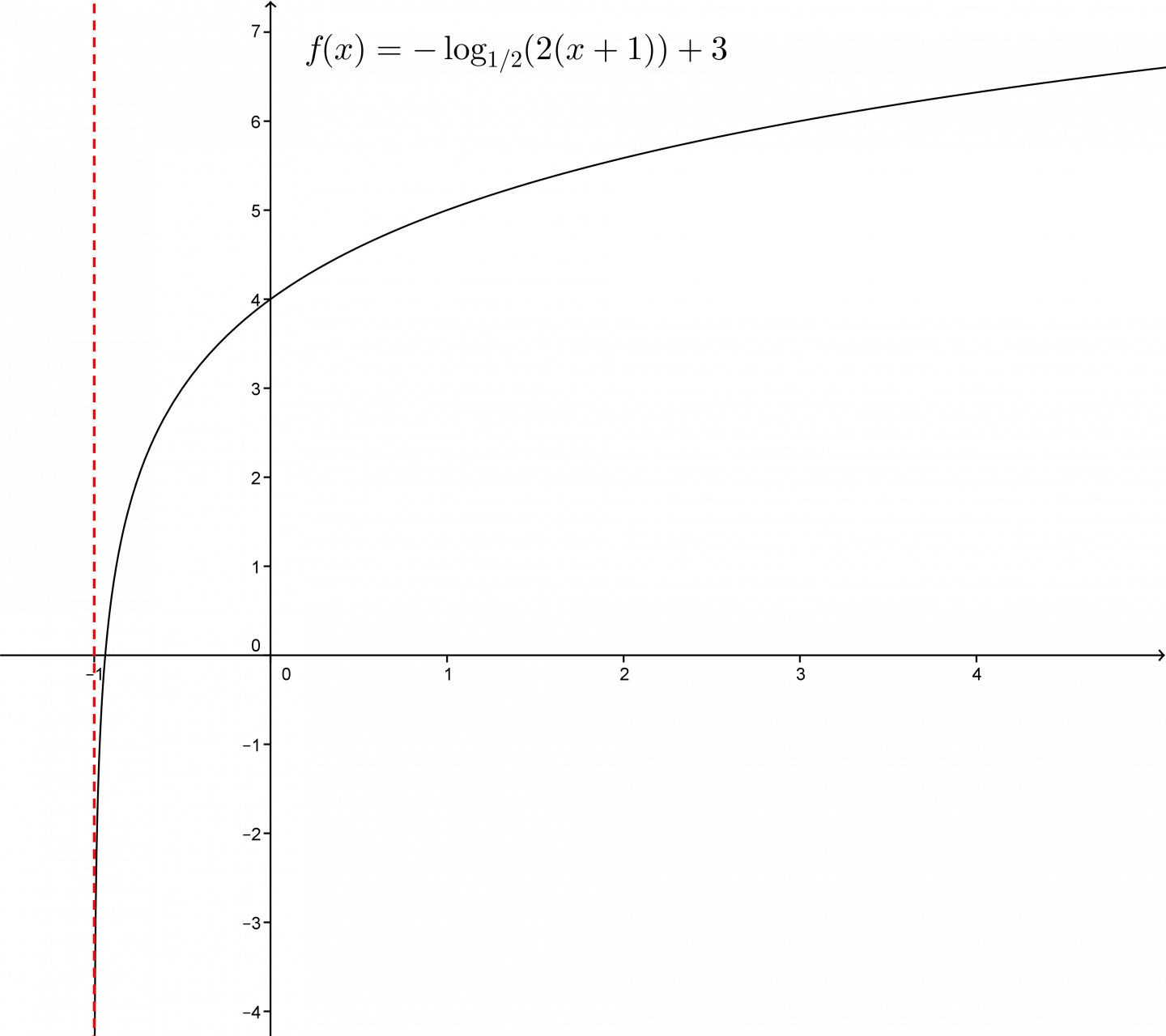
Determine the properties of the logarithmic function. ||f(x)=-\log_{1/2}(2(x+1))+3||
It can be useful to plot a graph.
The equation of the asymptote of the function is |x=-1.|
The domain of the function is |(-1, + \infty).|
The range of the function is |\mathbb{R}.|
To calculate the |x|-intercept of the function, replace |f(x)| with |0| and isolate |x.| ||\begin{align} 0 &= - \log_{1/2} (2(x+1)) +3\\-3 &= - \log_{1/2} (2(x+1))\\3 &= \log_{1/2} (2(x+1))\end{align}|| Next, use exponent laws to rewrite the function. ||\begin{align} \displaystyle \left( \frac{1}{2} \right)^3 &= 2(x+1)\\ \displaystyle \frac{1}{8} &= 2(x+1)\\ \displaystyle \frac{1}{16} &= x+1\\ \displaystyle \frac{1}{16}-1&=x\\ \displaystyle -\frac{15}{16}&=x \end{align}||
To calculate the |y|-intercept, replace |x| with |0.| ||\begin{align}f(0) &= - \log_{1/2} (2(0+1)) +3\\ f(0) &= - \log_{1/2} (2) + 3\\ f(0) &= -1(-1) + 3\\ f(0) &= 4\end{align}||
Sign: the function is negative on |(-1, -\frac{15}{16}]| and positive on |[-\frac{15}{16},+\infty).|
Variation: the function is increasing over its entire domain.
The function has no extrema.